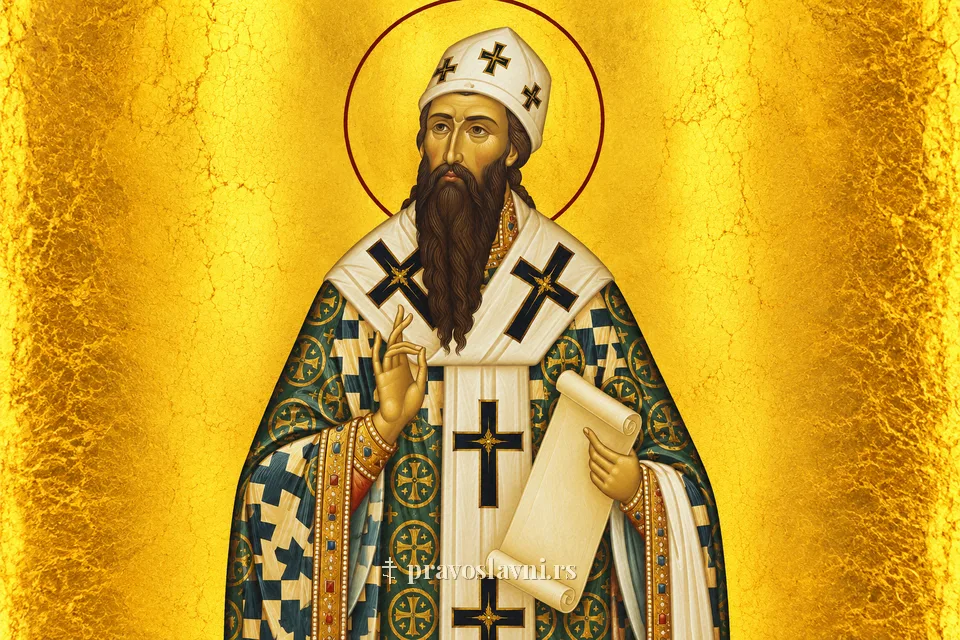
“Great is the Most Pure Virgin Mary, the Theotokos!” — so, according to his Life, the people of Ephesus cried out when the Third Ecumenical Council confirmed that we rightly call the Mother of God the Theotokos. The Council, at which about two hundred bishops gathered, was presided over by St Cyril, Archbishop of Alexandria, who at the same time also represented Pope Celestine of Rome.
Cyril was born into a distinguished family and was a close relative of Patriarch Theophilus, whom he succeeded on the see of Alexandria. His Life says that he was learned both in the secular sciences and in the Scriptures, and that he was a disciple of St Isidore of Pelusium. The Prologue records that he fought three hard battles; one of them was against the Novatians, whom he removed from the city.
The greatest challenge was brought by Nestorius, Patriarch of Constantinople, who called Mary “Christotokos” and not Theotokos. According to the Life, Cyril wrote to him first gently, then sternly, and turned to the imperial court, the pope, the patriarchs and the monks, until Nestorius was removed. In Ephesus in the year 431 Nestorius was condemned, and it was confirmed that Christ is true God. Even after that Cyril had no peace: according to the Life, his opponents accused him falsely and the emperor imprisoned him for a short time, until his innocence was established. The Prologue also ascribes to him the hymn “Rejoice, O Virgin Theotokos”, and the Life says that he wrote many books profitable for the soul.
And yet even this defender of the faith carried an injustice in his heart. From his uncle he had inherited an intolerance towards St John Chrysostom and he could not manage to free himself from it, although Isidore of Pelusium warned him with the words: “Partiality is not far-sighted, and hatred sees nothing at all”. Then the Theotokos appeared to him in a vision together with Chrysostom, who at her request forgave Cyril. Cyril repented, and according to the Life he honoured Chrysostom as a great saint to the end of his life.
He spent his last years in peace, caring for his flock, and reposed in the year 444.
St Cyril teaches that the truth of the faith is precious, but that even the most zealous must not keep hatred in their hearts.
Full Life
A Pupil from Alexandria
St Cyril was born in Alexandria, into a distinguished and Orthodox family, as his Life says. He was the nephew of Theophilus, Patriarch of Alexandria, the son of his sister. According to his Life, he received an excellent upbringing: he thoroughly mastered the secular learning of the Greeks and the Romans, and he was never parted from the Holy Scriptures. His teacher was St Isidore of Pelusium.
Theophilus noticed his gifts and his pure life, and so he received him into the clergy and made him archdeacon. After the death of Theophilus, Cyril became Patriarch of Alexandria, chosen unanimously, according to his Life.
The Prologue says that he waged three hard struggles. The first was against the Novatians, who had arisen in Rome and took their name from the presbyter Novatian: they forbade a second marriage and refused to receive back those who had fallen. Cyril removed them, together with their bishop, from Alexandria. His Life adds that at the place called Canopus and Menouthis, an old sanctuary of idols, he laid the relics of the martyrs Cyrus and John and built a church, following the instruction of an angel in a vision, and the demons were driven out from there. The Prologue also mentions grave conflicts in Alexandria itself.
The Struggle for the Name of the Theotokos
The most important struggle concerned the faith itself. Nestorius, Patriarch of Constantinople, who according to the Life had been brought from Antioch, blasphemed against the Mother of God and called her “Christotokos” (the one who gave birth to Christ), teaching, as the Life says, that Mary gave birth only to a man.
Cyril did not keep silent. According to his Life, he wrote to Nestorius gently at first, and then sternly. He also wrote to the clergy of Constantinople, to the imperial court, to Pope Celestine of Rome, to the other patriarchs, to bishops and to monks, and he did not cease until Nestorius was removed. Nestorius, for his part, slandered him as a heretic.
The Council in Ephesus
The dispute was settled at the Third Ecumenical Council in Ephesus, at which Cyril presided and at the same time represented the aged Pope Celestine. His Life says that the council was summoned by Emperor Theodosius the Younger in the year 431 and that the sessions began on 21 June. About two hundred bishops gathered: Cyril came with fifty Egyptian bishops, and Nestorius with sixteen. Juvenal of Jerusalem and Memnon of Ephesus presided together with Cyril.
Nestorius, according to the Life, did not come even at the third summons. The Fathers condemned his writings and approved the letters of Cyril. The council confirmed that Christ is true God and that Mary is truly the Theotokos, and the people, according to the Life, cried out: “Great is the Most Pure Virgin Mary, the Theotokos!”
Peace did not come at once. According to the Life, John of Antioch arrived late and held an opposing assembly which falsely accused Cyril; the emperor first imprisoned Cyril and Memnon, and then established that they were innocent. John and the Syrian bishops later accepted the council. Nestorius was condemned and anathematised, and the emperor sent him into exile, according to the Prologue to the east of the empire, and there he ended his life by a hard death. The Prologue also ascribes to Cyril the hymn “Rejoice, O Virgin Theotokos”.
Reconciliation with Chrysostom
The Prologue and the Life do not pass over Cyril's weakness in silence either. From his uncle Theophilus he inherited an intolerance towards St John Chrysostom; the Life says that this was out of ignorance and because of slanders, and according to the Life this is why he refused to enter Chrysostom's name in the diptychs. Isidore of Pelusium admonished him to change, and the Life preserves his words: “Partiality is not far-sighted, and hatred sees nothing at all.” Yet Cyril was not able to change.
Then the Mother of God appeared to him in a vision, with angels and with John Chrysostom. At her request Chrysostom forgave Cyril; according to the Life, he said: “For the sake of Your intercession, O Lady, I forgive him.” Cyril repented; according to the Life he arranged a feast in honour of Chrysostom, entered his name among the great hierarchs and venerated him to the end of his life.
He wrote, according to his Life, many books profitable to the soul. After all his struggles he shepherded his flock in peace and reposed in the year 444; the Life says that this was after thirty-two years of service as patriarch and that the Mother of God was present at his death.
Cyril defended the Orthodox faith and the honour of the Theotokos. Yet the Prologue reminds us that even a great hierarch can inherit a wrongful hatred, and that repentance and the intercession of the Theotokos bring reconciliation.