Wednesday31March 202718 March (according to the Julian calendar)
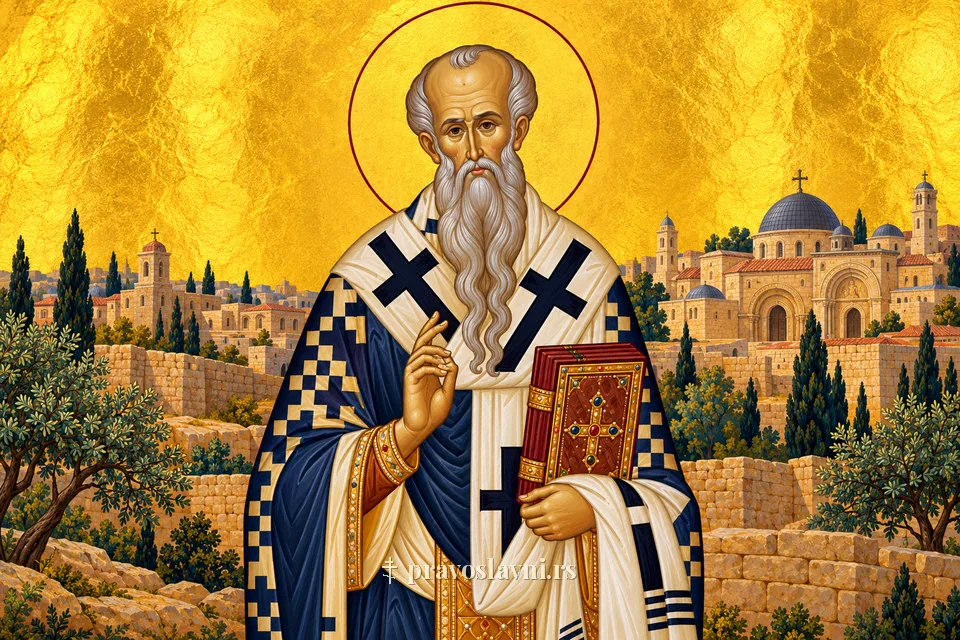
Illustration
Saint of the day
St Cyril, Bishop of Jerusalem
What happenedSt Cyril prayed that the Jews, urged on by Julian the Apostate, would not rebuild Solomon's Temple, and earthquakes threw down the new building and scattered the old stones.
“For the message of the cross is foolishness to those who are perishing, but to us who are being saved it is the power of God.”
— 1 Cor 1:18
Life
St Cyril of Jerusalem left the Church his Catechetical Lectures. According to his Life there are twenty-three of them, and in them the teaching and the holy mysteries of the Church are set out, and the Prologue bears witness that even today they have not lost their importance for the Orthodox faith. Behind those instructions stands a life full of struggle.
Cyril was born in Jerusalem, in the time of Constantine the Great, and according to his Life he became a monk while Constantine was still alive. He received the throne of Jerusalem after Archbishop Maximus — in the year 350 according to the Prologue, and in 348 according to his Life. The Prologue remembers his meekness, humility and asceticism, and the hymn in the Prologue says that he lived just as he taught.
At that time the Arians, under the Emperor Constantius, were powerful, and Cyril fought against them. Acacius, the Arian Archbishop of Caesarea, according to his Life, accused and persecuted him. His Life remembers that in a time of famine he sold the church vessels in order to feed the poor. The Prologue and his Life say that he was deposed and banished three times. According to his Life, Silvanus, the Bishop of Tarsus, refused to drive him out, and under Julian Cyril received his throne again, only to lose it once more under Valens.
God confirmed the truth by signs. The Prologue and his Life remember the Pentecost when all Jerusalem looked for several hours at a shining cross in the sky. When Julian the Apostate supported the Jews in rebuilding the Temple of Solomon, Cyril prayed that this would not come about. Both sources record that an earthquake brought down what had only just been raised; the Prologue adds a second tremor as well, after which not even the foundations remained in place. According to his Life, the builders were then left without their tools, which were destroyed by fire, and crosses appeared on their clothing. In this way, according to the Prologue, the word of the Lord was fulfilled that not one stone would be left upon another.
The Emperor Theodosius the Great restored him to his throne, and Cyril governed the Church in peace for eight more years. According to his Life, in the year 381 he took part in the Second Ecumenical Council. He reposed peacefully — in 386 according to the Prologue, and around the year 387 according to his Life.
His life teaches that neither slanders nor persecutions are able to stifle the truth.
Full Life
Three times deposed
St Cyril of Jerusalem lost his see and regained it again more than once. The Prologue and the Life say that he was deposed and driven out three times. He came to the throne of Jerusalem as the successor of Archbishop Maximus — in 350 according to the Prologue, and in 348 according to the Life — at a time when, under the Emperor Constantius, the Arians had great power. Cyril opposed them, and the Life adds that he also fought against the teachings of Macedonius and of Manes.
His opponent was Acacius, the Arian Archbishop of Caesarea of Palestine and a favourite of the Emperor. The Life says that Acacius hated him because he exposed the heresy and because of a dispute over primacy, for Cyril would not submit to Caesarea; the Council of Sardica in 343, the Life states, deposed Acacius and gave the primacy to Maximus of Jerusalem. When, around the year 357, a famine set in, Cyril sold church vessels and costly curtains and bought bread for the poor. From Acacius there nevertheless came an accusation to the Emperor that Cyril had disposed of the baptismal robe which Constantine the Great had given to Macarius.
Even in exile he had support. According to the Life, Silvanus, Bishop of Tarsus, would not agree to drive him away, and at the Council of Seleucia the majority of the bishops refused to remove him. Under Julian, who at first recalled the exiled Orthodox bishops, he returned to his see, and under Valens, with the renewed rise of the Arians, he went into exile once more. Only Theodosius the Great, after the death of Valens, restored him to his throne, and for eight more years Cyril guided his Church in peace. The Life records that in 381 he was among the fathers of the Second Ecumenical Council in Constantinople.
Signs by which God bears witness
The sources also remember the signs which encouraged the Orthodox in those struggles. All Jerusalem, according to both sources, beheld one Pentecost a cross of light above the city and the Mount of Olives, and the sight remained for several hours. News of it was sent by letter to the Emperor Constantius — according to the Life, Cyril then called on him to return to Orthodoxy — and the Orthodox drew new strength from that event.
The second sign is connected with the Temple of Solomon. Support and money for its rebuilding were given to the Jews by Julian the Apostate. Cyril's prayer was the opposite: that this building should not be raised. The Life says that he declared beforehand that the word of Christ would be fulfilled, that not one stone would be left upon another (Lk 21:6). The earthquakes, according to both sources, spared neither the new building nor the old foundations: the Prologue says that the second tremor, when the building work was resumed, scattered the old stones as well. The Life adds that the builders were also left without their tools, which were destroyed by fire from heaven, and that crosses appeared on their clothing which could not be removed.
Who he was
Jerusalem was both his homeland and his see. He was born there, in the time of Constantine the Great; the Life gives the year 315, devout parents and an upbringing in Orthodoxy. According to the Life, he became a monk while Constantine was still alive, and received the priesthood from Archbishop Maximus.
The Prologue praises his meekness and humility, and says that he was tried in everything, that he was a great ascetic and that he had a pale face. The hymn in the Prologue stresses that he lived just as he taught and that he comforted many who were suffering. His Catechetical Lectures have remained — the Life counts twenty-three of them — as an explanation of the teaching and the holy mysteries of the Church, and according to the Prologue their value has not been diminished even today.
Cyril ended his life in peace, after a life spent in the defence of Orthodoxy — in 386 according to the Prologue, and around 387 according to the Life.
Through slanders and exiles Cyril kept his faith and his humility. God confirms the truth by signs, and no heresy and no power is able to overcome it.