Monday15November 20272 November (according to the Julian calendar)
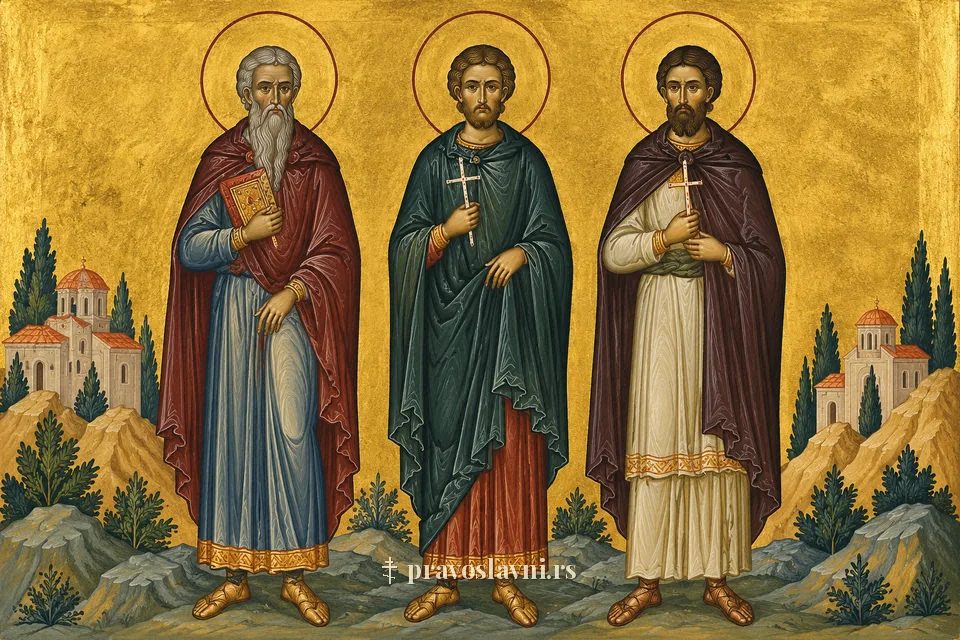
Illustration
Saints of the day
Holy Martyrs Acindynus, Pegasius, Aphthonius, Elpidephorus and Anempodistus
What happenedWhen asked where they were from, the courtiers Acindynus, Pegasius and Anempodistus answered the Persian king Shapur: “our fatherland and our life is the Most Holy Trinity”.
“Yet if anyone suffers as a Christian, let him not be ashamed, but let him glorify God in this matter.”
— 1 Pet 4:16
Life
At the court of the Persian King Sapor there served three men — Acindynus, Pegasius and Anempodistus — whose faith in Christ was hidden, as was their work of converting others. Before the King, when asked about their origin, they said: “Our homeland and our life is the Most Holy Trinity.” The Prologue places their suffering in the year 355, at the time of a great persecution of Christians.
Neither beatings, nor fire, nor cauldrons of molten lead, sulphur and pitch put an end to them. Through all of this they did not stop singing psalms and praying. The Prologue and their Life say that Christ Himself appeared to them in the fire and that angels accompanied them through their torments. Their Life credits them with other miracles too, among them the fall of the temple of Zeus after their prayer to the Trinity. Not even a pit of snakes, their Life writes, did them any harm.
Most striking of all, however, is how many people around them came to believe. The first to be changed was Aphthonius: he had been standing among the torturers, and he became a martyr. When the saints came out of the cauldron unharmed, he confessed, “Great is the God of the Christians!” and was executed at once. Soon afterwards, according to both sources, he himself came to their aid — from the other life, with the angels — when the King tried to drown them in the sea.
Before the King, Christ was confessed as the only true God by the nobleman Elpidephorus as well, who was also held guilty of having called the King a murderer of the innocent; about seven thousand believers fell together with him at that time. Sapor's own mother, who secretly believed in Christ, shared the end of the three saints in the furnace, as did twenty-eight Christian soldiers. Their death, according to both sources, was accompanied by signs from heaven.
These martyrs bear witness that faith in the Trinity is stronger than any violence. The King had power over their bodies, but not over their faith. Their steadfastness brought to Christ an executioner, noblemen, soldiers, the King's mother and thousands of people. Today too, through the faithfulness of His servants, God calls others to Himself.
Full Life
A Homeland in the Trinity
The Persian King Sapor wanted to know where three of his courtiers, accused of being Christians, came from. The answer of Acindynus, Pegasius and Anempodistus spoke of no country at all: “our fatherland and our life is the Most Holy Trinity”. The court knew them as the King's servants; that they worshipped Christ and were bringing others into the faith was meant to stay hidden. Sapor — whom the Prologue also calls Sabores — was at that time persecuting the Church with all his fury; their Life says that the demons of the idols ruled him. According to the Prologue, this was in the year 355.
According to their Life, after they were denounced they were taken by force out of the house, where they had shut themselves in to pray, and were brought bound before the King.
The King Against the Three
The King's threat of pain, according to their Life, did not shake them — they themselves invited him to put them to the test. Their Life records that the torturers grew weary and relieved one another, while the martyrs remained alive, by God's strength, not their own. They sang psalms and prayed, and no torment took that away from them.
Sapor saw sorcery in everything and tried fire. The Prologue and their Life say that here too the victory was Christ's, who appeared to them while they were praying, and that angels visited them later as well.
Miracles That Converted
Their Life sets out miracle after miracle, and almost every one brought someone to the faith: after his blasphemy the King remained mute until Acindynus healed him by the name of Jesus, the fire beneath the martyrs was put out by a storm obtained through their prayer, and the temple of Zeus fell when they prayed in it to the Trinity. Many of those who watched this were baptised, according to their Life, in a heavenly manner, but Sapor remained hard.
Aphthonius came as one of the torturers, and departed as a martyr. The turning point took place beside three cauldrons of lead, sulphur and pitch, from which the saints came out unharmed: he cried out “Great is the God of the Christians!” and for this he at once lost his head. The Prologue records that this miracle brought many others to the faith as well. When Sapor then tried to rid himself of the martyrs in the sea, both sources say that it was Aphthonius himself who came to their aid, now from beyond the grave, accompanied by angels.
Elpidephorus and the Seven Thousand
The people who followed the condemned, weeping, were met, according to their Life, by three hundred armed soldiers. Then came the turn of Elpidephorus as well, one of the King's nobles, who was brought in together with three others. Instead of explaining why he had forsaken the gods of his forefathers, he accused the King of killing innocent Christians and confessed Christ as the only true God. About seven thousand of the faithful shared with him, according to both sources, death by the sword.
The Last Fire
That day, according to their Life, Acindynus, Pegasius and Anempodistus were taken back to prison. The next day a heated furnace awaited them, and Acindynus reminded Sapor of hell, whose fire awaits the King himself. As a witness Sapor, according to their Life, called his own mother, who was secretly a Christian; she mocked him, and when he struck her, she called upon the saints for help and called her son a demon. He condemned his mother to the same fire that he had intended for the three saints, and twenty-eight Christian soldiers joined them as well. Both sources record that their end was accompanied by heavenly signs, and their Life — that even after the fire there was no trace of burning on their bodies.
The Prologue draws no lesson. Their Life, however, shows that God speaks most powerfully through those who suffer for Him. The steadfastness of these three brought to Christ an executioner, nobles, soldiers, the King's own mother and thousands of the common people. Even today nothing bears witness to Christ more clearly than a person who remains faithful to Him when it is hardest.