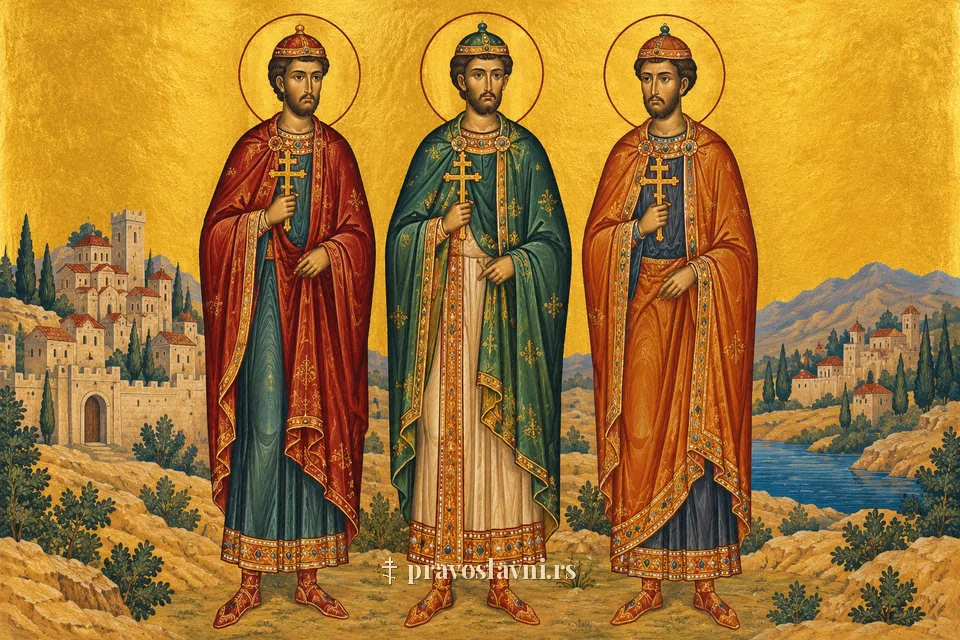
“Blessed are the peacemakers, For they shall be called sons of God.”
— Mt 5:9
Life
Three brothers, Manuel, Sabel and Ismael, came to Emperor Julian the Apostate as envoys of peace from the Persian king Alamundar. Instead of peace, they found with him a martyr's crown.
They were born in Persia, of a pagan father and a Christian mother, who brought them up in the faith. They served at the Persian court, and the king sent them to Julian to conclude peace.
When Julian held a pagan festival with sacrifices near Chalcedon, he wanted the brothers to take part as well. They said openly that they were Christians and would not bow down to idols. For this they were thrown into prison and cruelly tortured, but, as the Prologue and the Life say, in their torments they were strengthened by an angel, who took away their pain. They remained unshaken, and Julian ordered that they be beheaded.
According to both sources, the bodies, which the pagans meant to burn, were hidden by the earth: it shook and opened up. The Life says that many who saw this came to believe in Christ. Later the earth gave them back, according to the Life after two days, and the Christians buried them with honour.
The Persian king went to war because of the murder of his envoys. Julian led his army against Persia, was defeated and came to a wretched end.
The Prologue observes that the enemies of Christ achieve the opposite of what they intend: Julian's cruelty only multiplied the martyrs and spread faith in Christ.
Full Life
Three Brothers from Persia
The holy martyrs Manuel, Sabel and Ismael were three brothers from Persia. Their father was a pagan and their mother a Christian, who brought them up in the faith. Their Life says that the presbyter Eunoicus baptised them and taught them the Scriptures.
They served at the court of the Persian king Alamundar; according to the Life, in the army, loyal to the king, yet without abandoning their faith. The king sent them as envoys to Emperor Julian the Apostate, to conclude a peace.
Peace, Not Idols
Julian, according to the Life, at first received them well. But when a pagan festival with sacrifices was held near Chalcedon — the Life says at the place Orgia Trigon in Bithynia — he wanted them to take part as well. The brothers said that they were Christians and refused to bow down to the idols. According to the Life, they explained that faith is not a reason for war and that they had come only for the sake of the peace treaty.
Faithful to the End
Julian threw them into prison, and even after they were questioned they did not yield. Then they were subjected to severe torture. The Prologue and the Life record that in those torments the consolation of God came: an angel appeared to them and they bore the tortures without pain. The Life records that Julian tried both flattery and threats, and so he offered Sabel and Ismael rewards if only they would abandon Manuel, but all three remained together and faithful.
In the end Julian condemned them to death by the sword. The Life says that this was on 17 June (according to the Julian calendar), at a place called Constantine's, after a voice from heaven had called them to receive their crowns.
The Earth Hid Them
The Prologue and the Life also record the miracle that followed: when the bodies were to be burned, the earth shook, opened and hid them. The Life records that many witnesses then came to believe in Christ. Later the earth gave back the bodies — according to the Life after two days, fragrant as myrrh — and the Christians buried them with honour; the Life also mentions healings at their tomb.
The Persian king, embittered by the killing of his envoys, went to war. Julian led his army against Persia, was defeated and came to a wretched end.
From this the Prologue draws a lesson: the enemies of Christ achieve the opposite of what they desire. Julian's cruelty only multiplied the martyrs and spread the faith.