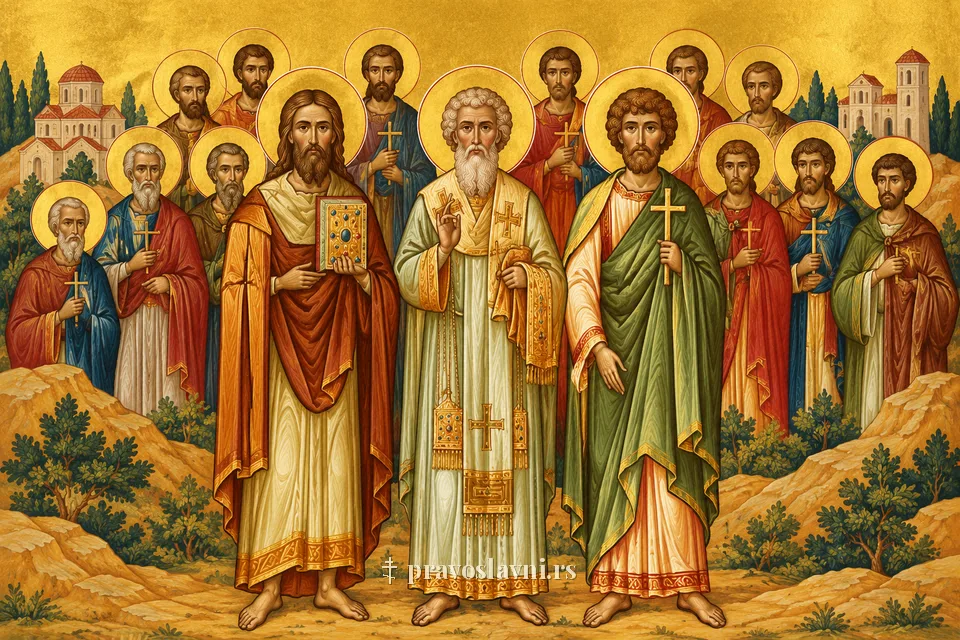
“I ask for the bodies of the saints, that we may bury them!” These words, according to the Life, were spoken from the crowd by the eighteen-year-old Porphyrius, servant of Pamphilus, a presbyter of Caesarea, when his master was condemned to the sword together with seven others. The Prologue calls him a youth. He paid for that request with his life: he was tortured and burned, and he went to the Lord before his teacher.
So begins the story of the twelve martyrs of Caesarea in Palestine, who suffered under the Emperor Diocletian — according to the Prologue, in the year 308. Pamphilus was a learned priest; the Prologue remembers his labour over the New Testament, whose copies he cleansed of errors and spread among the faithful. Condemned with him were the deacon Valens, an old man who knew the Scriptures extremely well, and Paul, who had already endured fire for the faith before.
Five brothers from Egypt were joined to them. At the city gate they said that they were Christians and ended up in prison. Before the judge they gave their names as Elijah, Isaiah, Jeremiah, Samuel and Daniel, and they no longer acknowledged their pagan names. As their homeland they named the Jerusalem above, and the judge did not even understand what city they were speaking of. The Life explains that Jerusalem bore a different name at that time, and that no one had mentioned the old one for almost two centuries.
After Porphyrius three more suffered. Seleucus, a former soldier — an officer, according to the Prologue — kissed the condemned before their execution and so, according to the Life, was himself beheaded. Old Theodulus, of the judge's household, according to the Prologue kissed one of the martyrs on the way to the place of execution; the Life says that he believed in secret and that he was crucified. Julian, according to the Life, came to the city on business, found the bodies of the martyrs left without a grave, kissed them and for that was burned.
The Life records that for four days not a single animal came near those bodies, and then the faithful buried them with honour. The Life compares the twelve with the twelve prophets and the twelve apostles.
The Prologue measures their sacrifice by eternity: the mortal life they laid down is small beside the life they received. Their homeland was not on earth, but in the heavenly Jerusalem.
Full Life
Twelve Different Witnesses
The Church celebrates the twelve martyrs of Caesarea in Palestine together, although life brought them to the place of execution from quite different directions. They suffered in the time of Emperor Diocletian; the Prologue gives the year as 308, while the Life does not mention a year.
Three of them were men of the Church. Pamphilus, a presbyter of the church of Caesarea, was learned and devout; the Life praises his knowledge of worldly philosophy together with his spiritual wisdom, and the Prologue says that he removed the copyists' mistakes from the New Testament and that he himself also made copies of that book for those who needed it. With him were Valens, a deacon of great age, who held almost the whole of Holy Scripture in his memory, and Paul, who had already once passed through fire for the faith. The Life stresses his zeal, and the Prologue the respect that he enjoyed. These three, as the Life says, were tortured by the earlier governor and kept in prison for two years, until a new judge took his place.
Five of them were brothers by birth from Egypt. The Life says that they had accompanied a hundred and thirty Egyptian confessors whom the authorities had sentenced to labour in the mines of Cilicia, and that on their way back home they came to Caesarea. The remaining four were a young servant, a former soldier, an old man from the judge's household and a man who had stopped in the city on business.
The City the Judge Did Not Know
The brothers told the guard at the city gate that they were Christians and that their homeland was in heaven. The Life gives their words: “We are Christians, and our homeland is the heavenly Jerusalem.” The guard then seized them as criminals and locked them up.
They found themselves before the judge together with Pamphilus, Valens and Paul. Their pagan names, they said, they no longer bore, but were called Elijah, Isaiah, Jeremiah, Samuel and Daniel. The judge wanted to know what region they came from, and what he heard was: “From the Jerusalem above.” The Life explains why this confused him: the city bore a different name at that time, and the old one had not even been mentioned for almost two centuries. Elijah, the eldest, was beaten, but, according to the Life, he still maintained that this city belongs only to Christians and that it lies in the east, and so the judge concluded that the Christians had a city of their own somewhere which could measure itself against Rome. According to the Life, the five brothers were condemned to the sword, and the same sentence was passed on Pamphilus, Valens and Paul when they refused to do what the Emperor commands.
Courage That Passed from One to Another
Then it was seen how the faith of one man gives courage to another. Porphyrius, the servant of Pamphilus — according to the Life an eighteen-year-old of pure life and bright mind, whom everyone loved, and according to the Prologue a young man — asked from among the crowd for the bodies of the condemned: “I ask for the bodies of the saints, that we may bury them!” The Life says that for this he was cruelly tortured and that he did not utter a sound, and that he was then burned, while he called upon Jesus Christ. And so he died before his teacher.
His end was watched by Seleucus, once a soldier — the Prologue says, an officer. The Life tells of him that confessing Christ had already, in an earlier persecution, cost him his rank and his place in the army, along with a beating, and that after that he lived for the sick and the poor. According to the Life, he carried the news about Porphyrius to Pamphilus, whom it filled with joy and with thankfulness to God. Before the execution Seleucus kissed the martyrs, and the Life says that because of this he too was seized and beheaded.
Theodulus, an old servant from the judge's household, has two stories in the sources. According to the Prologue, he kissed one of the martyrs while they were being led to execution. According to the Life, the old man had kept his faith in Christ hidden, and at that moment he asked one of the condemned to remember him in prayer before God, and when the other servants betrayed him, the judge ordered him to be crucified.
The twelfth, according to the Life, was Julian, a faithful and virtuous man, who had come to Caesarea to buy tools. He found the bodies of the martyrs outside the walls, left without a grave for the animals. He kissed them and glorified the martyrs, and so the guard arrested him; the Life says that he was burned, like Porphyrius. The Prologue says of the brothers and of the others with them that they were beheaded.
A Homeland That Cannot Be Lost
The Life records that for four days not a single animal so much as touched the bodies. After that the pagans no longer forbade anyone to take them, and the faithful buried them with honour. The Life compares the twelve with the twelve prophets and the twelve apostles.
The Prologue concludes that in exchange for what is small and passing they received eternal life. The Life reminds us that the true homeland of a Christian is the heavenly Jerusalem and that endurance unto death receives a crown in the Kingdom of Heaven.