“There is neither Jew nor Greek, there is neither slave nor free, there is neither male nor female; for you are all one in Christ Jesus.”
— Gal 3:28
Life
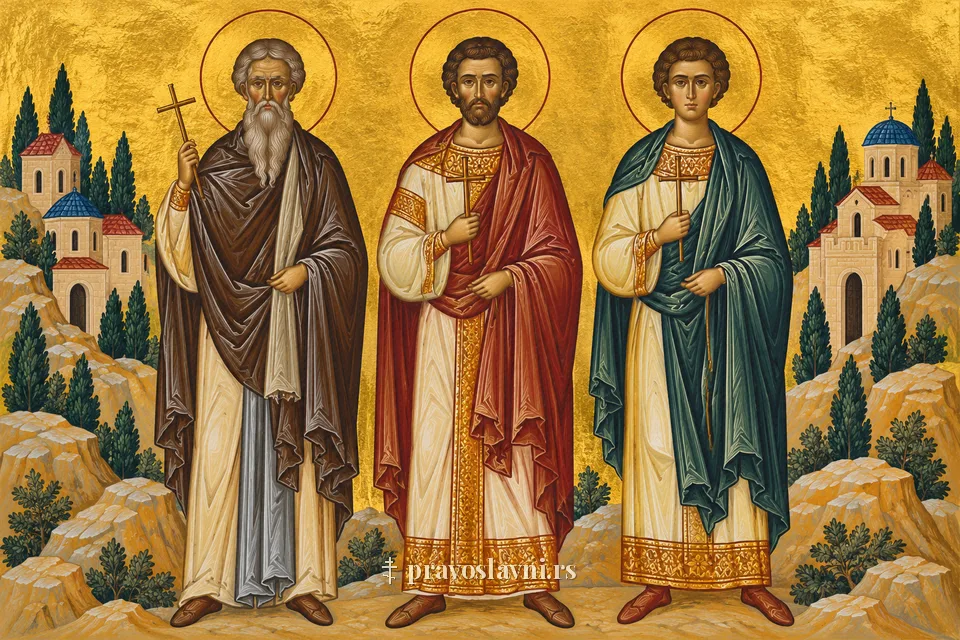
Cilicia, the time of the Emperor Diocletian. Their Life says that in the city of Pompeiopolis three Christians were seized and brought before the proconsul Numerian Maximus. Tarachus, says the Prologue, was sixty-five years old and a native of Claudiopolis. Probus was from Pamphylia. Andronicus was the son of one of the most distinguished citizens of Ephesus.
The proconsul first asked the eldest what his name was. Tarachus answered: “A Christian.” The Prologue says that he answered in this way three times. Their Life also records his explanation: that name was dearer to him than the one his parents had given him. Only then did he say that his name was Tarachus, and that in the army they had called him Victor.
The proconsul advised Tarachus to spare his old age. Tarachus replied that he had lived in this faith for sixty-five years and would not depart from the truth. To Probus he offered honours from the emperor and his own friendship. The Prologue records his answer: “I neither want the emperor's honours, nor do I desire your friendship.” Their Life adds that Probus had great wealth and that he left it in order to serve the living God. Andronicus, the youngest, the proconsul called upon to obey him as a father. Andronicus replied that from his youth he had never served idols and would not do so now. The Prologue records his words: “my body is before you, do what you will.”
All three were subjected to cruel tortures, more than once. Not one of them gave way.
At last the proconsul ordered that the martyrs be thrown to the wild beasts in the amphitheatre outside the city. They let loose a bear. The bear came up to Andronicus, lay down beside him and began to lick his wounds. They let loose a lioness as well, and she bent her knees and lay down before Tarachus. The Prologue says that both the bear and the lioness fawned on them. Many, says the Prologue, then came to believe in Christ. The enraged proconsul ordered that the martyrs be put to death. The Prologue says that they were cut down with swords.
The proconsul ordered that their bodies be mixed with the bodies of others who had been executed, and he left a guard. The Prologue says that on that night three Christians, Macarius, Felix and Verus, came to take the bodies. Their Life passes on their testimony. They knelt and prayed to God to help them. A storm arose, and the guard scattered. Then they prayed that God would show them which were the martyrs' bodies. The Prologue says that all at once three candles appeared above the bodies of the saints. Their Life says that they were like stars and that they went before them all the way to a cave behind the hill, where they buried the bodies.
An old man, a rich man and a youth had nothing in common except Christ. That was enough.
Sts Tarachus, Probus and Andronicus teach us that faith wipes away differences of age and origin, and that the name “Christian” can be dearer than any other name.
Full Life
Three men, one answer
In the reign of Emperor Diocletian, in Cilicia, three Christians stood before the proconsul Numerius Maximus. The Life says that they were seized in Pompeiopolis. It would be hard to find three men more unlike one another. Tarachus, according to the Prologue, was an old man of sixty-five, from Claudiopolis. Probus was from Pamphylia. Andronicus, the youngest, was the son of a respected citizen of Ephesus. Yet before the court they spoke as one.
The Life also reveals why we know their words so exactly. The interrogation was written down by the court scribes, from beginning to end. That record later became a precious testimony for the Church.
A name that does not change
When Tarachus was asked what his name was, he said that he was a Christian. That was not enough for the judge, but the old man, according to the Prologue, gave the same answer three times. The Life explains why: of all the names he had borne, this one was the dearest to him. Only then did he also say what the judge was asking for: his name was Tarachus, while his fellow soldiers used to call him Victor. According to the Life, he left the army as soon as he became a Christian.
The proconsul tried to move him by speaking of his years. Should an old man not take care of what little life is left to him? Tarachus calmly replied that he had spent the whole of that life in the faith and that he would not sell it in his old age.
What a man can lose
Probus, according to the Prologue, was offered what many long for — the emperor's favour and the goodwill of the proconsul himself. He refused briefly: “I neither want the emperor's honours, nor do I desire your friendship.” The Life adds that he had already earlier left behind great wealth in order to serve God. One who had once renounced everything could hardly be bought with honours.
Andronicus, according to the Life, they tried to win over with fatherly gentleness: let him obey the judge as one obeys a father. The young man answered that never in his life had he bowed down to an idol and that he would not begin now. Threats did not frighten him. The Prologue records his answer: “my body is before you, do what you will.”
The tortures lasted a long time and were repeated. Not one of the three gave in.
Beasts gentler than men
At last the proconsul condemned them to the beasts in the amphitheatre. The Life says that by then the martyrs were so exhausted that they could not reach the arena on their own. The stands were full. For many of the spectators, according to the Life, it was not easy to watch this, so some murmured against the proconsul, and some got up and left.
Then something happened that no one had expected. According to the Life, neither the bear nor the lioness would attack the martyrs. The Prologue says that the beasts behaved towards the saints like tame animals. On that day, according to the Prologue, the crowd of spectators gained many new Christians. Then the proconsul, according to the Prologue, gave his last command: that the martyrs be beheaded with the sword.
Night and light
It was not enough for the proconsul that he had put them to death. He ordered that their bodies be lost among the bodies of other condemned men, and he set a guard. According to the Prologue, that night three Christians came for them — Macarius, Felix and Verus.
The Life relates what they themselves told. They prayed to God, and then a storm came, so that the guards ran away. The question remained how they would recognise their own in the dark. The Prologue says that God gave them a sign by means of light, and so they recognised the bodies of the saints. According to the Life, they carried the relics to a cave behind a hill, buried them there and closed up the entrance.
The three faithful men afterwards, as the Life records, described all of this in a letter to their brothers in the faith. Thanks to them, the grave of the martyrs was not forgotten, and their story has reached us as well.
Sts Tarachus, Probus and Andronicus show that in Christ the difference between old and young, rich and poor, disappears. Only one name matters — Christian.
Other saints of the day
Venerable Cosmas of Maiuma
St Cosmas was born in Jerusalem and was orphaned early. According to his Life, he was taken in at Damascus by the parents of St John of Damascus, who brought him up as their own son, together with John. The two boys had the same learned teacher, who was himself also called Cosmas, and under him, as the Life says, they mastered the secular sciences, and above all came to love the Holy Scriptures. As grown men, according to the Life, they left the world and became monks in the Lavra of St Sabbas the Sanctified. The Church remembers Cosmas to this day through her services: the Prologue states that he was John's fellow worker on the Octoechos and that he wrote many canons in honour of the saints. Among his works the Prologue singles out especially the canons for the days before Pascha and for Holy Week. Later he became Bishop of Maiuma, not far from Gaza, and according to his Life he guided his flock in a manner pleasing to God. John departed before him, and Cosmas ended his earthly path at a great age. The life of St Cosmas teaches us to give back to God and to people what we have received as a gift from others.