Sunday, 16 May 2027no fast · Sunday — a festive day · 3 May (according to the Julian calendar)
Sunday16May 20273 May (according to the Julian calendar)
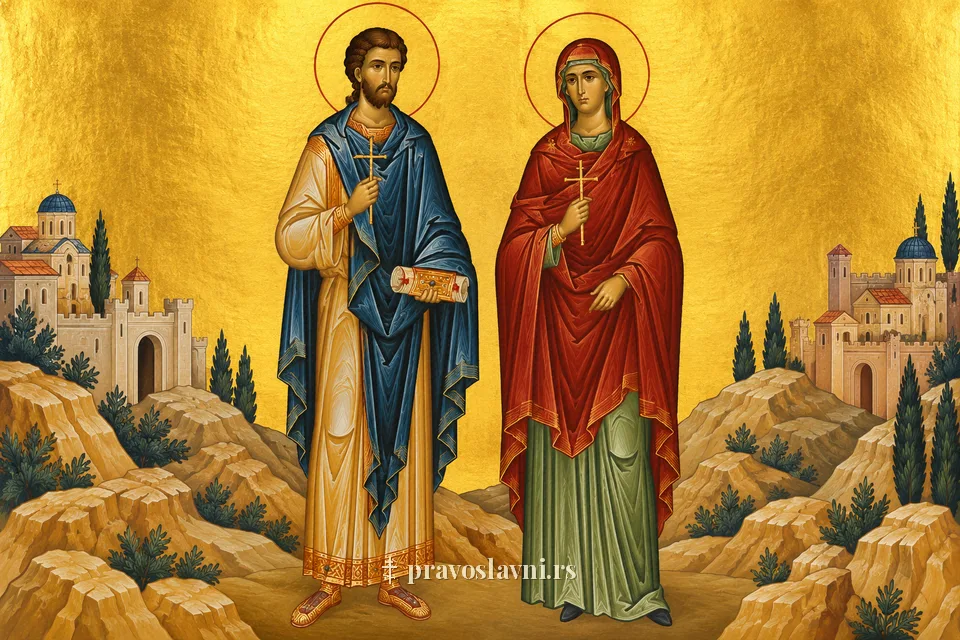
Illustration
Saints of the day
Holy Martyrs Timothy and Maura
What happenedTimothy and Maura, a couple married only some twenty days, were crucified facing each other and for nine days on their crosses encouraged one another in the faith.
“But lay up for yourselves treasures in heaven, where neither moth nor rust destroys and where thieves do not break in and steal.”
— Mt 6:20
About this day
The Sunday of the Myrrh-bearers is dedicated to the Righteous Joseph of Arimathea and Nicodemus, who begged the body of the Lord from Pilate and buried it, and to the holy Myrrh-bearing Women, who came to the tomb to anoint the Lord with myrrh.
At Vespers the paschal stichera are sung after the aposticha, and at Matins the whole paschal canon is sung, with theotokia added. Where the church is dedicated to the Myrrh-bearers, the magnification is added as well. On the following days of the week the stichera are combined from the Triodion, the Menaion and the Octoechos, and in the first place, instead of the paschal canon, comes the canon of the feast. There is no fasting on this day.
Life
For nine days they hung on crosses, facing one another, and encouraged each other to hold out to the end. That is how the Holy Martyrs Timothy and Maura suffered, a husband and wife who had been married for only some twenty days when their suffering began. On the tenth day they gave up their souls to God, in the year 286.
Timothy was a reader in his village. At the time of Diocletian's persecution he was brought before Arianus, the governor of the Thebaid, and openly confessed that he was a Christian and a reader of the Church of God. His Life records that he would not offer sacrifice to the gods and did not hand over the holy books, calling them his children. The Prologue says that he was not afraid of torture, because the angels of God strengthened him. He was subjected to severe tortures and lost his sight.
The governor then summoned the young Maura — the Life says that she was about seventeen years old — and promised her gold and silver if she would persuade her husband to give way. At first the fear of torture took hold of her, but her husband's words strengthened her, and she herself confessed Christ before the governor. According to the Life, she also refused the offer to marry her to a certain centurion, saying: “I have betrothed myself to the Heavenly Bridegroom, Jesus Christ, the Son of God.” She too was tortured, and the Prologue says that both of them survived the tortures only thanks to the grace of God. The Life tells that on the way to the crucifixion her mother begged her to give up, and she answered her that gold, silver and beauty pass away, but the crown of Christ remains.
On the cross, as both sources record, they supported one another. According to the Life, they encouraged each other in turn, he her by day and she him by night, and Maura saw thrones and crowns prepared for them both.
Timothy and Maura are an example of spouses who help one another on the way of salvation. The husband strengthened his frightened young wife, and then on the cross they encouraged each other until the last hour. Out of everything they could have had on earth, they chose the crown that does not pass away.
Full Life
Twenty days of marriage
At the time of Diocletian's persecution Arianus, the governor of the Thebaid, tried two Christians for their faith in Christ: Timothy and his wife Maura. Timothy was a reader of the church in his village; the Life says that he was young and that he came from the village of Perapa. He had been married to Maura for only some twenty days when they seized him.
The confessor who did not hand over the books
Before the governor Timothy said openly that he was a Christian and a reader of the Church of God. The Life records that he would not offer sacrifice to the gods, saying: “The Spirit of Jesus Christ dwells in me”. When the governor demanded the holy books, Timothy refused to hand them over to the pagans, calling them his children. The Prologue says that he told the governor that he was not afraid of the instruments of torture, because the angels of God were strengthening him. They tortured him cruelly and deprived him of his sight, but he, as the Life records, called upon God even in his torments.
Fear that grew into courage
The Life relates that the governor then summoned Maura, who was about seventeen years old, and promised her gold and silver if she persuaded her husband to offer sacrifice. Maura asked that the wooden gag be taken out of Timothy's mouth, which they had put there while they were torturing him. At first she was afraid of the tortures. Timothy encouraged her — according to the Life, he called her to join him in his struggle and prayed for her — and she openly confessed Christ before the governor. The Life says that she rebuked the governor and refused his offer to marry her to one of his centurions, saying: “I have betrothed myself to the Heavenly Bridegroom, Jesus Christ the Son of God”.
Maura too endured cruel torments, and the Life records that after each one she thanked her torturer, saying that he was taking away her sins. The Life also tells that she was thrown into a cauldron of boiling water, yet she stood there unharmed; when she splashed the governor's hand, the water scalded him, and so even he praised Maura's God. Still he did not relent: the Life says that he then threatened her with burning coals and tortured her with fire. According to the Prologue, there were many more torments, and only the grace of God kept them alive.
Nine days on the cross
As they were leading her to be crucified, according to the Life, her mother met her and begged her to give up. Maura answered her that gold, silver and beauty pass away, but that the crown of Christ is eternal: “Gold and silver perish; garments are ruined by moths”.
Timothy and Maura were crucified facing one another. For nine days they lived on their crosses and encouraged one another to endure; the Life says that they took turns: the day belonged to Timothy's instruction, and the night to Maura's. On the cross, according to the Life, Maura saw a man offering her a cup of milk and honey and recognised in this a deception of the devil. Then she saw a river of milk and honey, and thrones and crowns prepared for her and for Timothy. On the tenth day they gave up their souls to God — the Life says that angels came for them — in the year 286.
Marriage as a shared path of salvation
Timothy and Maura leave us the example of a husband and wife who help one another towards salvation. He supported his frightened young wife, and then on the cross they encouraged one another to the end. Their suffering reminds us that earthly goods and beauty pass away, while the crown of Christ remains.