“But Peter and John answered and said to them, ”Whether it is right in the sight of God to listen to you more than to God, you judge.”“
— Acts 4:19
Life
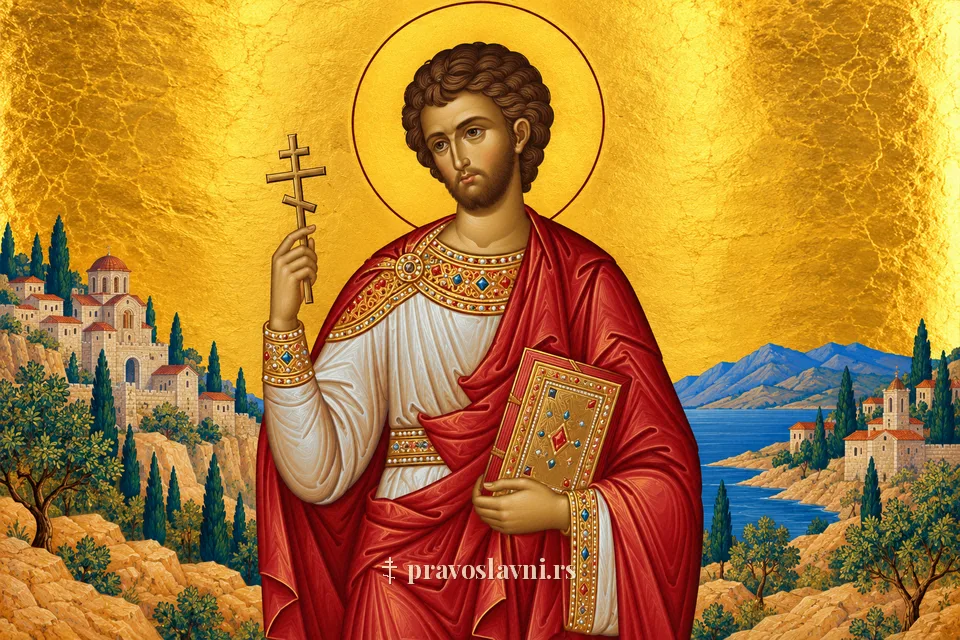
St Emilian is remembered as a young man who gave himself up of his own accord, so that an innocent man should not suffer in his place. According to the Prologue, he was a servant of the city governor in the Thracian city of Dorostolum, at the time when Julian the Apostate began his struggle against Christianity. The Emperor's envoy, who found no Christians in Dorostolum, held a feast for the people and ordered a great sacrifice to the idols.
According to the Prologue, under cover of night Emilian smashed the idols with a hammer in the temples, in the market place and along the streets. When a peasant was seized the next day, Emilian went to the envoy and confessed the deed. Asked who had put him up to it, he said: “God and my soul commanded me to shatter those dead pillars which you call gods.”
They scourged him and tortured him, and then gave him over to the fire. He suffered in the year 362.
Full Life
So that an innocent man should not suffer
The most important moment in the life of St Emilian came when a peasant was arrested in Dorostolum for a deed that he had not done. So that this man should not suffer in his place, Emilian went of his own accord to the Emperor's envoy and confessed that it was he who had smashed the idols.
What went before
According to the Prologue, Emilian was a young man, a servant of the governor of the Thracian city of Dorostolum. Emperor Julian the Apostate had at that time begun a struggle against Christianity throughout the empire. The Prologue relates that one of the Emperor's envoys had the task of wiping out the Christians in Dorostolum, but he did not find any there; and so he arranged a great feast for the citizens and ordered a great sacrifice to the idols.
According to the Prologue, under cover of night Emilian went through the idols' temples, the market-place and the streets and smashed all the idols with a hammer. On the next day fear seized the city, and that was when the peasant was arrested.
Who commanded him
The envoy wanted to know who had urged him to do this. Emilian answered: “God and my soul commanded me to shatter those dead pillars which you call gods.” For this he was scourged and tortured, and then given over to the fire. According to the Prologue, he passed over into the Kingdom of Heaven on 18 July (according to the Julian calendar), in the year 362.
He could have kept silent, but he chose to take the blame upon himself, only so that another should not suffer.
Other saints of the day
Holy Martyr Hyacinth
According to tradition, whenever the Christians gathered each year on his feast for the service at his tomb, dust would rise from the tomb; the bishop would collect it and distribute it to the faithful to heal them both in soul and in body. Hyacinth was born in Amastris, of devout parents, Theoclitus and Theonilla, while Bishop Heraclius was leading the church there. He received his name from an angel of God, who appeared to him. As a three-year-old child he brought a dead child back to life by calling upon the name of Christ. As he grew, he advanced in the virtues and worked many miracles. A hollow elm tree was an object of worship for the idolaters; when he saw this, Hyacinth, inflamed with zeal for God, cut that tree down. For this he was brought before the governor Castrensius and the elders of the city, beaten, dragged outside the city and shut up in prison. There he ended his life, giving up his soul to God.