“But Daniel purposed in his heart that he would not defile himself with the portion of the king’s delicacies, nor with the wine which he drank; therefore he requested of the chief of the eunuchs that he might not defile himself.”
— Dan 1:8
Life
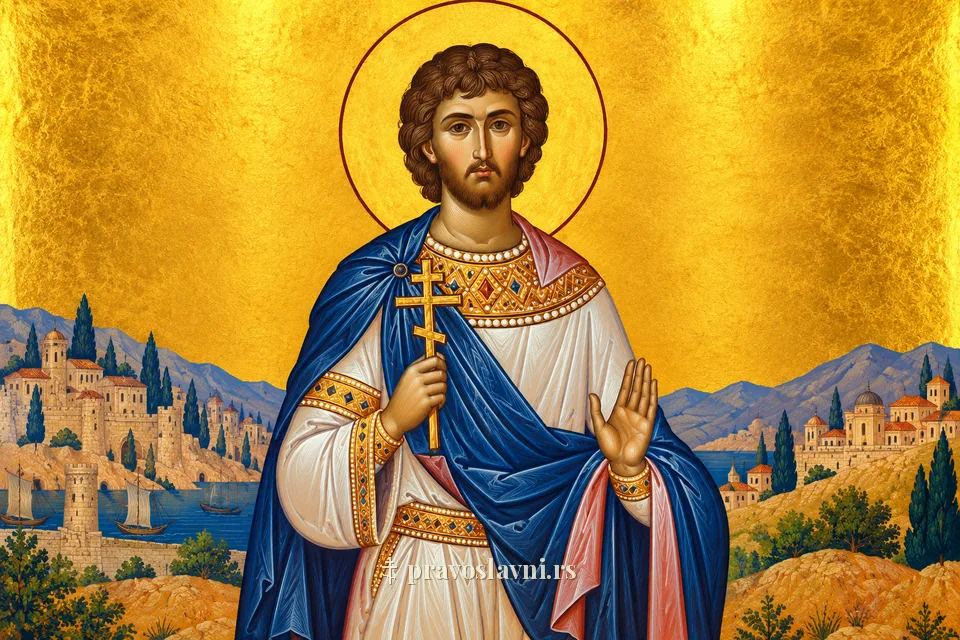
As a young man Hyacinth served at the court of Emperor Trajan; according to his Life, he was born in Caesarea in Cappadocia, into a Christian family, and at the age of twenty he was the emperor's chamberlain. He was a Christian, but he kept his faith secret. When the emperor and the court were offering sacrifices to the idols, Hyacinth kept away from this and, according to the Life, prayed to the one God in a small room. Another chamberlain heard him and denounced him.
Brought before Emperor Trajan, Hyacinth firmly refused to renounce Christ and to eat what had been sacrificed to idols. According to the Life, he said: “It is not fitting for me, a Christian, to eat what is defiled.” The Prologue records that even then he did not yield, but confessed that he was offering himself to Christ as a living sacrifice. For this he was tortured and thrown into prison.
The emperor ordered that he be given only food that had been offered to idols. Hyacinth would not take it, but fasted and, according to the Life, prayed; the guards swore that no one had fed him in secret. The guards saw one radiant angel bringing him a shining garment, and another a crown. Hyacinth died of hunger, and the prison was filled with light and fragrance. The Prologue records his death in the year 108.
According to the Life, his body was thrown outside the city, but the wild beasts did not touch it, for an angel guarded it. The presbyter Timothy, his kinsman, whom an angel had warned in a dream, took it by night and kept it in his own house. The Life also records the healing of a blind man with oil from the lamp, after which that man believed and was baptised. The relics were later translated to Caesarea: mules without a driver brought them to the house where Hyacinth was born, and there the relics were laid in a marble coffin.
On this day the Prologue teaches that love helps the departed too, through prayer and almsgiving for the dead.
The young courtier chose Christ instead of the emperor's favour. He would rather starve than betray his faith, and God crowned him through His angels.
Full Life
A Christian at the imperial court
In the time of the Emperor Trajan, according to the Life, a great persecution began: everyone was ordered to offer sacrifice to the gods. Hyacinth was born in Caesarea of Cappadocia, of devout Christian parents, who brought him up in the faith — so the Life says. As a young man he served at the court of the Emperor Trajan; the Prologue calls him a courtier, and the Life says that at the age of twenty he was the Emperor's chamberlain. He was a Christian, but he kept his faith secret. According to the Life, he was known for his purity, self-restraint, meekness and good works.
Prayer in a small room
When the Emperor and the court were offering sacrifices to the idols, Hyacinth kept away from it; the Life says that he prayed to the one God in a small room. According to the Life, another chamberlain, Urbicius, heard him praying to Jesus Christ as God and reported him, and so Hyacinth was brought before the Emperor.
They demanded that he renounce Christ and offer sacrifice — according to the Life, that he eat meat offered to idols. The Life records his words: “It is not fitting for me, a Christian, to eat what is defiled.” According to the Life, he made the sign of the cross and called on the Emperor to abandon idolatry. The Prologue compares him to a diamond, because he did not yield: he confessed that he was a Christian and said: “I honour Christ, I worship Him, and to Him I offer my own self as a living sacrifice.” To the Emperor, according to the Life, he said: “Do with me what you will!”
Hunger and the crown
For this he was tortured and thrown into prison. According to the Life, under torture he kept repeating: “I am a Christian! I am a servant of Christ, and I will not deny Him!” The Emperor ordered that in prison he be given only food that had been offered to idols. Hyacinth did not take it, but fasted and, according to the Life, prayed; the guards swore that no one had fed him in secret.
The guards saw two radiant angels in the prison: from one Hyacinth received a shining garment, and from the other a crown. Hyacinth died in the prison of hunger, and the prison was filled with light and fragrance. The Life says that the guards found angels around his body, in the form of shining young men with candles. The Prologue records his death in the year 108, and according to the Life he died in Rome, on 3 July (according to the Julian calendar).
The relics and the healing of a blind man
According to the Life, his body was thrown outside the city to the beasts and the birds, but it remained untouched, for an angel guarded it. The presbyter Timothy, a relative of Hyacinth, warned by an angel in a dream, took the body by night and kept it in his house with an oil lamp and incense. Later the relics were kept in secret by a devout widow.
The Life also records a miracle. To a man who had been blind for a year Hyacinth promised, in a dream, healing by the oil from the lamp, and he received his sight. When he hesitated to obey, he went blind again; he repented, was healed, believed and was baptised. The relics were then sent to Caesarea. No one drove the cart with the relics, and the mules stopped of their own accord in front of the house in which Hyacinth was born; there the relics were laid in a marble coffin.
The teaching of the Prologue
On this day the Prologue teaches that love helps the departed too, through prayer and almsgiving for the dead. As an example it gives the holy abbess Athanasia, who rebuked the sisters because after ten days they stopped giving out the alms that were meant to last for forty days. The reflection on the rod of Moses, which was turned into a serpent and back into a rod (Ex 4), says that God turns death into life and gives life to the soul deadened by sin. The homily, on the words of the Apostle Peter (1 Pet 1:8), speaks of the joy of faith in Christ, Whom we love although we have not seen Him (Jn 20:29).
The young courtier chose Christ instead of the Emperor's favour. He would rather go hungry than betray his faith, and God crowned him through His angels.
Other saints of the day
St Anatolius, Patriarch of Constantinople
At the Ecumenical Council in Chalcedon in the year 451 the see of Constantinople was recognised as equal to that of Rome, and according to his Life the Monophysite heresy of Eutyches was also condemned at that time. The Church of Constantinople was governed in those days by St Anatolius. Before that he had served as a presbyter in Alexandria. He was appointed patriarch in 449, after the death of Flavian. He devoted his whole ministry to the defence of the Orthodox faith in its purity; the heretics persecuted him greatly. In the end they also killed him, in the year 458, in the time of Emperor Leo the Great. He was patriarch for almost nine years.