“And that from childhood you have known the Holy Scriptures, which are able to make you wise for salvation through faith which is in Christ Jesus.”
— 2 Tim 3:15
Life
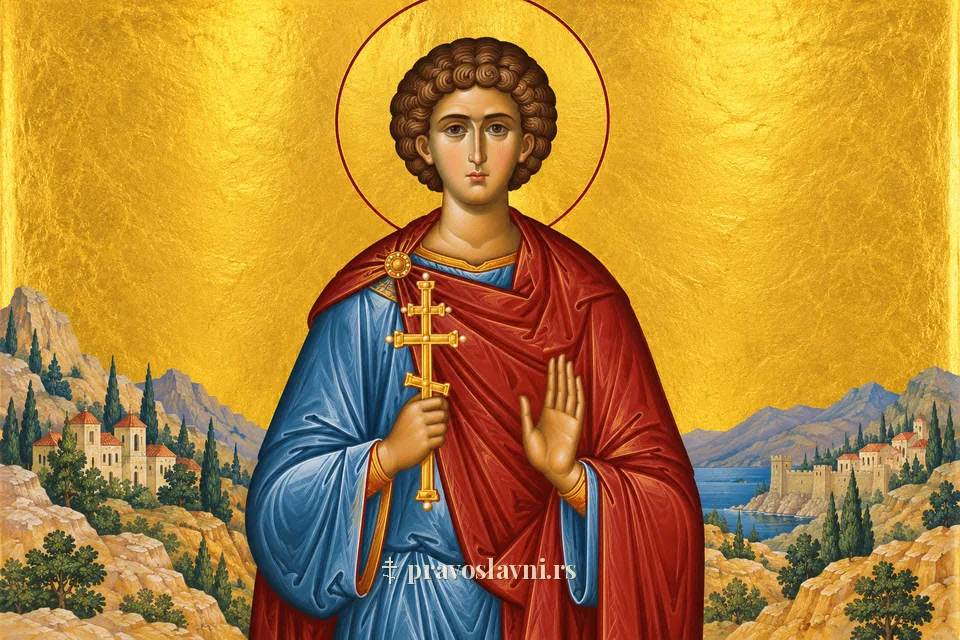
Julian of Tarsus was eighteen years old when, in the time of Emperor Diocletian, he was brought to trial as a Christian. He came from a senatorial family; according to his Life, his father was a pagan and his mother a Christian, who after his father's death had him baptised and brought him up in Tarsus.
For a whole year the governor led him from city to city, trying to turn him away from Christ, but, according to the Life, neither tortures nor promises shook him. All that time his mother followed him from a distance. For three days in the prison she encouraged him not to lose heart. The governor, according to the Life, hoped that she would persuade him, but at the trial she publicly confessed Christ, and Julian with her. The mother died under torture, and Julian was thrown into the sea, shut up in a sack with snakes, scorpions and sand.
A homily in his praise was delivered by St John Chrysostom, who described the miracles at the martyr's tomb. His body, which the sea cast up on the shore, was first buried in Alexandria in the year 290 and later translated to Antioch. Mother and son together remained faithful to Christ to the end.
Full Life
The Son of a Senator and a Christian Woman
Julian came from a noble, senatorial family. According to his Life, his father was a pagan and a senator, and his mother was a Christian. He was born in Anazarbus in Cilicia; when his father died, his mother moved with him to Tarsus, had him baptised and brought him up in Christian piety.
A Whole Year from City to City
He suffered in the time of Emperor Diocletian, at the age of eighteen. According to the Life, he was brought before the governor Marcian, but neither tortures, nor rewards, nor honours, nor threats could induce him to renounce Christ or to offer sacrifice to the idols. For a whole year the governor led him from city to city — according to the Life, through Cilicia — trying to turn him away from Christ. The Life relates that in the harbour of Aegeae the idolaters forced sacrificial meat and wine into his mouth, and afterwards he was thrown into prison.
A Mother beside Her Son
His mother followed him from a distance the whole time. For three days in the prison she encouraged him not to lose heart; according to the Life, she had asked the governor for those three days, supposedly in order to give him advice. The governor hoped that she would persuade him, but at the trial, as the Life says, she openly confessed Christ and condemned the idols, and Julian did the same. His mother died under torture.
Julian was put to death in the sea: he was thrown into it shut up in a sack, together with snakes, scorpions and sand.
The Relics and Chrysostom's Praise
The sea cast up the body, and it was found, according to the Life, by a devout widow. It was buried in Alexandria in the year 290, and from there it was later translated to Antioch. St John Chrysostom praised him in a homily and described the miracles at his tomb; according to the Life, he writes in it that the demons flee from the tomb, and he calls the martyr himself “a light brighter than the rays of the sun”.
The eighteen-year-old youth and his mother together confessed Christ to the end, and the mother's word of encouragement strengthened her son in his martyrdom.
Other saints of the day
Venerable Anastasija of Serbia
Venerable Anastasija was the wife of Stefan Nemanja and the mother of Vukan, Stefan and Rastko, who is St Sava. At baptism she was given the name Ana. She was tonsured a nun in 1196 and received the name Anastasija; according to her Life, this was on the Annunciation, together with Nemanja, who became the monk Simeon. Her Life says that as a nun she lived in Kuršumlija, in a monastery dedicated to the Most Holy Theotokos, not far from the Toplica, where she met the end of her life. Sava had gone to the Holy Mountain (Mount Athos) while still a young man, and according to her Life she never saw him again in this life, but she lived to hear that Hilandar had been founded. She reposed on 21 June 1200 (according to the Julian calendar) — according to her Life, about four months after Simeon, who reposed at Hilandar on 13 February of the same year. She was buried at Studenica; according to the Prologue, in the narthex, where her relics also are. Her Life reminds us that she, her husband and her sons Sava and Stefan are numbered among the saints, and that the Nemanjić family is the first Serbian dynasty with canonised members.