Monday14June 20271 June (according to the Julian calendar)
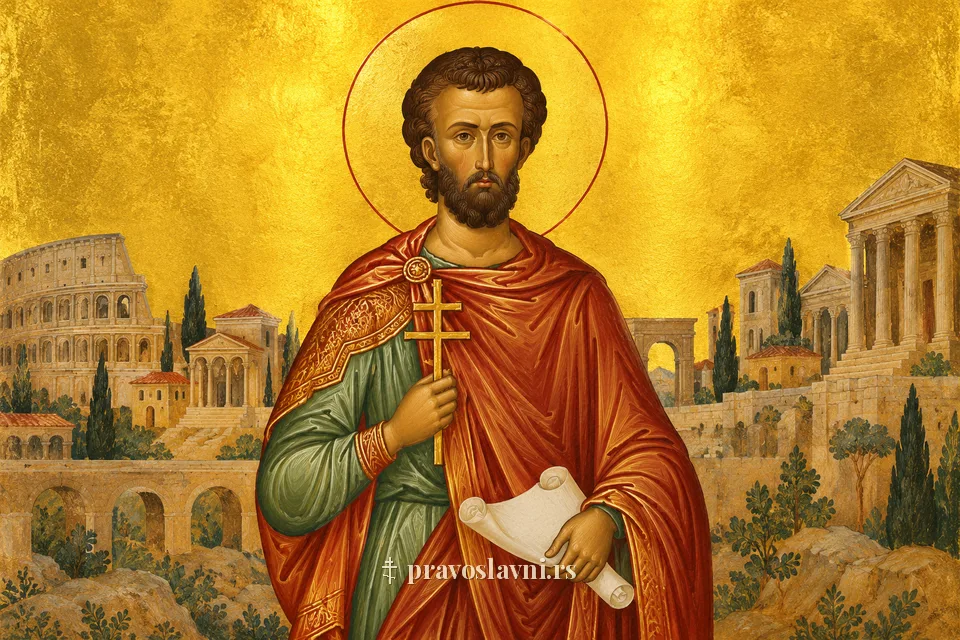
Illustration
Saint of the day
Holy Martyr Justin the Philosopher
What happenedJustin the Philosopher, who had sought the truth in vain in all the schools of philosophy, found it in Christ and defended it until death.
“In whom are hidden all the treasures of wisdom and knowledge.”
— Col 2:3
Life
“You can kill us, but you cannot harm us” — these words, as his Life quotes them, Justin the Philosopher wrote in a defence of the Christians addressed to Emperor Antoninus and the Senate. In that apology he refuted the slanders against Christians, and the emperor ordered the persecution to be stopped. Justin took a copy of the decree to Asia and in this way saved many who were being persecuted.
He came to the faith by a long road. He was born in Samaria, in the city of Shechem, and his Life says that his father was a pagan. He studied in turn with a Stoic, a Peripatetic, a Pythagorean and a Platonist. He stayed longest with the teaching of Plato and became famous as a philosopher, but he did not find true knowledge of God. Then a certain elder directed him to the Scriptures: God Himself reveals the truth about Himself, and He has revealed it in Holy Scripture. His Life says that the elder first directed him to prayer to the true God, and then vanished.
Justin became convinced of the truth of the Scriptures, but he was baptised only when he saw that the accusations against the Christians were false. After that he preached Christ, and in Rome he gained a reputation and followers; according to his Life, he opened a school and wrote against the heretic Marcion. There he was also a witness of the martyrdom of Ptolemy and Lucius. In Ephesus, as his Life records, he got the better of the Jewish teacher Trypho in a debate about the Old Testament.
He also defeated the Cynic Crescens more than once in debates, but out of envy that man became his enemy. He denounced him and Justin ended up in prison, and the Prologue says that before this, when the persecution was renewed under Marcus Aurelius, he had also written a second apology. When it seemed that he was going to be set free, Crescens secretly poisoned him.
On the same day the Prologue also makes separate mention of the martyrs Justin, Chariton and their companions, beheaded in Rome under the prefect Rusticus. Asked whether they expected a reward in heaven, Justin replied that they did not think so, but knew it.
St Justin teaches that God is not reached by the mind alone, but by prayer and faith, and that a Christian defends the truth with his life.
Full Life
A seeker after truth
Justin was born in Samaria, in the city of Shechem, which according to the Prologue was later called Nablus, and according to the Life Flavia Neapolis. The Prologue says that his parents were Greeks, and the Life that his father Priscus was of noble family and a pagan. Justin himself, before his conversion, was an idol-worshipper, gifted in oratory and in Greek learning.
He longed to come to know God, and he went from teacher to teacher. The Life describes how not one teacher satisfied him: the Stoic was unable to tell him anything about God, he left the Peripatetic as a lover of money because he asked for payment, and the Pythagorean wanted him first to master astronomy, geometry, arithmetic and music, which Justin regarded as slow and useless for the soul. He stayed longest with a Platonist and became a famous philosopher, but that teaching did not bring him to the true knowledge of God either.
The elder by the sea
The Life tells that, while he was walking alone beside the sea, he met an unknown elder and talked with him for a long time about philosophy and the knowledge of God. From the elder, as both sources record, he heard that people receive the truth about God as a gift of God's revelation, and not by their own searching, and that this gift has been given in the Scriptures; the Life adds — through the prophets who foretold Christ. The elder advised him: “Above all, pray diligently to the true God.” Then he vanished, and Justin never saw him again.
Later, as the Life records, he told the Jew Trypho that at that moment a longing for God was kindled within him. He turned to the books of the prophets and the apostles, and the Scriptures convinced him. Even so, he put off baptism until he was sure that the accusations against the Christians were false; the Life says that he was convinced of this by their courage in martyrdom and by their pure life.
Defender of the Christians
He was baptised and became a defender of the faith before pagans and Jews, and the Life says that, preaching Christ, he travelled through many lands. He settled in Rome, where he gained a good name and followers. According to the Life, he opened a school in which he set out Christian wisdom in a form that resembled ordinary philosophy. There he opposed the heretic Marcion and wrote books against him and against other heresies. In Rome he was also a witness of the martyrdom of Ptolemy and Lucius.
He wrote the Apology, a defence addressed to Emperor Antoninus and the Senate, in which he refuted the slanders against the Christians. The Life quotes his words from it: “You can kill us, but you cannot harm us.” The Emperor ordered that the persecution be stopped, and the Life adds that Christians were not to be punished for their faith alone. Justin carried a copy of the decree to Asia and saved many who were being persecuted; according to the Life, he made it public in Ephesus. There, as the Life records, he debated with the Jewish teacher Trypho on the basis of the Old Testament and overcame him, and he also wrote about that conversation. The Prologue adds that, when the persecution was renewed under Marcus Aurelius, he wrote a second apology as well.
Death at the hand of an envious man
The one who hated him most was the Cynic Crescens, a philosopher whom Justin had defeated more than once in debates. Out of envy he denounced him, and Justin was thrown into prison; according to the Life, the accusations were false, he was put on trial, and no guilt was found in him. When he saw that Justin might go free, Crescens secretly gave him poison in the prison.
In a separate commemoration on the same day the Prologue also records the martyrs Justin, Chariton, Charito, Euelpistus, Hierax, Paeon, Valerian and Justus, who suffered in Rome under Marcus Aurelius and the prefect Rusticus, and who were all beheaded. When Rusticus asked them whether they expected a reward in heaven, Justin answered: “We do not suppose it, we know it.”
What he leaves us
The Life teaches that a man cannot rightly come to know God by his own mind: true knowledge comes through prayer, the Holy Spirit, faith and the Scriptures. Justin passed through all the schools of his time, but he found the truth in Christ and bore witness to it to the end. His defence reminds us that Christians ought to be judged by their life, and not by slanders.
Other saints of the day
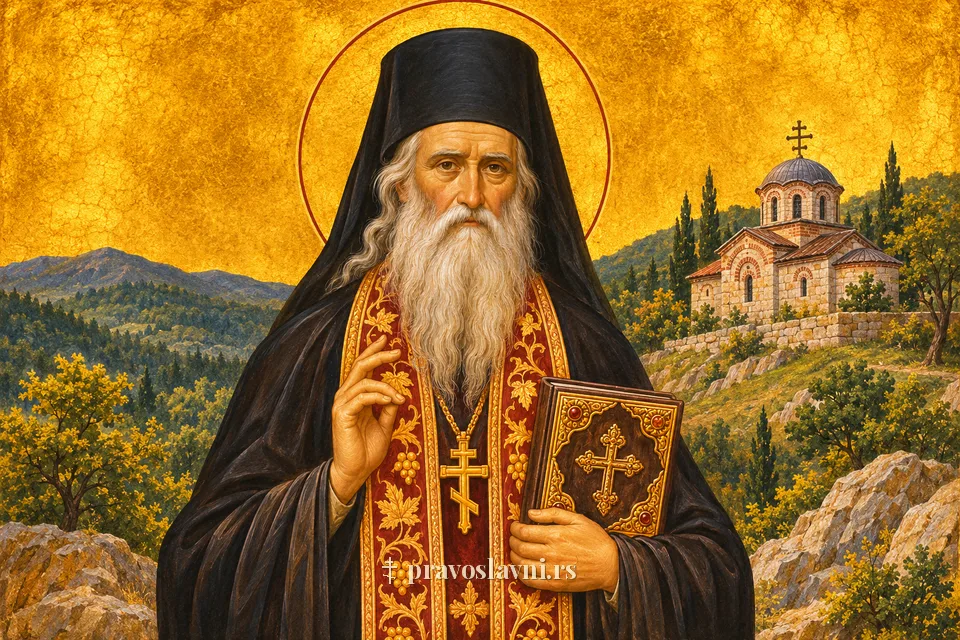
Venerable Justin of Ćelije
Justin of Ćelije was born as Blagoje Popović in 1894 in Vranje, on the feast of the Annunciation, to his father Spiridon, who came from a priestly line, and his mother Anastasija. As a boy, in the Pčinja Monastery, he saw his mother healed by the prayers of St Prohor. At the Seminary of St Sava in Belgrade he was strongly influenced by one of his teachers, Nikolaj Velimirović. In 1914 and 1915 he was a medical orderly in the military hospital in Niš, recovered from typhus and retreated with the Serbian army across Kosovo and Albania. In Skadar he became a monk and received the name Justin, after the holy martyr Justin. He studied in Petrograd and at Oxford, where his degree was not granted because he would not soften his criticism of Western humanism in his work on Dostoevsky, and he took his doctorate in Athens, on St Macarius of Egypt. He taught in Sremski Karlovci, Bitolj and Belgrade, edited the journal “Hrišćanski život” (Christian Life), wrote his Dogmatics and refused the rank of bishop that was offered to him. After the war the new authorities removed him from the University, imprisoned him and took away his civil rights. From 1948 he lived in the women's monastery of Ćelije near Valjevo, where he served the Divine Liturgy every day, wrote, translated and was a spiritual father to the nuns and to visitors. He left behind some forty volumes of works. He reposed on his birthday, on the feast of the Annunciation, in 1979, and was buried beside the church at Ćelije, where pilgrims visit his grave. His Life sees in him a living gospel: by his faithfulness, suffering and teaching he showed that a Christian is called to write the Gospel with his own life today as well.