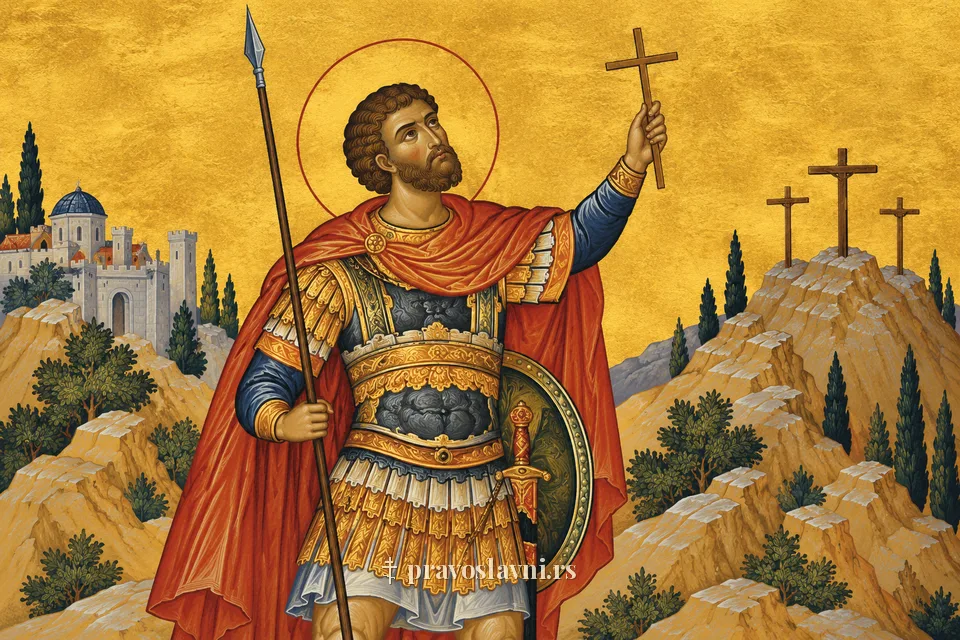
Longinus was a Roman centurion, according to his Life a native of Cappadocia. On Golgotha he commanded the guard beside the cross. When Christ breathed His last, the soldier who had seen many deaths understood that this one was not like the others. The Evangelist Matthew wrote down what the centurion and the guard said then: “Truly this was the Son of God!” We keep the name of that centurion thanks to the Prologue — it was Longinus, and two of his soldiers believed with him. His Life also mentions the tradition that it was Longinus's spear that opened the Lord's side, and that after this he was healed of a disease of the eyes.
He guarded the tomb as well, and so he lived to see the Resurrection too. He did not keep silent: he reported everything to Pilate and the chief priests. The guard spread the lie about the stolen body for money, but Longinus, as the Prologue particularly stresses, did not so much as touch that money. His Life says that from then on he bore witness to Christ even more boldly.
He knew that death was being prepared for him, and so he left the army. He became a Christian, as did his two faithful soldiers, and all three withdrew in secret to Cappadocia. The Prologue says that he lived there as an ascetic and brought many to Christ.
According to the Prologue, Pilate believed the slanders and passed sentence: Longinus must die. God revealed to the saint in advance who was coming to him. The condemned man became host to his own executioners, and they had no idea who was entertaining them. He called his two companions as well, and spent the night with God. In the morning he revealed his name to his guests. They felt sorry for their host, but Longinus, according to the Prologue, did not let them hesitate. So he, together with his companions, was beheaded.
Not even after death did he cease to help those who weep. His Life relates that he showed a blind widow where his head lay, and that she, when she found it, received her sight.
Longinus saw the truth with his own eyes and gave his life for it. He teaches us to bear witness to Christ even when it costs us our head, for the one who remains faithful to Him loses nothing.
Full Life
The closest witness
Of all those who watched the death of Christ, few stood closer than he did. Longinus was a Roman centurion in Pilate's service, a soldier who was respected and known to Caesar himself. The Life says that he was a native of Cappadocia. On that day his task seemed to him like any other: to oversee the execution with his men.
But that day was not like the others. The Life describes how all of nature responded to the death of the Crucified One. A man used to swords and blood felt the fear of God for the first time. The Evangelist Matthew records what the centurion and the guard confessed then: “Truly this was the Son of God!” The Prologue also gives us the name of that centurion — Longinus. Two of his soldiers confessed the same together with him. The Life also mentions a tradition according to which Longinus had diseased eyes. To him is attributed the spear that opened the Lord's side, and after that, the tradition says, he himself was healed.
Money could not buy the truth
After that Pilate appointed him in particular to keep guard at the tomb. So Longinus became a witness of the second miracle as well — the Resurrection. Now there was no more wavering. With his two soldiers he went to Pilate and the chief priests and told them everything that he had seen.
Such news did not suit the elders at all. So they bought the guard with money, to spread the lie about a stolen body. The Prologue especially stresses that Longinus did not so much as touch that money. The Life says that after this he spoke even more boldly about the risen Christ.
With that he signed his own sentence. He saw that his enemies were plotting against his life, and so he left the army. In this way the soldier became a disciple of the apostles: from them he received baptism, as did the two who believed with him. All three of them then went secretly to his native land. The Prologue says that there he led a strict, ascetic life. He told of what he himself had seen at the tomb, and many who had not known of Christ came to believe through him. Later he moved to the country, to his father's estate.
Host to his own executioners
When the slanders reached Pilate, he, according to the Prologue, decided on the worst: soldiers set out after Longinus with orders to kill him. The Life tells the story at greater length: a letter reached Caesar Tiberius in which Longinus was accused of rebellion, and the answer was a command that all three be put to death.
The soldiers did not know what the man they were looking for looked like. The Prologue says that Longinus, by a revelation from God, knew in advance that the executioners were coming for him. So an unusual meeting came about: the condemned man himself found his executioners and became their host. He kept his name to himself until the morning. According to the Life, he even promised them that he would help them find Longinus. When at table they confided to him why they had come, he gave nothing away. He also sent for his two companions. He did not spend the night in sleep, but in conversation with God.
He welcomed his companions cheerfully, as if they were going to a celebration. According to the Life, he comforted them by saying that now all three of them would stand before the Lord. Then he went out to his guests and, as the Life relates, said: “I am Longinus, whom you seek.”
Death without fear
The soldiers could not raise a hand against a man who had only just fed them. Shame overcame them. But Longinus was not seeking mercy — he was seeking Christ. The Prologue says that he himself encouraged them not to hesitate. According to the Life, death for him was only the way to the Lord, for whom he had long been yearning. He fell beneath the sword, and with him his two faithful companions.
A head from the rubbish heap
As proof that the order had been carried out, the saint's head was brought to Pilate. They did not even give it a grave: according to the Prologue, it was buried in rubbish.
But God did not allow His witness to remain forgotten. The Life tells of a blind widow from Cappadocia. She came to Jerusalem to pray for her sight, and there her only son, her only comfort, died. In a dream the saint showed her the way. When she found his head, her sight returned. And then he showed her something dearer still than sight: her son, beside him, in heavenly light. He told her not to grieve. She buried the saint's head next to her son.
Longinus once saw the truth and did not depart from it — neither for money, nor before the sword. Even those who came for his head he welcomed as guests. From him we learn to bear witness to the end, without fear, to what we have come to know as the truth, because at the end of the road Christ is waiting for us.