Wednesday23December 202610 December (according to the Julian calendar)
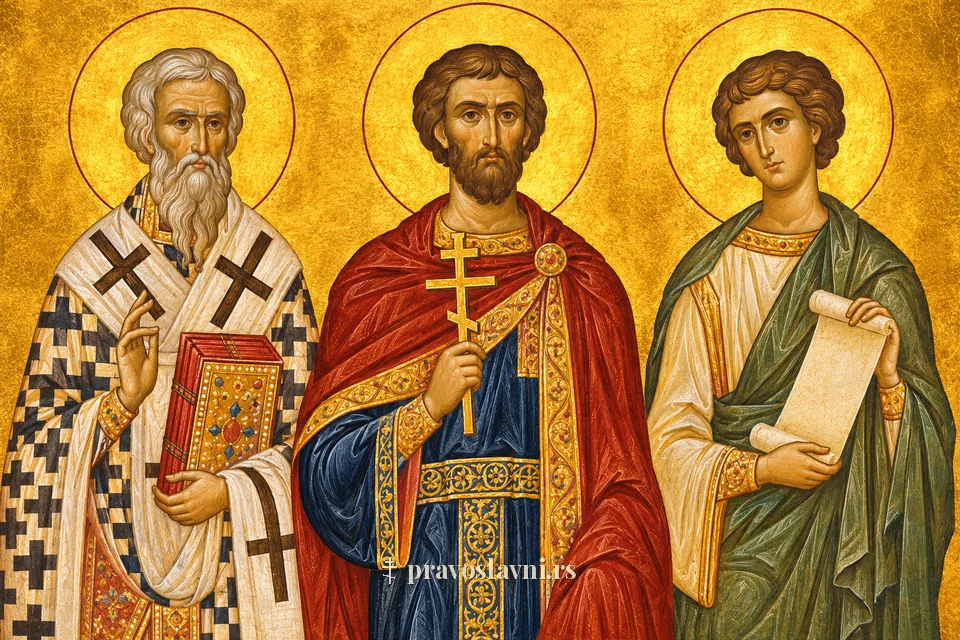
Illustration
Saint of the day
Holy Martyr Menas and those with him
What happenedAccording to the Prologue and his Life, when the Lord healed the mutilated Menas in prison, his judge Hermogenes came to believe in Christ and later suffered together with him.
“Do not be overcome by evil, but overcome evil with good.”
— Rom 12:21
Life
“I too am a Christian!” — with that cry, as the Prologue records, Eugraphus, the secretary and friend of Menas, stood before Emperor Maximinus in Alexandria, and the emperor himself killed him with a sword; Eugraphus met his death giving thanks to God. Before the same emperor there stood at that time Menas and Hermogenes, arrested after Maximinus had come to the city in person.
Menas, a learned Athenian from the imperial court, was secretly a Christian. Sent to Alexandria, which was in the grip of religious unrest, to restore order and root out Christianity, he did restore order, and then openly confessed Christ; he preached and healed in the name of Christ, and many were baptised. To judge him there came the prefect Hermogenes, a merciful pagan, to whom, according to the Life, it was made known in a dream while he was still on the way that his good deeds had been accepted by God.
Before the court Menas, according to the Life, spoke for hours of how worship belongs only to the true God, and then he was tortured until he was left blind and mute. In prison, according to the Prologue and the Life, the Lord Jesus healed him that same night, and many of the soldiers who found him well in the morning, the Life says, came to believe themselves. When he arrived before the court singing, the people cried out: “Great is the God of the Christians!” Then Hermogenes also believed: he was baptised, began to preach and later became Bishop of Alexandria.
The emperor called them sorcerers, and, according to the Life, he stripped Alexandria of its honours. With God's help both of them endured the tortures, and they were beheaded after they had prayed for the peace of the Church and for those who would call upon them. According to both sources, the relics, cast into the sea, miraculously reached Byzantium, where they were received by a bishop to whom this had been revealed beforehand. The Life records that Maximinus went blind during his flight and died soon afterwards.
The story of Menas and Hermogenes shows that the grace of God can turn a persecutor into a martyr and a bishop. Endurance leads to victory over death, and the martyrs to this day protect those who call upon them.
Full Life
Two Athenians in the Capital
Both Athenians, Menas and Hermogenes, held a high place and were held in honour in Byzantium. Menas, a learned man and a skilled orator, served at court, and he kept his faith in Christ a secret. The city was governed as prefect by Hermogenes, a pagan whose mercy and good deeds were known to all.
According to the Life, this was the time after Diocletian and Maximian had left power, when Rome fell to Maxentius, Gaul to Constantine, and the East to Maximinus — and when the Christians in the East were still being persecuted.
The Envoy Who Confessed Christ
Alexandria was then the scene of a conflict between two faiths, and Maximinus sent Menas there, with orders to establish order and to stamp out Christianity. According to the Life, Menas did indeed bring about order, but by leaving everyone freedom of faith, and he submitted a written report to the Emperor. Soon he also declared publicly that he was a Christian. The Prologue and the Life remember that in Alexandria, at his preaching and before the miracles which he worked by the name of Christ and by the cross, many pagans received baptism — the sick of every kind recovered, and those whom a demon tormented were set free as well.
Informers reported to Maximinus that his envoy had become a Christian and that the temples were empty. At the suggestion of his advisers, Hermogenes was sent to Alexandria, with an army and with the authority to judge Menas and suppress the new faith. In a dream on that journey, according to the Life, Hermogenes heard from three men bathed in light that his good deeds had been accepted by God and that a certain man would open to him the way to friendship with God.
A Night in Prison
Before the court Menas spoke for hours about how worship is owed to the true God alone — according to the Life, from nine in the morning until one in the afternoon. Then he was tortured so that he was left blind and mute, and he was thrown into prison.
Nevertheless, Menas left the prison in good health: according to the Prologue and the Life, the Lord Jesus visited him at night, restored his sight, his speech and his strength and promised that Hermogenes would share the crown with him. The Life adds that the sight in the prison that morning was seen by the soldiers too, and that two detachments came to believe. Menas went before the court singing, and the people cried out: “Great is the God of the Christians!” For Hermogenes this was the turning point: he himself, according to the Life, had a vision above Menas, and so he confessed the true God.
From Judge to Bishop
The miraculous healing made Hermogenes a Christian and a preacher. The Life says that he was baptised together with many others, in the presence of some thirty bishops; later he himself became Bishop of Alexandria, and the poor received his property.
The news of this brought Maximinus himself to Alexandria, where he seized them both. The torments they endured were severe, but, according to the Life, the grace of God sustained them, and angels delivered and healed them. The Emperor called them sorcerers, and he stripped Alexandria of its honours. Then, as the Prologue records, Menas's secretary and friend Eugraphus also spoke out: “I too am a Christian!” The Emperor himself killed him, with a sword, and Eugraphus met his death giving thanks to God. Menas and Hermogenes were beheaded, and the last thing they asked of God was peace for the Church and help for those who would call upon them.
A Coffin on the Sea
Byzantium, according to both sources, received their relics in a miraculous way, although they had been thrown into the sea; Menas, according to the Life, had in fact wished to be buried there, and the Life adds that the relics were in an iron coffin, thrown in so that the Christians would not venerate them. They were met by the bishop, who had been told beforehand in a dream, and he buried them with honour. The Life also records the end of Maximinus: on his way to Byzantium he lost his sight and within a few days he died.
The story of Menas, Hermogenes and Eugraphus shows that the grace of God can turn even a persecutor into a martyr and a bishop. Endurance leads to victory over death, God does not abandon His martyrs, and they protect all who call upon them.
Other saints of the day
St Jovan, Despot of Serbia
St Jovan, Despot of Serbia, was the second son of Despot Stefan the Blind and Angelina, born while the family was living in Albania. His mother brought him up, together with his brother Maksim, in a Christian spirit, and he grew up in Friuli, in Italy. Not even life in Italy and Hungary, among people of another faith, separated him from Orthodoxy, according to his Life. In the year 1486 Angelina and her sons translated the relics of Stefan the Blind to Buda, and the Hungarian King Matthias gave them Kupinovo and Slankamen in Srem. When his elder brother Đorđe became a monk with the name Maksim, the title of despot passed to Jovan. Because of the Turkish attacks he moved his seat from Kupinik on the Sava to Berkasovo, fought against the Turks and withstood the pressure to bring the Orthodox Serbs into union with Rome. The Serbian lands in the south remained under the Turks, for he did not have enough strength to liberate them; and so in prayer he asked God that his people might keep their faith as well. The endowments (zadužbine) and gifts made by him, his mother and his brother reached as far as Hilandar, Esphigmenou, St Paul's and Krupa in Dalmatia, as well as numerous monasteries in Banat, Bačka and Srem. He passed away in Berkasovo in the year 1502; according to his Life, when after three years they found his body incorrupt, the people began to celebrate him as a saint. Krušedol, to which the relics were later translated and where miracles took place, was set on fire by the Turks in the year 1716, and so only portions of Jovan's relics were left, which are kept in that monastery to this day.