“For as the sufferings of Christ abound in us, so our consolation also abounds through Christ.”
— 2 Cor 1:5
Life
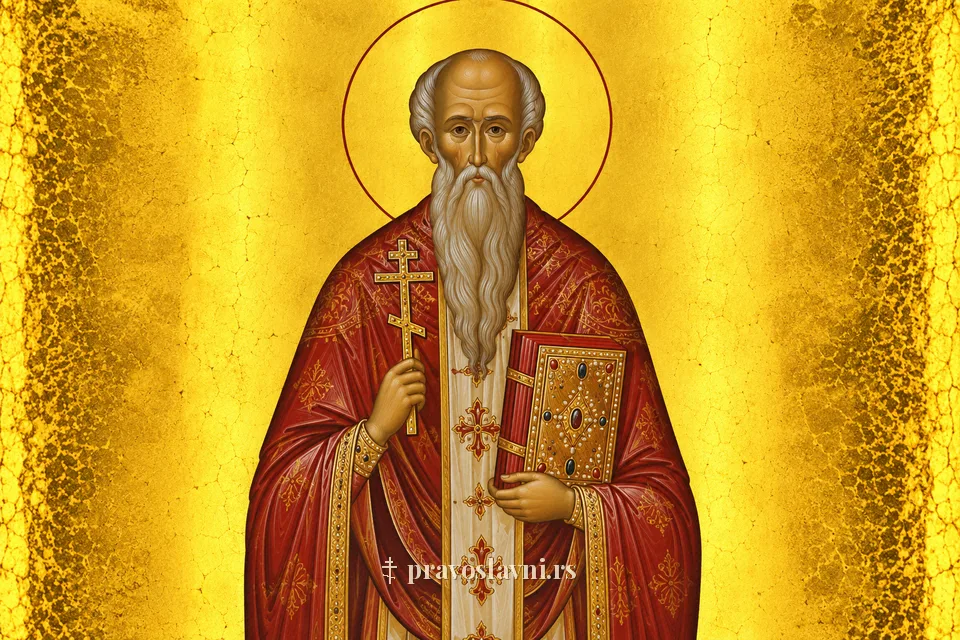
St Myron was a presbyter in a city in Achaia, from a rich and respected family, gentle and meek, full of love for God and for people.
In the time of Emperor Decius, on the feast of the Nativity of Christ, pagans burst into the church during the service to seize the Christians. According to the Life, they were led by the governor Antipater, and Myron zealously rebuked him. They seized him and tortured him with fire, but an angel appeared to him and strengthened him. According to the Life, even the wild beasts to which he was thrown did him no harm.
In the end Antipater, according to the Prologue, killed himself with a sword. Myron was taken to Cyzicus and there his head was cut off; according to the Prologue, this was in the year 250.
The meek presbyter overcame the persecutor, and faithful endurance brought him the crown of martyrdom.
Full Life
The meek presbyter
Myron was a presbyter in a city in Achaia, from a rich and respected family. He was gentle and meek, full of love for God and for people.
The attack on the church on the Nativity of Christ
In the time of Emperor Decius, on the feast of the Nativity of Christ, pagans burst into the church during the service to seize the Christians. According to the Life, they were led by the governor Antipater, and Myron rebuked him with divine zeal.
They seized Myron and tortured him, with fire among other things. An angel appeared to him and strengthened him in the fire. The Life says that he was thrown into a furnace and that angels were seen in it turning the fire into coolness, while he stood unharmed and blessed God. According to the Life, the flame killed one hundred and fifty of the governor's servants who were standing near the furnace.
The persecutor overcome by meekness
According to the Life, even after that Myron refused to bow down to the idols. The torture was continued. The Life also says that they threw him to the wild beasts, but they did him no harm.
Antipater, beside himself — according to the Life, with shame and rage — killed himself, according to the Prologue with a sword.
The beheading in Cyzicus
Then they took Myron to the city of Cyzicus and there cut off his head. According to the Prologue, he suffered in the year 250, in the time of the persecution of Decius.
Faithful endurance brought St Myron the crown of martyrdom and joy in the Lord. The meek presbyter overcame the persecutor, and the persecutor, overcome, destroyed himself.
Other saints of the day
Holy Martyr Patroclus
When the Emperor Aurelian, persecuting the Christians, came to Gaul, Patroclus from Tricassinum, the present-day Troyes, was brought before him, and he openly confessed Christ. According to the Prologue, he offered the emperor a part of his property, and when the emperor told him that he himself was rich too, Patroclus replied that it was precisely the emperor who was poor: “you have only earthly, passing treasures, but you are poor”. The property of which he spoke he had inherited from his parents, together with a house, according to his Life in the outskirts of the town, and from it he gave alms every day; his Life mentions widows, orphans and poor Christians. He ate once a day, in the evening after prayer, and according to his Life he read Holy Scripture unceasingly. He had from God the gift of healing, according to his Life also authority over unclean spirits, and he was known as a wonderworker. According to his Life, when they threatened him with fire if he did not offer sacrifice, he said that he himself was the sacrifice that he was offering to God, and so he was put in chains and imprisoned. They condemned him to death in a marsh beside the river, so that his body would not be buried. The martyr asked God that his body should not remain in the mud, and the soldiers lost sight of him, while he found himself on the other bank; according to his Life, he waded across the swollen Sequana (Seine), and the water came up to his knees. The soldiers found him all the same, according to his Life with the help of a woman in a boat, and beheaded him on dry ground. The burial was carried out by people to whom he had done good during his life, two poor men who recognised him; according to his Life, the protopresbyter Eusebius was with them, and the burial was carried out secretly, by night, for fear of the pagans.