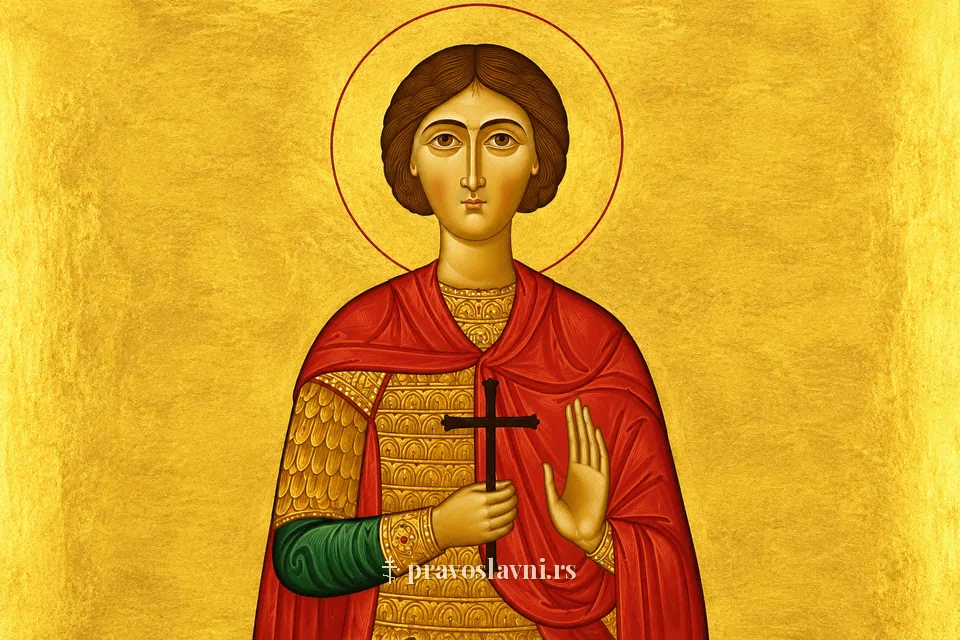
“You therefore must endure hardship as a good soldier of Jesus Christ.”
— 2 Tim 2:3
Life
The story of St Polyeuctus is, above all, a story about friendship. He and Nearchus were officers in Melitene, in Armenia, and the closest of companions, but only Nearchus was baptised. Polyeuctus, although unbaptised, was, according to his Life, already living as a Christian.
The turning point came with the imperial persecution. Nearchus was afraid that he would lose his friend for eternity, and Polyeuctus promised him that he would accept the faith. He also confided to Nearchus a dream of two gifts, a bright garment and a winged horse, which Christ had given him; his Life says that Nearchus saw in this the conversion of Polyeuctus and his swift departure to heaven.
From then on Polyeuctus did not hide his faith. Before everyone he destroyed the edict against the Christians and smashed the idols that were intended for the temple. To the pleas of his father-in-law and the tears of his wife he replied with a call that they too should come to the true God, and the judges achieved nothing either by fair words or by intimidation. The punishment was death by the sword.
Not even at the very end did he forget his friend. The Prologue records that, catching sight of him, he called out to him: “Save yourself, my dear friend!” He was beheaded around the year 259, and Nearchus later suffered for Christ himself.
Thus Polyeuctus became the first martyr of Melitene, a city in which many Christians suffered for Christ. His life teaches that eternal life is worth more than any earthly honour, and his friendship with Nearchus that true love reaches into eternity.
Full Life
The First Martyr of Melitene
The Armenian city of Melitene gave the Church many martyrs, and the first among them was St Polyeuctus. He suffered in the days when Decius and Valerian were reigning, around the year 259; the Prologue places his death in the reign of Valerian. His story cannot be told without his friend Nearchus.
Two Officers
Both of them were army officers and the closest of companions. Nearchus was baptised; Polyeuctus was not, but, as the Life bears witness, even without baptism he lived honourably and according to Christian customs. When, according to the Life, it was commanded by imperial decree, under threat of torture and death, that all should bow down to the gods, Nearchus was tormented by the thought that he would lose his friend for eternity. Polyeuctus comforted him with the promise that he would come to Christ.
Then he also confided to him what he had dreamed. The Prologue and the Life remember that dream by two gifts of Christ, a bright garment and a winged horse, and Nearchus, according to the Life, concluded from them that his friend was on the threshold of faith and that he would soon be in heaven. Then Polyeuctus revealed that in his desires and intentions he had long since been a Christian.
A Confession before Everyone
From that moment on he did not hide his choice. He publicly destroyed the Emperor's decree against the Christians, and the idols that were being carried into the temple did not remain whole either: he smashed them — the Life counts twelve of them, the Prologue says only that there were many.
The first to try were those who were closest to him. His father-in-law Felix, who was charged with the persecution of Christians, begged him, according to the Life, to give it up, and from his son-in-law he heard a call to abandon his own gods himself. Nor did Paulina's tears shake him: he called on his wife to bow down, she too, to the one true God. The Life says that many of the pagans who were watching this came to believe.
At the trial it was the same: neither flattery nor threats moved him. The Prologue also mentions torture, and the sentence was death by the sword. The Life records that near the end he spoke of a radiant young man whom only he could see, and that he cried out: “Glory be to Christ, the true God!”
A Covenant That Endures
Even in his last moments he did not forget Nearchus, whom he saw among those gathered there: he called on him to keep their friendship and to think of his own salvation; in the Prologue that greeting reads: “Save yourself, my dear friend!” Nearchus, according to the Prologue, later became a martyr himself as well and suffered in the fire.
St Polyeuctus chose eternal life in Christ instead of honours and family. His friendship with Nearchus bears witness to a love that reaches into eternity, and his death strengthened the Church on earth.
Other saints of the day
St Philip, Metropolitan of Moscow
St Philip of Moscow is remembered as a hierarch who did not keep silent about injustice even before the tsar. He was born on 11 February 1507, as Theodore, in the noble house of the Kolychevs, and as a young man he served at the court of the grand prince. Decisive for him were the words of the Gospel “No one can serve two masters”, which he heard in church: because of them he left both the court and the world. His Life records that on the way he tended cattle at Khizhi, beside Lake Onega, and that on Solovki he received the tonsure and the name Philip only after he had worked long and hard as a novice. As abbot of that monastery, according to his Life, he built two stone churches, a hospital and a bell tower, and in addition mills and canals; word of him spread throughout the whole of Russia. Tsar Ivan Vasilyevich, in the Prologue Ivan the Terrible, summoned him to Moscow to the metropolitan throne, but the metropolitan would not let himself be frightened: he asked that the oprichnina be abolished, and then he openly condemned the tsar's atrocities. The tsar answered him with false witnesses: Philip was deposed and sent as a prisoner to Tver, where the tsar's man Skuratov smothered him on 23 December 1569. Solovki later received him again, this time as incorrupt and fragrant relics, and in the time of Tsar Alexei Mikhailovich they were translated to Moscow. His example teaches that conscience and faithfulness to God are more important than the favour of any man of power.