“For you had compassion on me in my chains, and joyfully accepted the plundering of your goods, knowing that you have a better and an enduring possession for yourselves in heaven.”
— Heb 10:34
About this day
Among the people, Istočni petak (Bright Friday) is the name for the feast of the Theotokos which the calendar also records as the Feast of the Life-giving Spring. The name comes from the church of the Life-giving Spring, which Emperor Leo the Great built in the fifth century over a spring close to Constantinople, and it was precisely in that church that the feast was first celebrated.
According to Liturgics, on that day the service of the Life-giving Spring of the Most Holy Theotokos is added to the Paschal services, in memory of the renewal and consecration of that church. This service came into being in the fourteenth century and is a local one, not part of the Typikon.
The feast falls in Bright Week, which Liturgics describes as one unbroken feast. Every day the Liturgy is served with Paschal chanting, the Royal Doors and the side doors remain open all week, and the bells ring all day long.
Life
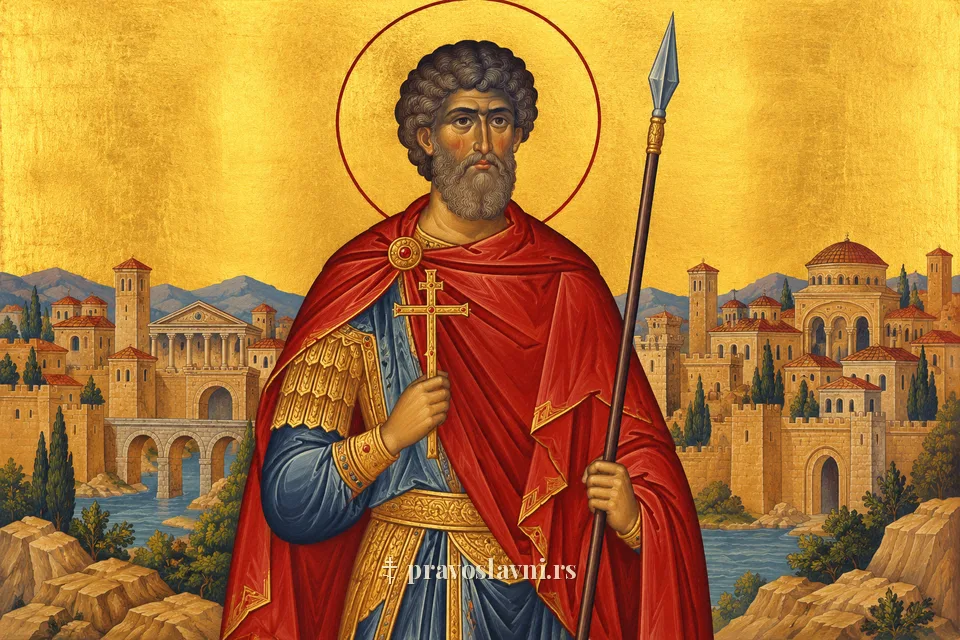
The Holy Martyr Sabbas Stratelates served, above all, people who were in trouble. As a Roman general of Gothic descent, in the time of the Emperor Aurelian, he spent his money on the Christians held in the prisons and, according to his Life, encouraged them to persevere. He lived purely and in fasting, and so God made him a healer of those who were tormented by evil spirits. Even his suffering became a form of service: seventy soldiers came to believe in Christ because of him, and by the Emperor's command all of them were beheaded.
When he was denounced as a Christian, he took off the badge of his rank before the Emperor and in this way broke with the army, but he did not deny Christ. According to his Life, neither the fine words nor the threats of the authorities could move him. In the end he gave up life itself: in the year 272 he was put to death by drowning in a river.
Through all of this God's help went with him. The tortures, which the Prologue and his Life each describe in their own way, did him no harm. In prison Christ Himself visited him and gave him strength, and according to his Life told him not to be afraid.
His example teaches that faithfulness to the Lord is worth more than any rank, and that a steadfast man opens the way to faith for others as well.
Full Life
The commander who visited the prisons
Sabbas was of Gothic descent and lived in Rome in the time of the Emperor Aurelian. He bore the rank of stratelates, which means that he commanded an army. He spent his wealth on Christian prisoners, whom he also visited in person. His Life says that in doing so he encouraged them to endure to the end.
The Prologue and his Life also say that he was a man of strict and pure life, to whom God granted to free people from unclean spirits.
The belt thrown down before the Emperor
Before Aurelian, to whom he had been reported as a Christian, Sabbas confessed Christ, and his military belt, the sign of his rank, he took off and left behind. He preferred to renounce his rank rather than his faith.
His Life says that the authorities did not manage to bring him back to the idols by any means — neither by flattery, nor by threats, nor by tortures. About the tortures the sources speak differently: the Prologue records scourging, scraping with iron and burning with candles, while his Life records hanging, beating, candles and a cauldron of boiling pitch. On one thing, however, they agree: God guarded him, and so the tortures did him no harm.
The seventy who believed
This miracle did not remain without an echo. Seventy soldiers — his comrades-in-arms, according to the Prologue — understood that God was with Sabbas and believed in Christ; according to his Life, they declared their faith aloud. By the Emperor's order they were all beheaded. Thus the steadfastness of one man became for others a path to faith.
Sabbas was thrown into prison. There too he was not left alone: according to both sources, Christ appeared to him, in light, and strengthened him. His Life adds that this was at midnight, during prayer, and that the Lord encouraged him to remain without fear.
Faithfulness to the end
The final sentence was: death by water. He was drowned in the river in the year 272 and so departed to the Lord whom he had faithfully served.
St Sabbas Stratelates remains an example of a faithfulness that does not give way before rank, or before threats, or before torture. He was ready to bear everything for Christ, and his steadfastness and God's protection brought others to the faith as well. His life reminds us that faithfulness to the Lord is worth more than any rank.
Other saints of the day
St Sava of Erdelj (Transylvania)
St Sava Branković, Metropolitan of Erdelj, suffered a great deal because he defended Orthodoxy against the Calvinists. Because of this, as his Life records, he lost his see and ended up in prison, from which he came out only when Șerban, Prince of Wallachia, intervened vigorously on his behalf. He reposed in the year 1683 from the sufferings he had endured. He carried out his ministry as metropolitan from 1656 to 1680, and his seat was in Alba Iulia. Before that he was an archpriest in Jenopolje. The Brankovićs, his family, were originally from Herzegovina, and in the fifteenth and sixteenth centuries they moved to the Pomorišje region. Metropolitan Longin Branković was his paternal uncle, and Count Đorđe Branković — a historian, the Serbian “despot” and the prisoner of Cheb — was his brother. He paid for his faithfulness to Orthodoxy with his position, his freedom and his health.
Branko Dobrosavljević, today a holy hieromartyr, came from Skadar, a village near Vojnić, where he was born in the year 1886. His Life records that in 1908 he completed eight years of grammar school with the leaving examination and the seminary in Sremski Karlovci, and in 1909 he was ordained first deacon and then priest. He served in the parishes of Buvača, Radovica and Veljun and was decorated with the Order of St Sava and the Order of the Yugoslav Crown, fifth class. In the year 1941, on the day of his Krsna slava (family patron saint's day), Đurđevdan (St George's Day), he was arrested by the Ustaše, and the arrest, according to the Life, was led by Ivan Šajfor from Veljun. On that day the Ustaše arrested more than five hundred Serbs; among them were Branko's son Nebojša and Dimitrije Skorupan, the parish priest from Cvijanović Brdo. From the gendarmerie station in Veljun, where they had been held, they were taken the next day to the Kestenovac forest near Hrvatski Blagaj and killed there. According to the Life, they forced the priest to read the funeral service over his son while he was still alive. In the year 1946 his remains, together with those of the other murdered Serbs, were transferred to a common tomb in Veljun. The Holy Assembly of Bishops of the Serbian Orthodox Church proclaimed him a hieromartyr and entered him in the calendar of saints. In this way the Church keeps the memory of a shepherd who suffered together with his people and his son.