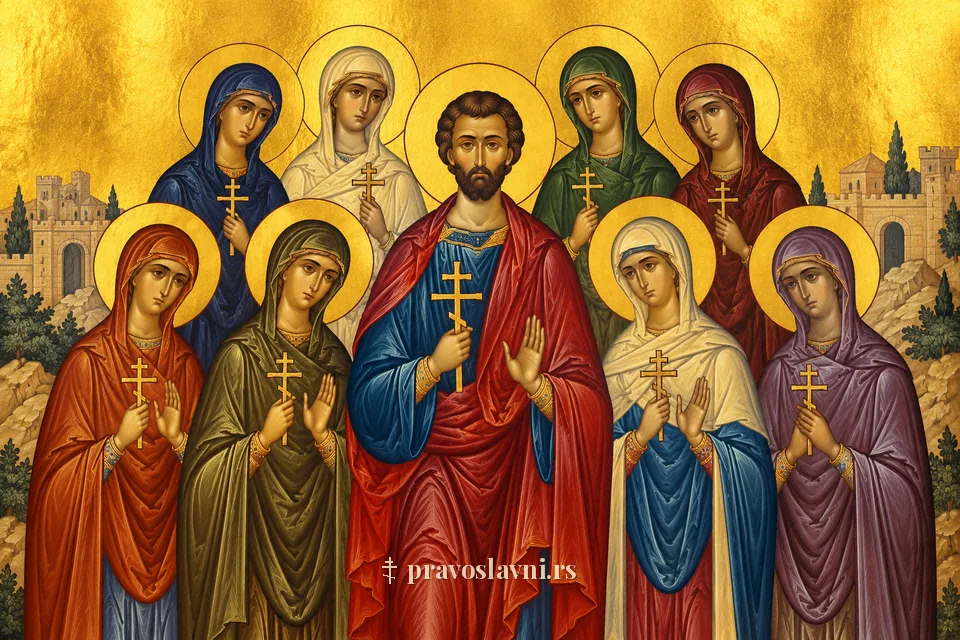
St Theodotus was a layman, an innkeeper from Ancyra, in the time of Emperor Diocletian. He had a wife; according to both sources, he lived by the Apostle's word about those who are married, and his Life also mentions his self-restraint. His inn, according to the Prologue, served him as an opportunity to help Christians. While the persecution lasted, his home was a support for the persecuted, and his Life compares it to Noah's ark. He helped those who had fled to the mountains and took care that those who were killed should have a grave. According to his Life, he encouraged his friend Victor, who gave way under torture in prison, and in the village of Malos he laid in a tomb the relics of the martyr Valens.
His best-known deed is connected with seven virgins — Tecusa, Alexandra, Claudia, Phaine, Euphrasia, Matrona and Julia — who, after trial, tortures and mockery, were thrown into a lake. Tecusa, according to his Life, was his aunt. The Prologue and his Life say that she appeared to him in a dream with the request that their bodies should not be left in the water, and that he, with the help of angels, found them by night and buried them.
He was betrayed to the judge: according to the Prologue he was betrayed by a travelling companion, and according to his Life by his kinsman Polychronius, who could not endure the torture. His Life says that he did not hide, but after praying went out before the court of his own accord and refused the honours and riches that were offered. According to the Prologue and his Life, even in his torments he remained with the Lord in his thoughts. To the Christians who were in tears he sent word that instead of weeping they should glorify Christ, Who had given him strength to the end. He was beheaded in the year 303. According to his Life, a storm and a light preserved his body from being burnt. A certain priest, according to his Life named Fronto, buried him outside the city, and later a church dedicated to Theodotus was built over his grave.
His martyrdom was written down by Nilus, who was with him in prison and watched his torments.
Theodotus was neither a monk nor a priest, but an innkeeper, and yet he became a martyr: holiness can be lived in every calling, when a person remains with Christ in his heart.
Full Life
A layman among the martyrs
St Theodotus was neither a priest nor a monk. He lived in Ancyra in the time of the Emperor Diocletian and was married, but, as the Prologue and his Life say, he followed the Apostle's teaching that those who have wives should live as though they had none; his Life adds that he was temperate, that he fasted and gave away his property to the poor. He kept an inn, and the Prologue explains why: in that way he could help Christians without being noticed.
When the persecution came, his house became a place where the persecuted found help. To those who had taken refuge in the mountains he secretly sent help, and he also saw to it that those who had been killed did not remain without a grave. His Life compares that house to Noah's ark, in which people prayed and the Eucharist was celebrated.
His Life says that Diocletian sent the governor Theotecnus to the city, who tore down churches, imprisoned the faithful and ordered that food be sprinkled with the blood of sacrifices to idols. At that time, according to his Life, Theodotus encouraged his friend Victor, who had been accused of blaspheming against Artemis and who gave way under the tortures in prison. In the village of Malos, as his Life records, he buried the relics of the martyr Valens, sat down to a meal with the Christians he had ransomed, gave his ring to the priest Fronto and told him that one day his own relics too would be brought there.
Seven virgins from the lake
Among the martyrs of that time there were also seven virgins: Tecusa, Alexandra, Claudia, Phaine, Euphrasia, Matrona and Julia. The Prologue and the Life say that they went through trial, tortures and mockery, and were then drowned in a lake. The eldest, Tecusa, was, according to the Life, Theodotus's aunt. The Life relates that the governor wanted to have them dishonoured by young men, but the young men drew back when Tecusa reminded them of their own mothers; the virgins did not agree to serve Artemis as priestesses, but threw her white robes and wreaths under their feet, and so they were drowned with stones around their necks. The news of their death, according to the Life, made Theodotus weep, but he gave thanks to God for them.
The Prologue and the Life say that Tecusa came to him in a dream, asking that the virgins should not remain in the water but that he should bury them; according to the Life, she also warned him of a traitor. Under cover of night, with the help of angels, he went to the lake with a companion — the Life mentions several companions, among them the young Glycerius — and, as the Prologue and the Life say, not one body remained unfound; he buried them all, according to the Life, by the Church of the Holy Patriarchs.
Betrayal and confession
Theodotus was then betrayed to the judge. The Prologue says that his companion betrayed him, while the Life says that his captured kinsman Polychronius spoke under torture, after which the pagans burned the bodies of the virgins. The Life records that Theodotus did not hide: after a night spent in prayer he took leave of the brethren and went before the court of his own accord. The honours and riches that were offered to him if he would renounce his faith he refused, according to the Life, and he defended the faith at length.
The Prologue and the Life say that his mind was with the Lord, and in his heavy tortures he was not parted from Him. The Life preserves his prayer: “Lord Jesus Christ, hope of the despairing, grant that I may complete the martyr's struggle well.”
Last words and the grave
Condemned to be beheaded, he saw the Christians in tears and said to them: “Do not weep for me, brethren, but glorify our Lord Jesus Christ, Who helped me to finish my struggle and to defeat the enemy.” He was beheaded in the year 303. According to the Life, a storm and a light around his body did not allow the soldiers to burn it.
The Prologue and the Life agree that a priest buried the body outside the city and that a church in his honour was later built over that grave. The Life says that it was Fronto, who put the soldiers to sleep with wine, placed his own ring on the martyr's finger and loaded the body onto a donkey; the animal stopped at the very place where the two of them had once shared a meal. The Life was written by Nilus, Theodotus's companion in life and in prison, who watched his suffering with his own eyes.
Theodotus, as an ordinary layman, made his inn into a refuge for the persecuted and paid with his life for the honourable burial of the women martyrs. He bears witness that holiness is possible in every calling.