Save your slava — you'll get a reminder a week and a day before.
Monday22November 20279 November (according to the Julian calendar)
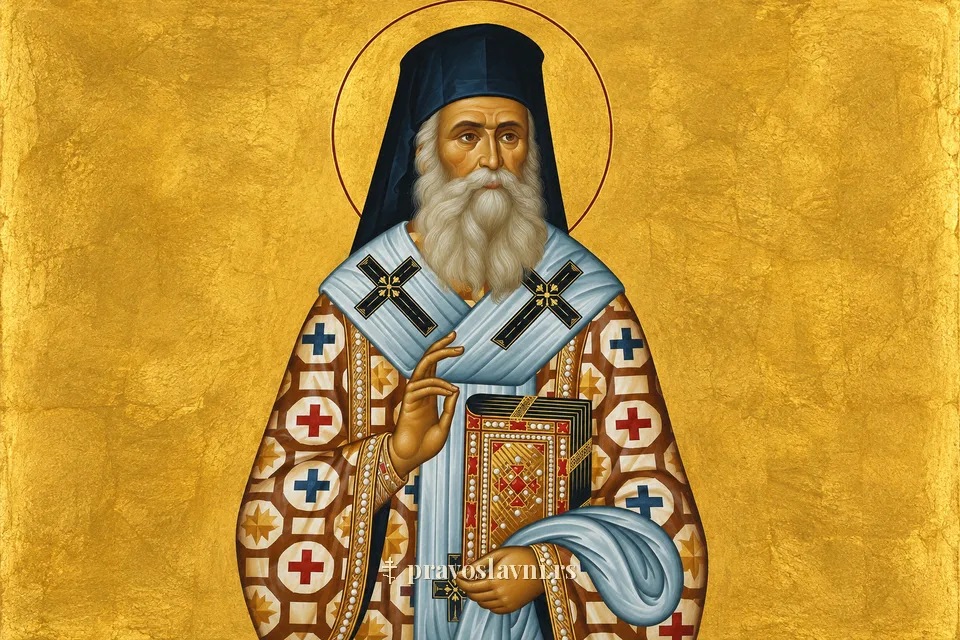
Illustration
Saint of the day
St Nectarius of Aegina
What happenedWhile the caretaker Lucian lay in hospital for months, Bishop Nectarius secretly cleaned the corridors and lavatories of the seminary at dawn.
“Blessed are those who are persecuted for righteousness’ sake, For theirs is the kingdom of heaven.”
— Mt 5:10
Life
St Nectarius of Aegina lived very close to our own time, and his Life remembers him above all as a humble man who was more than once gravely slandered.
He was born in 1846 at Selymbria in Thrace, into a poor and devout family, and was baptised as Anastasius. As a boy he worked in Constantinople and read the holy fathers, as a young man he was a schoolteacher on Chios, and at the New Monastery he received the monastic tonsure. He was educated in Athens, became a priest in Alexandria, and then Bishop of Pentapolis.
Then his greatest trial began. Envious men accused him of wanting the patriarchal throne and of living immorally, and Patriarch Sophronius, according to his Life, removed him from Alexandria without a hearing. He came to Athens with nothing, because he used to give his money to the poor and spend it on edifying books. The slanders did not stop later either: around 1918, on account of a false accusation in connection with a certain nun, he was roughly questioned by an examining magistrate, until a doctor proved the girl's innocence. Nectarius forgave him.
What set him apart was best seen at the Rizarios Seminary, where he was the rector and where he guided the pupils by love, and not by force. Two pupils who had quarrelled, and who would not even hear of peace, received an unusual answer from him: for three days he himself fasted for them. According to his Life, while the poor caretaker Lucian lay in hospital for months, his work was done at dawn by the bishop himself, and afterwards he forbade Lucian to speak of it for as long as he was alive.
In the year 1904 he founded the women's monastery of the Holy Trinity on Aegina, and from 1908 he lived there in prayer, work and writing. His Life records that by prayer he obtained rain in a drought and healed the sick. He died in 1920, at the age of seventy-four, in a hospital in Athens; on the same day, according to his Life, a paralysed patient in the next bed recovered. His body remained incorrupt for more than twenty years, and in 1961 he was numbered among the saints. His Life also lists many miracles after his death.
His commemoration is on 9 November by the old calendar, that is, 22 November by the new one. Nectarius teaches us to bear injustice humbly: God raises up the one whom men bring low.
Full Life
From the shop counter to the rank of bishop
St Nectarius of Aegina lived very close to our own time — he died in 1920 Everything we tell here comes from his Life; the Ohrid Prologue only mentions him.
He was baptised as Anastasius, and was born on 1 October 1846 in Selybria in Thrace, in the poor and devout home of Dimos and Vasiliki. His Life says that even as a child he used to make books and vestments out of paper. His path led him from a relative's shop in Constantinople, where as a fourteen-year-old he read the holy Fathers and copied out their thoughts, by way of a classroom in the village of Lithi on Chios, to the New Monastery (Nea Moni), where in 1876 he received the monastic tonsure with the name Lazarus, and somewhat later, as a deacon, the name Nectarius as well. With the help of benefactors he completed his theological studies in Athens, he became a priest in Alexandria, and after about three years he was elected Bishop of Pentapolis.
A rector who cleans the corridors
What kind of man he was is best shown by a secret which his Life reveals. The poor caretaker Lucian lay in hospital for months, and his work, the lavatories not excepted, was done at daybreak by the rector of the Rizarios Ecclesiastical School himself, who was also a bishop. Afterwards he forbade Lucian to speak of it as long as he himself was alive.
That is how he ran the school too: by love, not by force. The most unusual means of education which his Life remembers was the rector's own fasting: for three days he fasted on account of two pupils who had come to blows and would not be reconciled. He taught pastoral theology, preached in the churches of Athens and Piraeus, and heard the confessions not only of pupils and lay people but of many priests as well. With him money went to the poor and to the printing of edifying books, and so, according to his Life, he arrived in Athens with empty pockets.
Slander as a cross
He suffered most from human envy, which struck him in Alexandria in two ways: by the tale of his supposed desire for the patriarchal throne, and by an accusation of immorality. Patriarch Sophronius took these rumours for the truth and removed him without a trial, and then ordered him to leave the city; the faithful expressed in a letter their sorrow at his departure. In Athens he was without a post for a year, and then as a travelling preacher he went round Euboea, Phthiotis and Phocis. In the year 1902 he wrote humbly to Patriarch Photius and asked to be rehabilitated — no answer came.
Slanders followed him to the end. The Archbishops of Athens, having listened to accusations, sent investigators, and around 1918 a false accusation concerning a young nun brought him before the examining magistrate of Piraeus, who questioned him roughly, until a medical examination proved the girl's innocence. His Life says that the magistrate later fell ill and died five days after the saint had forgiven him in prayer.
An island of prayer
At the request of women who desired the monastic life, among them some of his former pupils, he founded in 1904 the women's monastery of the Holy Trinity on Aegina. The first abbess was the blind Xenia, a woman of great spiritual sight. From 1908, when he gave up the office of rector, he lived there for some thirteen years: he worked in the garden, helped with the rebuilding, and wrote books and hymns to the Holy Trinity and to the Theotokos.
His Life also tells of miracles from those years. Twice by his prayer he obtained rain in a drought, and he healed a woman of severe headaches, a girl of a long-lasting fever and a possessed young woman who was betrothed. In the years of the First World War the sisters began to lay in stores of grain, and he rebuked them for it: such hoarding, he said, would call down famine. The stores then multiplied, so that there was food for guests as well.
What remained after him
For a year he bore his illness in silence. Returning from his last veneration of the icon of the Theotokos at Chrysoleontissa, his Life says, he blessed Aegina and said that he was doing so for the last time. He died in the Aretaieion hospital in Athens on the eve of 9 November 1920 by the old calendar, at the age of seventy-four. A miracle, according to his Life, came on the very day of his death, through an ordinary garment: when his jumper was laid on the bed of a paralysed man in the next bed, the man recovered. His body remained whole and fragrant for more than twenty years, and in 1961 the Patriarchate of Constantinople numbered him among the saints.
He left behind him books — on the Church, the Holy Mysteries, the immortality of the soul, Christian morality, and a two-volume study of the causes of the schism — and disciples, among whom are Amphilochius Makris of Patmos and Philotheos Zervakos of Paros. His Life also lists many healings after his death, among them that of a Serbian priest who, while serving in Germany, was cured of cancer after he had venerated the relics.
His commemoration is on 9 November by the old calendar, that is, 22 November by the new. St Nectarius teaches us that slander is not answered with revenge, but with prayer and forgiveness. God vindicated the one whom men had rejected, and to this day he helps those who turn to him.
Other saints of the day
Holy Martyrs Onesiphorus and Porphyrius
Sts Onesiphorus and Porphyrius suffered for Christ in the time of Emperor Diocletian. Before the judge, as their Life records, they confessed “that Christ is the true God and the Creator of heaven and earth”. Because of that confession they were subjected to severe tortures. Their Life says that the martyrs, to the fury of their torturers, gave thanks to God and said that His help made the pain light for them. Death was brought to them, according to both sources, by being dragged behind wild horses, and they gave up their souls to God. The faithful secretly gave them a burial worthy of martyrs. According to their Life, their grave became a place of many miracles and healings. Their example teaches that God helps those who suffer for Him, so that their torments become light.
Venerable Matrona was born in Perge in Pamphylia, married the distinguished Dometian and gave birth to a daughter, Theodota. After they had moved to Constantinople, the example of the virgin Eugenia drew her so strongly to the church that her husband, doubting her faithfulness, began to forbid her to go to church. Under the man's name Babylas and as a eunuch she was received into the monastery of the abbot Bassian, after she had, on the advice of the virgin Susanna, left her daughter with her. Her Life says that it was revealed three times to the abbots Bassian and Acacius that Babylas was a woman, and when she admitted it, Bassian said to her: “Do not be afraid, daughter; your faith has saved you.” So that her husband would not find her, the brotherhood sent her to a convent in Emesa, of which she later became the abbess; when Dometian arrived there too, she went away to Sinai, and then to Beirut. There she settled in a tumbledown pagan temple and withstood the attacks of the demons; according to her Life, she converted Sophronia and the priestess Euchea, and in time eight sisters were living there. A dream and the casting of lots brought her back to Constantinople; Bassian gave her a house near his monastery, where the sisters from Beirut joined her. She reposed, according to the Prologue, in the year 492, a hundred years old, of which she had spent seventy-five in the monastic life. Her life bears witness that God directs the steps of those who put their trust in Him.
Venerable Theoctiste was born in Methymna on Lesbos; she was left an orphan early in life, and her relatives gave her to a convent, where she became a nun. Arab pirates led by Nisiris took her captive at midnight, on Pascha itself, while with the blessing of the abbess she was visiting her sister; she was eighteen years old at the time, and her captors took her off to Paros in order to sell her. She escaped from them into the deserted interior of the island, guarding her purity at the risk of her life. For thirty-six years, as her Life reckons it (the Prologue says thirty-five), her home was the ruins of a church of the Theotokos in the heart of the island; she ate whatever seeds she could find, and drew her strength from the psalms and the Scriptures which she knew by heart. Her Life says that she was found there by a hunter from Euboea, an unlettered but devout man, and that she, being naked, asked him to bring her the Holy Gifts the next time he came. When he brought them, she received Holy Communion with tears and said: “Now I depart to where Your goodness commands.” A few days later the hunter found her dead and buried her. Her Life adds that when they came back later, the body was no longer in the place where she had been buried. Her hidden life teaches us how greatly prayer and a thirst for Holy Communion can strengthen a person.