“Therefore, brethren, stand fast and hold the traditions which you were taught, whether by word or our epistle.”
— 2 Thess 2:15
Life
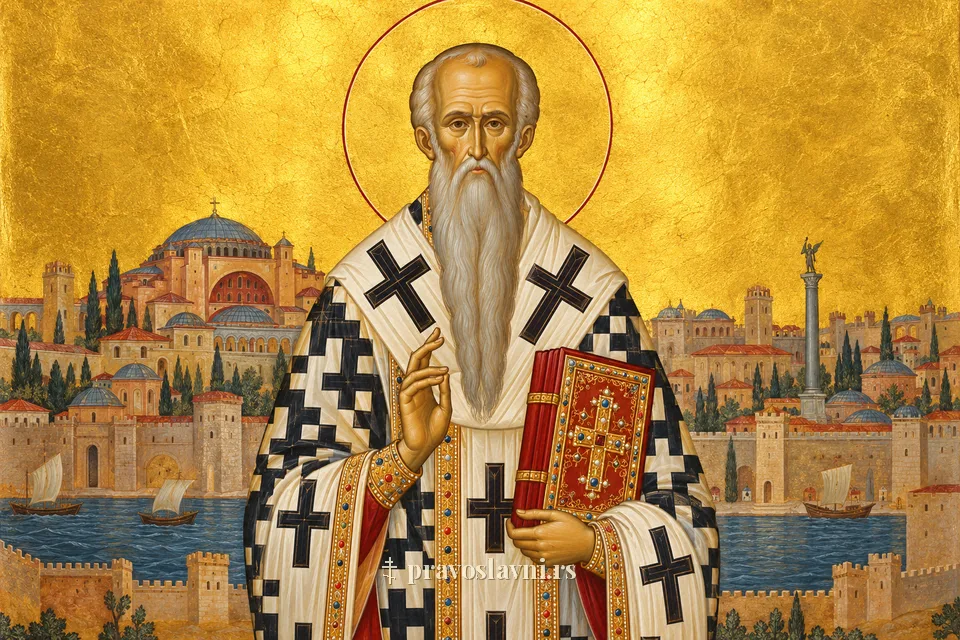
When Emperor Leo the Armenian demanded that the holy icons be rejected, Patriarch Nicephorus, according to his Life, answered him: “We bow down not to the board and not to the paints”. He defended the veneration of icons with examples from the Old Testament: the bronze serpent, the ark of the covenant and Solomon's temple.
Nicephorus was a native of Constantinople from a distinguished family. His father, according to his Life, was tortured in the time of Emperor Copronymus for venerating the icons and died in chains in exile in Nicaea, and his mother shared the exile with him. Nicephorus himself served at the imperial court. Educated in the secular sciences and in the Scriptures, as a layman he assisted the fathers of the Seventh Ecumenical Council, which according to his Life was held in Nicaea in the year 787. Then he left the court, built a monastery on the Bosphorus and guided monks, without himself even having been tonsured. After the death of Patriarch Tarasius he was chosen patriarch against his will; he was tonsured a monk, passed through all the holy orders and, according to the Prologue, was enthroned in Hagia Sophia in the year 806.
Leo the Armenian put off signing the confession of the Orthodox faith right up until his coronation, and then he refused and began to persecute those who venerated the icons. According to the Life, books defending the icons were burned in the emperor's name, and bishops who resisted ended up in prison. The iconoclast council of the year 815, as the Life records, deposed Nicephorus, and soldiers took him away by night. Before leaving, according to the Life, he prayed in Hagia Sophia and blessed the faithful, who were weeping. While they were taking him by ship into exile, as the Life relates, he greeted Theophanes the Confessor across the water and foretold to him the sufferings that awaited him.
He was banished to the island of Proconnesus and spent thirteen years there, according to the Prologue in poverty and want. He died in the year 827, after nine years of service as patriarch, as the Prologue records, and his relics, according to his Life, were translated to Constantinople in the year 846 and laid in Hagia Sophia.
St Nicephorus teaches that the faith must be kept even when the persecutors are stronger and more numerous: they can take away a throne and freedom, but not the soul.
Full Life
The son of a confessor
Nicephorus was born in Constantinople, into a noble family; his father was called Theodore, and his mother, according to the Life, Eudocia. Nicephorus later served at court in the same office which, according to the Prologue, his father had also held, a devout and wealthy man in a high position. The Life adds that Theodore, an imperial notary, was a confessor in the time of Emperor Copronymus: for venerating the icons he was tortured and banished, first to Molin and then to Nicaea, where he died after six years in chains. His mother shared his exile with him, lived to see her son a monk and a bishop, and then herself became a nun and died in deep old age.
Nicephorus, as the Life records, was educated in the secular sciences and in the Scriptures, eloquent and chaste. Although a layman, he took part in the Seventh Ecumenical Council, which according to the Life was held in Nicaea in the year 787, and he helped the fathers by his knowledge of the Scriptures.
A layman at the head of a monastery
Later he left the court, withdrew to the Bosphorus, built a monastery and gathered monks. He guided the community and lived the ascetic life, but he did not become a monk, because, according to the Prologue, he considered himself unworthy. When Patriarch Tarasius died, Nicephorus was chosen against his will as his successor. He was tonsured a monk, passed through all the sacred ranks and was enthroned; the Prologue says that this took place in Hagia Sophia in the year 806.
A crown like a thorn
The emperors at that time followed one another quickly. Emperor Nicephorus was killed in the war with the Bulgarians, his son Staurakios reigned for about two months and died, and Michael Rangabe, whom the Prologue calls a good emperor, was overthrown after two years by Leo the Armenian. According to custom, the Patriarch sent the new Emperor a confession of the Orthodox faith for him to sign, and Leo put this off until after his coronation.
The Life tells that the Patriarch, while he was crowning Leo in Hagia Sophia, felt a pain in his hands as if from thorns; in this way God gave him a sign of what kind of emperor this would be. After the coronation Leo refused to sign and showed himself to be an iconoclast, and the Patriarch's counsels remained in vain. The Life says that at that time, by appeal to the Emperor's authority, the books written in defence of the icons were gathered up and destroyed in the fire, and the bishops who resisted Leo threw into prisons and starved with hunger.
The defence of the icons
Nicephorus, as the Life records, gathered the Orthodox bishops and abbots, among them Theodore the Studite, and with them he spent the whole night in prayer in Hagia Sophia. In the debate at court Leo appealed to the commandment from the Book of Exodus (Ex 20:4–5), and the Patriarch answered him with the examples of the bronze serpent, of the ark of the covenant and the cherubim, and of Solomon's temple. He said: “We bow down not to the board and not to the paints,” but to the one whom the icon depicts.
The iconoclast council of the year 815, as the Life records, deposed him and anathematised him, together with his predecessors Tarasius and Germanus. According to the Life, the soldiers led him away by night; before that he prayed in Hagia Sophia and blessed the faithful, who were weeping. He was taken by ship to Chrysopolis, and on the way, as the Life tells, he and Theophanes the Confessor greeted each other across the water, each having perceived the other in spirit, and Nicephorus foretold to him the sufferings that awaited him.
Thirteen years on the island
Leo banished him to the island of Proconnesus, where, according to the Life, he lived in the monastery of St Theodore. There he spent thirteen years, according to the Prologue in poverty and want. He died in the year 827, and the Prologue says that he had been patriarch for nine years. The Life records that his last words were from Psalm 123. According to the Life, in the year 846, under Emperor Michael and Empress Theodora, his relics were translated to Constantinople and placed in Hagia Sophia.
Nicephorus did not seek power, and when he received it, he did not hold on to it at the price of the truth. He lost his throne and his freedom, but he kept the faith; the Life teaches that persecutors can kill the body, but not the soul.
Other saints of the day
Hieromartyr Erasmus of Ohrid
Erasmus, a native of Antioch, was a man of prayer and solitude. He lived the ascetic life on Mount Lebanon, where, according to his Life, a raven brought him food from God, and he spent his last years as a hermit in a cave in Hermelia. To this day there is a cave near Ohrid with a small church dedicated to him, in which his power is felt. He was brought out of the desert by the office of bishop, which, according to his Life, he accepted against his will in the time of the Emperors Diocletian and Maximian, and so he set out to preach. The gift of working miracles accompanied him on that road. In Ohrid he baptised a young man whom he had first raised from the dead by prayer, the son of a certain Anastasius, and after him many pagans as well, and he pulled down the altars of the idols. When he was brought before the Emperor and was supposed to bow down to a bronze statue of Zeus, his Life says that at his prayer the statue was shattered, and that by his power the dragon which lived in the idol also perished. Then about twenty thousand people received baptism, all of whom the Emperor afterwards put to death. Erasmus himself the Emperor tortured and imprisoned, but an angel set him free, according to his Life the Archangel Michael. He also preached in Campania, before he withdrew to the cave. At the end he bowed three times towards the east and, according to his Life, prayed that forgiveness and eternal life might be given to all who call upon the name of God with faith, and a voice from heaven answered: “Let it be as you have asked, My healer Erasmus!” He reposed about the year 303.