Friday13August 202731 July (according to the Julian calendar)
Illustration
Saint of the day
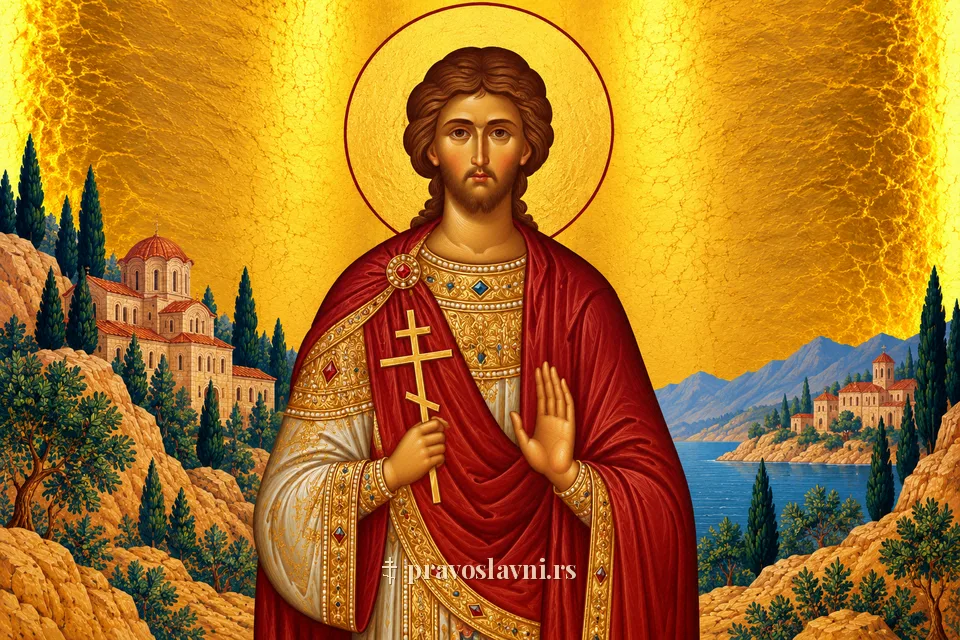
Holy Righteous Eudocimus
What happenedSt Eudocimus, a young commander from Cappadocia, kept purity and righteousness while living in the world, and after his death God glorified him with incorruption.
“For you died, and your life is hidden with Christ in God.”
— Col 3:3
About this day
Gospojinske poklade (the last day before the Dormition Fast) is the name the church calendar gives to the final day before the Dormition Fast. The word poklade denotes the day on which a certain kind of food is eaten for the last time, because the fast begins the very next day.
The fast that follows is opened by the feast of the Procession of the Precious Cross and of the Holy Maccabean Martyrs, and closed by Velika Gospojina, the Dormition of the Most Holy Theotokos. During the fast, food is mostly prepared with water; oil and wine are permitted only on certain days, and fish solely on the Transfiguration. There is more about fasting in the guide “Fasting — simply explained”.
On the same day the Church remembers the Righteous Eudocimus and the Martyr Julitta, and according to the Prologue also St Joseph of Arimathea and St John the Exarch.
Life
About eighteen months after the death of the young commander Eudocimus, his mother came to his grave and asked for it to be opened. The body was found whole, without corruption, and it gave off a fragrance. In this way God revealed the holiness which Eudocimus had hidden from people all his life.
He was born in Cappadocia, of pious parents, and as a young man he entered the army of the Emperor Theophilus. Neither in the army, nor later, when the Emperor appointed him a commander, did he live by the measure of the world. He fasted, prayed with tears and read the holy books, kept away from judging others, from lies and from idle talk, and guarded his purity. To the poor he was merciful, and he governed justly before God and before men.
He died young, in his thirty-third year, and his Life says that only God knew his hidden ascetic labours. According to his Life, not even on his deathbed did he wish to be spoken about: he forbade his body to be prepared for burial and prayed behind closed doors. Healings took place at his grave: a man possessed by a demon and a paralysed child were made well. The relics were later translated to Constantinople and laid in the church of the Most Holy Theotokos, which his parents had built.
St Eudocimus bears witness that even in the midst of the world, in service and in authority, it is possible to live for God.
Full Life
The opened tomb
About eighteen months after Eudocimus' death his mother came to the place where he was buried and asked for the tomb to be opened. She found the body whole, without corruption, and fragrant. His Life records how she wept over her son: “My sweet child! light of my eyes!”
The local people, according to his Life, would not give her the relics. Only later did the presbyter Joseph carry them off secretly to Constantinople, and healings accompanied that journey too. According to both sources, they were laid in the church of the Most Holy Theotokos in Constantinople, a foundation of his parents; his Life also mentions a reliquary overlaid with silver.
Officer and governor
Eudocimus was born in Cappadocia; his parents were devout, and his father was called Basil. Under Emperor Theophilus he entered the army as a young officer, and the emperor afterwards entrusted him with the office of commander. Here the sources give different details: according to the Prologue, he became commander of Cappadocia, and according to his Life the head of the Cappadocian regiment, with the task of governing the region of Charsianon. Both the one source and the other remember him as a just governor, before God and before men. The Prologue says of him: “Amid the turmoil and vanity of the world he was like a lily among thorns and like gold in the midst of fire”.
A life according to the Gospel
His position did not change the direction of his life, for the commandments of the Gospel were his measure. He fasted, prayed with tears, and read the holy books attentively. Silence was dearer to him than words: he fled from vain amusements and from lies, and he did not allow himself slander or the judging of others. He guarded his purity so strictly that he spoke with no woman except his mother, and his mother he honoured. Widows, orphans and the destitute had in him, according to his Life, a constant help, and he also helped churches and monasteries. His Life adds that his inner struggle remained known to God alone.
Hidden to the end
Eudocimus lived only thirty-three years. Even on his deathbed he did not want to be spoken about: according to his Life, he bound the members of his household by an oath not to wash his body nor dress it in new clothes, but to lay him in the tomb just as he was. He prayed in solitude. The last thing he uttered, according to his Life, were the words: “Into Your hands, O Lord, I commit my spirit” (cf. Lk 23:46).
Yet God revealed what he had hidden. At the tomb a man possessed by a demon, whom his Life calls Elias, was set free, and a paralysed child also recovered — according to his Life, by oil from the lamp above the tomb. His Life also mentions a woman with a sore and a boy who could not walk, healed by earth taken from the tomb.
St Eudocimus shows that holiness can be attained even in the midst of the world, in service and in authority.
Other saints of the day
Holy Martyr Julitta
St Julitta was from Caesarea in Cappadocia. A certain neighbour seized her property, according to her Life a large part of it. When the matter came before the court, he declared that she was a Christian, and Christians at that time did not have the protection of the law. According to her Life, the judge offered to return her property to her if she would deny Christ. She answered that she was ready to be left without everything she had, and even without her life, but that she would not deny Christ. Her faith meant more to her than her possessions. She was condemned to death by fire in the year 303; her Life says that she was thrown into a red-hot furnace, in the time of Diocletian. According to her Life, the fire did not harm her body, which was a comfort to the Christians. In her honour, as her Life records, a homily was delivered by St Basil the Great. According to the Prologue, she spared neither her property nor her life, because the salvation of her soul was above all else to her.