Wednesday02December 202619 November (according to the Julian calendar)
Illustration
Saint of the day
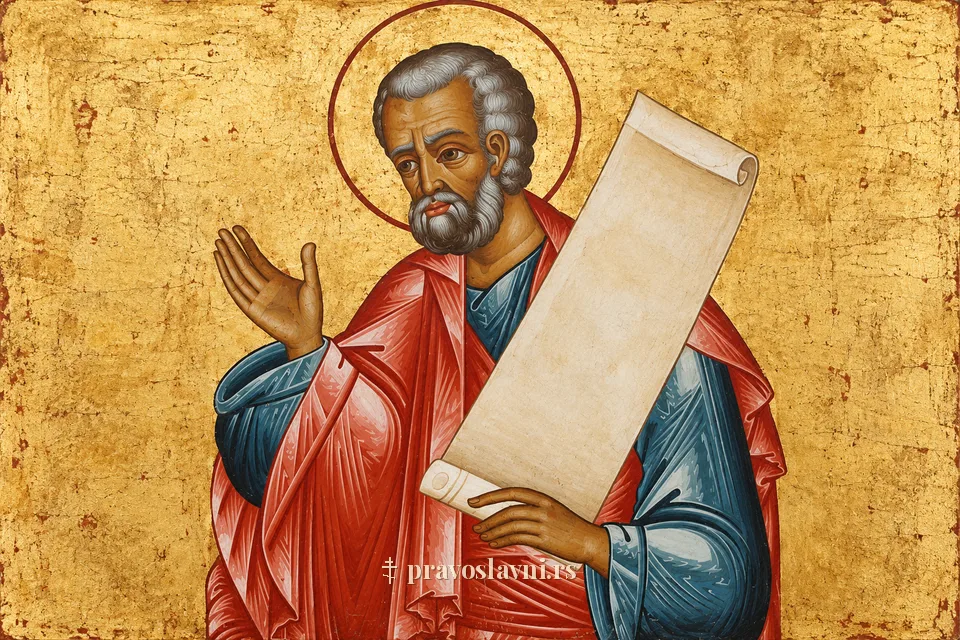
Holy Prophet Obadiah
What happenedWhile Queen Jezebel was killing the prophets of the Lord, Obadiah, the steward of King Ahab's household, hid a hundred prophets in two caves and fed them.
“For the day of the LORD upon all the nations is near.”
— Obad 1:15
Life
The holy prophet Obadiah came from Bethacharam, a village in the neighbourhood of Shechem, and his Life says that he feared God from his youth. At the court of King Ahab he was in charge of the palace. Even when the king and the people went over to Baal, Obadiah did not betray the faith of his forefathers, which he now had to keep hidden.
He saved a hundred of the Lord's prophets from Jezebel's persecution: he hid them in two caves and took care of their food, as Holy Scripture also testifies. According to his Life, there were fifty of them in each cave, and while the famine lasted he provided them with bread and water.
His Life also tells of his meeting with Elijah. While searching, by the king's order, for springs and pasture for the horses, Obadiah met the prophet and bowed down to the ground before him. Elijah told him to let the king know where he was. Obadiah was afraid that he would pay for it with his head, but when the prophet swore to him that he would appear before Ahab that very day, he did as he had been told. The Life also mentions Elijah's miracle with the fire on the altar, after which Obadiah, full of joy, served God still more fervently. The Prologue records that he was a contemporary and a disciple of Elijah and that he held him in great honour.
His Life, relying on St Dorotheus and Blessed Jerome, also speaks of a later event. Obadiah was then a soldier of King Ahaziah and the third of the captains of fifty whom the king sent to Elijah. The fate of his two predecessors, who, according to Scripture, were burned up by fire from heaven, did not befall him: he humbly knelt before the prophet and begged for mercy. The captain who had been spared then left the court and, as Elijah's companion, received from God the gift of prophecy. The Prologue says that he lived about nine hundred years before Christ and that he died in peace.
Obadiah's example teaches us that the fear of God is to be kept from one's youth, that God is to be served quietly and faithfully, and that we should bravely help those who are persecuted. Humble before the messenger of God, Obadiah received from God the gift of prophecy.
Full Life
A secret in two caves
Jezebel was killing the prophets of the Lord, and the Prologue says that she persecuted them because of Elijah. One of the highest men at the court of her husband, King Ahab, was hiding them from her. Obadiah, the steward of the palace, sheltered a hundred prophets in two caves and took care of their food. His Life specifies that there were fifty men in each cave and that, while famine was wasting the land in Elijah's time, they received bread and water from him. The Third Book of Kingdoms also bears witness to this.
Faithful in the midst of the court
By birth he was from Bethacharam, a village in the region of Shechem, and, according to his Life, he feared God from his earliest years. When Ahab, and with him the whole people, turned to Baal, the steward of the royal palace remained faithful to the God of his forefathers, although he had to conceal that faith.
A meeting on the road
His Life relates that Ahab and Obadiah divided the land between them, and each went through his own part in search of springs and pasture for the horses and mules. On his way Obadiah came upon Elijah and, as soon as he recognised him, bowed down to the ground before him. The prophet said to him: “It is I. Go, tell your master, “Elijah is here.””
That order frightened Obadiah. Ahab had been looking for Elijah among all the nations, and what if the Spirit of the Lord should carry the prophet off somewhere while he was informing the king? Then the king would put him to death. So he reminded Elijah that he had hidden a hundred prophets. Only when Elijah swore to him by the Lord of hosts that he would show himself to Ahab that same day did Obadiah go to the king, and Ahab came out to meet the prophet.
According to his Life, Elijah reproached the king for having ruined Israel, because he had replaced God's commandments with the Baals. The scene which his Life then retells according to the Books of Kingdoms, the fire that at Elijah's call fell from heaven upon the sacrifice and the water, filled Obadiah with joy, and his service to God became still more zealous. The Prologue records that Obadiah lived in the days of Elijah, that he was his disciple and that he honoured him greatly.
The third captain of fifty
His Life says that Obadiah, at the time when Ahab's son Ahaziah ruled Israel, was a soldier. His Life also passes on the account of St Dorotheus and Blessed Jerome: Ahaziah three times sent a captain with fifty soldiers to Elijah, and the last of them was Obadiah. The first two companies, according to Scripture, were burnt up with their captains in the fire which came down from heaven at Elijah's word. According to that account, Obadiah humbly fell on his knees before the prophet and begged for his own life and for the lives of his soldiers. His Life records his words: “Man of God, spare my soul”. Elijah had mercy on him and set off with him to the king.
The gift of prophecy
The gift of prophecy, according to his Life, he received after he had left the king and joined Elijah. The Prologue places him at a time about nine hundred years before Christ and records that he died peacefully, while his Life states that he was buried with his ancestors. The Church celebrates his memory on 2 December, that is, 19 November by the old (Julian) calendar.
Obadiah's life shows what the fear of God, kept from one's youth, means. Although he lived at a godless court, he served God quietly and faithfully and bravely helped the persecuted. Before God's messenger he was humble, and therefore God counted him worthy of the gift of prophecy.
Other saints of the day
Holy Martyr Barlaam
The holy martyr Barlaam came from Antioch in Syria and was already an old man when, for confessing the name of Christ, he was brought before a pagan judge. He would not offer sacrifice to the idols, and so they tortured him again and again. The last trial awaited him in the temple of the idols: they held his hand over the altar, with burning coals and incense on his palm, for every grain of incense that fell into the fire would mean that he had offered incense to the idols. The torturers' reckoning came to nothing, for Barlaam did not move his hand towards the altar until it was burnt away. He died on that spot, confessing Christ, and his soul went to the Lord. The Prologue records the year 304 and quotes the praise of St Basil the Great: “He had a right hand stronger than fire.” St John Chrysostom, his Life states, stresses in his homily that Barlaam felt the pain, for he was made of flesh and not of iron, and yet he endured it, and he applies his example to the struggle against the fire of the passions. The old man's steadfastness teaches that faithfulness to Christ can be stronger than any pain.
“Bless, father!” — with these words Venerable Joasaph greeted, in front of a cave in the desert, the elder Barlaam, whom he had sought for two years in the midst of demonic temptations, until God granted him that one and only wish. The road to that cave began at the court of the Indian King Abenner, Joasaph's father, a pagan who persecuted Christians, and monks most of all. His Life says that the prince grew up in a secluded palace, where he was not allowed to hear of sickness, or of death, or of Christ, but meetings with a leper, a blind man and an old man led him to ask himself where suffering and death come from. Then, as his Life goes on to say, by God's revelation there came from the desert of Senaar Barlaam, a monk and priest disguised as a merchant, who instructed him in the faith and baptised him. Although after his teacher's return to the desert he was left alone among the temptations of the court, Joasaph withstood them with God's help and, according to his Life, kept his virginity, and in time he also brought to the faith his father, who after his baptism lived for four more years repenting of the persecutions. The search for Barlaam began when, at about twenty-five years of age, he left the throne to his friend Barachias. The elder, who had spent seventy years in the desert, reposed after receiving Holy Communion, and his disciple buried him, and Joasaph lived in the desert for thirty-five years in all. Their life teaches that power and pleasure cannot satisfy the soul, and that the lasting good is faith, repentance and self-denial.
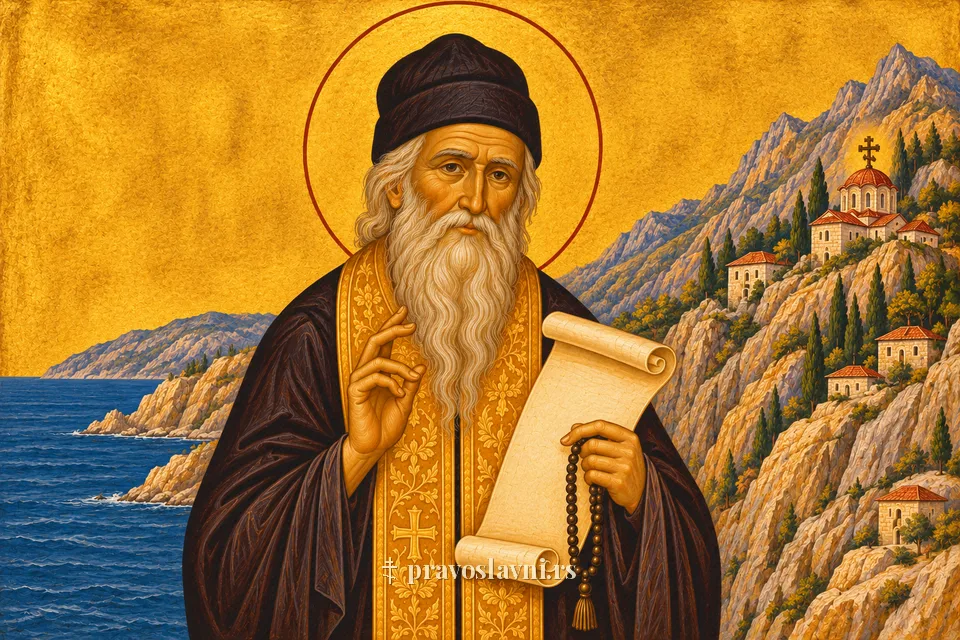
Evangelos, as the future Venerable Porphyrios was named at baptism, came into the world on 7 February 1906 in St John of Karystia, a village near Aliveri on Euboea. His father Leonidas Bairaktaris and his mother Eleni worked the land and lived modestly and in the fear of God, and their son, the second of five children, completed only two years of school and began to work when he was just eight years old, first in a coal mine, then in a shop, in Chalkida and Piraeus. The Life of St John the Hut-dweller awakened in him a longing for the monastic life, and at about the age of twelve he arrived on the Holy Mountain (Mount Athos); since children were not accepted there, the elder Panteleimon, who took him in, passed him off as his nephew. At Kavsokalyvia he lived in strict obedience with his two elders and received the monastic tonsure with the name Nikitas, and his Life says that after a visitation of divine grace he received the gift of clairvoyance and of healing, which he never used for his own benefit. Because of illness he had to leave the Holy Mountain at about the age of nineteen, and in the year 1927 he was ordained a priest and given the name Porphyrios. As a spiritual father on Euboea he received a multitude of people for confession, and from the year 1940 he served for about thirty-three years in the chapel of St Gerasimus at the Polyclinic in Athens, near Omonia. Of his gifts he used to say: “It is not science; it is not skill; it is grace”. Although he bore many illnesses and by the year 1987 had gone completely blind, he founded the Convent of the Transfiguration at Milesi, and he reposed in his hut at Kavsokalyvia on 2 December 1991 The Holy Synod of the Ecumenical Patriarchate canonised him in the year 2013, and his life teaches humility, obedience and love, not judging others, and seeking unity in the Church through prayer and repentance.