Wednesday30December 202617 December (according to the Julian calendar)
Illustration
Saints of the day
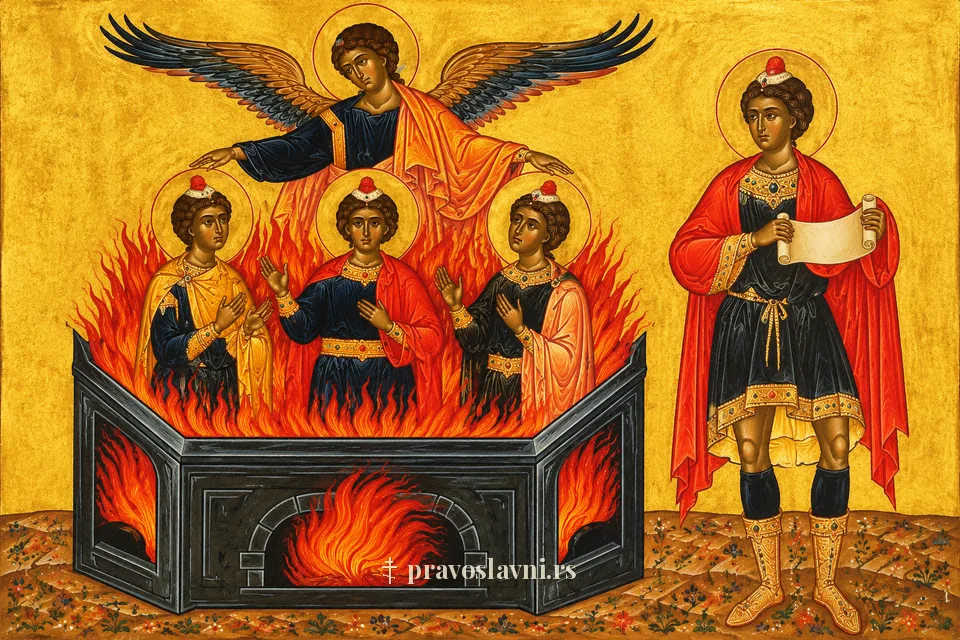
Holy Prophet Daniel and the Three Holy Youths
What happenedThe three youths refused to bow down to the golden statue, and in the burning furnace an angel cooled the fire, so that they walked about unharmed and sang praise to God.
“If that is the case, our God whom we serve is able to deliver us from the burning fiery furnace, and He will deliver us from your hand, O king.”
— Dan 3:17
Life
The Prophet Daniel and the three youths, Ananias, Azarias and Misael, were of the royal tribe of Judah. Nebuchadnezzar carried them off to Babylon as captives after the fall of Jerusalem. Their Life says that, as chosen young men, they were taught the wisdom of the Chaldeans for three years, but they would not eat the king's food. After ten days on vegetables and water they looked healthier than all the others. God gave them wisdom ten times greater than that of all the magicians.
Daniel interpreted Nebuchadnezzar's dream about the statue and the stone cut out without hands, which signified the eternal Kingdom of God, and so the king appointed him a prince at the court and gave offices to his companions. Then the king set up a golden statue and commanded that everyone should bow down to it. The three youths refused. They said that their God was able to save them, and that even if He did not save them, they would not bow down to the statue. They were thrown into the red-hot furnace, but, according to the Prologue and the Life, it did them no harm, for an angel quenched its heat; the king, who caught sight of a fourth among them, like the Son of God, led them out himself and showed them honour.
Later Daniel alone was able to read the words which a hand wrote on the wall during Belshazzar's feast. He interpreted them as announcing the end of Belshazzar's rule, and the king was killed that very night. Under Darius, Daniel continued to pray to God in spite of the prohibition. They threw him among the lions, but, as the Life records, God sent an angel and shut the lions' mouths. Both sources say that this happened a second time as well, and that then too God preserved the prophet.
St Cyril of Alexandria testifies that all four of them reached old age in Babylon and perished by the sword for the faith; an angel then carried their bodies to Mount Gebal. The Church, according to the Life, glorifies them a week before Božić (Christmas), because they were descended from the same tribe as Christ.
Their life teaches that God keeps those who remain faithful to Him. Prayer and firmness are stronger than any threat, and all earthly kingdoms pass away before the Kingdom of God.
Full Life
Who They Were
The Prophet Daniel and his three companions, Ananias, Azarias and Misael, came from the royal tribe of Judah. Daniel, while still a boy, came to Babylon after the fall of Jerusalem: Nebuchadnezzar carried him off together with King Jehoiakim and a multitude of Israelites.
The Life says that the king numbered the four of them among the best of the captive youths, who were taught the learning of the Chaldeans for three years. They refused the king's food and wine, and after a ten-day trial with vegetables and water they looked healthier than the rest.
Wisdom That Comes from Above
According to the Life, God gave them wisdom ten times greater than that of all the magicians, and to Daniel in particular the gift of understanding dreams and visions.
The Prologue and the Life remember Susanna, the wife of Joakim and daughter of Hilkiah, whom two elders who were judges accused of adultery because she had rejected them, so that she was condemned to death. The Life says that Daniel, moved by the Spirit, then said: “I am clean of her blood!” Questioned separately, the elders named different trees under which they had supposedly seen her — a mastic tree and an oak. In this way the innocent woman was saved, and the liars were put to death.
Nebuchadnezzar forgot one of his dreams and threatened all the wise men with death; the Life says that Daniel prayed with his companions and received the answer by night. According to the Life, in his dream the king saw a statue made of four metals, on feet that were partly of clay, and a stone, cut without human hand, which strikes it down and grows into a mountain. The meaning: kingdoms that come one after another, and the eternal Kingdom of God. For this reason Daniel became a governor at the court, and at his request his companions were also given offices.
Finally, at Belshazzar's feast, where they were drinking from the vessels carried off from the temple in Jerusalem, a hand wrote three words on the wall. Only Daniel was able to read them — the Life gives them as “Mene, Tekel, Upharsin.” He refused the gifts, rebuked the king and told him that his days were numbered, that he had been weighed and found wanting, and that the kingdom was passing to the Medes and the Persians. That same night Belshazzar was killed, and the kingdom passed to Darius the Mede.
Faith That Does Not Yield
For the three youths the greatest trial came on the plain of Dura, where Nebuchadnezzar set up a golden statue sixty cubits high and ordered everyone to bow down to it when the music began to play. They answered the king that their God was able to deliver them, and that even if He did not deliver them, they would not bow down to the statue. The furnace, as the Life says, was heated seven times hotter, so that even those who threw them inside were burned up. An angel protected them from the heat, and so, unharmed and singing, they glorified God in the midst of the furnace. That sight — four men in the flames, one of whom looked like the Son of God — compelled the king to bring them out, to pay them honour, and to threaten with death anyone who might blaspheme against their God.
The Prologue and the Life agree that Daniel was twice thrown among the lions and that God preserved him both times. The Life relates that envious nobles at the court of Darius set a trap for him: for thirty days no one was allowed to pray to anyone except the king. He did not hide his prayer: three times a day he turned towards Jerusalem, and the windows remained open. The king neither slept nor ate, and at dawn the answer reached him from the sealed den: “God has shut the lions' mouths.” The accusers then, with their wives and children, themselves ended up among the beasts, and Darius ordered that everyone should fear the God of Daniel.
The second time, according to the Life, he angered the people when he exposed the deceit of the priests of the idol Bel and killed the dragon that they worshipped. He was thrown among seven hungry lions and spent six days there, and an angel brought the Prophet Habakkuk from Judea to feed him. On the seventh day the king found him alive.
The End and the Commemoration
The Prologue counts him among the four great prophets and places him about five centuries before Christ. To him, says the same source, more was revealed than to the others: he saw the heavenly powers around the throne of God, the destinies of kingdoms, and the time when the Saviour would come.
St Cyril of Alexandria says that all four of them grew old in Babylon and suffered for the faith by the sword; the Life names King Cambyses as the one who put them to death. Their grave was taken care of by an angel, who carried the bodies to Mount Gebal and covered them there with a stone. Tradition knows that this sleep was not unbroken: many, it is said, saw them when they once arose, before they returned to the grave; the Prologue connects this with the death of Christ. As for why their commemoration is linked to the Sunday of the Holy Fathers before the Nativity of Christ, the Life explains it by their descent: they were of Judah, as Christ was, and so the Fathers gave them that place.
The lesson is simple: whoever does not renounce God, God does not abandon — neither in the fire nor among the beasts. Whoever digs a pit for another falls into it himself, and all earthly kingdoms pass away, while the Kingdom of God remains.
Other saints of the day
Venerable Martyrs Deacon Avakum and Abbot Pajsije
The baptismal name of Deacon Avakum was Lepoje; according to his Life, his parents were Gavrilo and Božana, and he was born in 1794 in Knez Polje, at the foot of Mount Kozara. After his father's death his mother brought him to the Monastery of Moštanica, where Abbot Genadije Šuvak received him; there he was tonsured a monk with the name Avakum, and at the age of eighteen he was ordained a deacon by Josif Jovanović Šakabenta, Metropolitan of Pakrac. After the uprising in Bosanska Krajina had been crushed, Genadije fled in 1811 with his son Stojan, with Avakum and with Božana, and after a year in Slavonia they reached the Monastery of the Annunciation at Trnava near Čačak. The abbot of that monastery was Pajsije, a native of Trnava, of the Ristović family, and Avakum became one of his brethren. His Life records that in 1814 Hadži-Prodan's revolt failed, and in reprisal one hundred and fifteen prisoners in chains, Pajsije and Avakum among them, were taken to Belgrade and shut up in the Nebojša Tower, while their mothers followed after them. According to the Life, by order of the vizier Sulejman-paša Skopljak, Pajsije was put to death on a stake at the Stambol Gate on 17 December 1814, saying: “Glory to God.” Genadije and Stojan accepted Islam out of fear, while Pajsije's brother Dimitrije refused and was beheaded. Avakum was urged to give way by the notables, by the apostates Genadije and Stojan, and even by his own mother, but he answered: “I am a soldier of Christ.” The stake on which he was to suffer he had to carry through the city himself, and his singing, according to both sources, did not cease all the way to Kalemegdan, where he was put to death. The Life does not give the exact day of his death, while the Prologue says that both were put to death at Kalemegdan on the same day, 17 December 1814. These Serbian New Martyrs chose death rather than the denial of their faith, and so became part of the suffering which the Church has shared with Christ through the centuries.