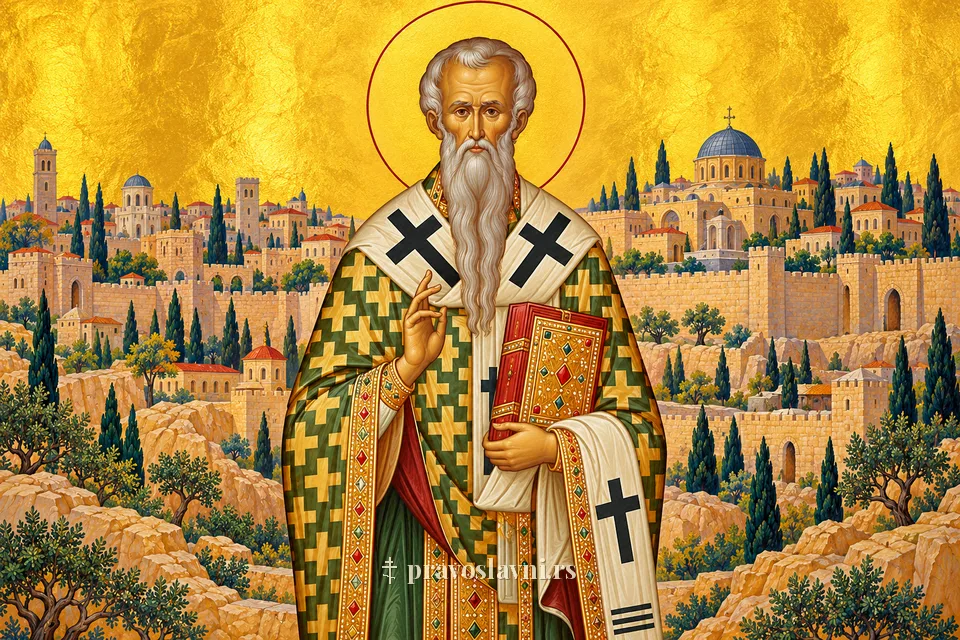
St Sophronius, Patriarch of Jerusalem, left the Church books that are still read today: the Life of St Mary of Egypt and, together with his teacher, the “Leimonarion”, or “Spiritual Meadow”. The Prologue also attributes to him the order of the Great Blessing of Water and new church hymns.
He was a native of Damascus, from a respected and devout house. When he had mastered the secular sciences, he went in search of another wisdom, the one that the monasteries keep. He found a teacher in the monk John Moschus. As they visited the ascetics together, they wrote down what they saw and heard, and that is how their book came into being. His Life tells that the Persian invasion drove them into exile, in which Sophronius, suffering from a disease of the eyes, was healed through the intercession of Sts Cyrus and John, and was then tonsured a monk. Patriarch John the Merciful valued him at that time as a friend and fellow worker. After his teacher's death he buried him in the Monastery of St Theodosius, fulfilling his wish to rest either on Sinai or in that monastery.
He came to the patriarchal throne after Zacharias and Modestus. He was a defender of Orthodoxy against the Monothelites, and so that heresy was condemned in Jerusalem before the Sixth Ecumenical Council. The Prologue praises the wisdom and zeal of his governance.
He met his hardest years in a city that had been conquered by the Arabs. From the Caliph Omar he asked protection for the Christians and received a promise which, according to the Prologue, was not sincere. When the violence began, the patriarch prayed that God would spare him that sight, and both sources say that God heard this prayer of his. The Prologue gives the year 644, and his Life 638.
St Sophronius shows that not even the greatest misfortune separates a shepherd from his flock.
Full Life
A Writer Whom the Church Still Reads Today
Whoever has read the Life of St Mary of Egypt has read St Sophronius — that Life was written by him. The Prologue also ascribes to him the order of the Great Blessing of Water, as well as new hymns that entered into various services. His Life lists in addition homilies, instructions, hymns and lives of saints. Before all of that, together with his teacher, he compiled the book “The Leimonarion”, or “The Flower Garden”, a collection of stories about holy elders; the Prologue says that it consisted of two books, and his Life says that it was approved by the Seventh Ecumenical Council.
Behind that book stands a life spent in the search for wisdom.
A Disciple of the Desert Elders
He was born in Damascus, in a distinguished and devout home; his Life knows the names of his parents, Plynthas and Myro, and states that he was born around 580. He mastered secular learning so well that, according to his Life, he was called “the Sophist”. But his soul was seeking another wisdom, the kind that is kept by monasteries and hermits.
The monk John Moschus became his guide. The Prologue first brings them together in the Lavra of St Theodosius, and his Life in Jerusalem. They went from monastery to monastery and from ascetic to ascetic, writing down what those men lived and said. According to the Prologue, they kept to one rule: that no day should pass without their learning something new about the spiritual life.
His Life tells that, after the Persians had captured Jerusalem and carried off the Precious Cross and Patriarch Zacharias, the two of them fled, first to Antioch and then to Alexandria. There Sophronius fell ill with a disease of the eyes and in a vision heard: “Welcome, Sophronius! Sophronius has been crowned!” He was healed by the holy Unmercenaries Cyrus and John, and after that John Moschus tonsured him a monk. Patriarch John the Merciful valued him as a friend and fellow worker in the struggle against the Severian heresy. On his deathbed, in Rome, John Moschus asked to be laid to rest on Sinai or in the Monastery of Theodosius, and Sophronius brought his body to the Monastery of Theodosius — as Joseph once brought the body of his father Jacob.
A Voice against the Monothelites
When the teaching of the Monothelites appeared, Sophronius, according to his Life, went in person to Patriarch Cyrus of Alexandria and Patriarch Sergius of Constantinople to turn them away from it. Both of them rebuffed him. Later, when he became Patriarch, a council was held in Jerusalem at which that heresy was rejected, earlier than at the Sixth Ecumenical Council; his Life says that the decisions of Jerusalem were indeed read out there, in the year 680.
Patriarch in the Hour of the Fall
He was in Jerusalem when the Precious Cross returned to the city, set free from the Persians; according to the Prologue, the Emperor Heraclius brought it in person, carrying it on his shoulders. Zacharias, himself set free from captivity, soon died, and after Modestus, who, according to his Life, lived only two more years, the throne passed to Sophronius — his Life says, in the year 634. The Prologue praises the wisdom and zeal with which he led the Church.
The hardest was yet to come. The Arabs, according to his Life, conquered Damascus and Bethlehem and held Jerusalem under siege for two years, and a Nativity homily of Sophronius from that time laments the devastation. When the city fell into the hands of Caliph Omar, the Patriarch interceded for his faithful; his Life says that, as the first condition of surrender, he demanded that the faith and the Church remain untouched. Omar gave the promise, but, according to the Prologue, not from the heart. Watching him enter, Sophronius, according to his Life, said: “Behold, the abomination of desolation, foretold by the prophet Daniel, will stand in the holy place.”
Soon plunder and violence against the Christians began. Sophronius, according to both sources, wept and prayed God to take him before he saw the holy places defiled. And so it was. The year is disputed: the Prologue gives 644, his Life 638. His Life says that he then passed from the city of affliction into the heavenly city of joy. St Sophronius teaches that spiritual wisdom is worth more than any other, and that a shepherd stays with his flock even when it is hardest for him.