“Therefore, putting away lying, ”Let each one of you speak truth with his neighbor,” for we are members of one another.“
— Eph 4:25
Life
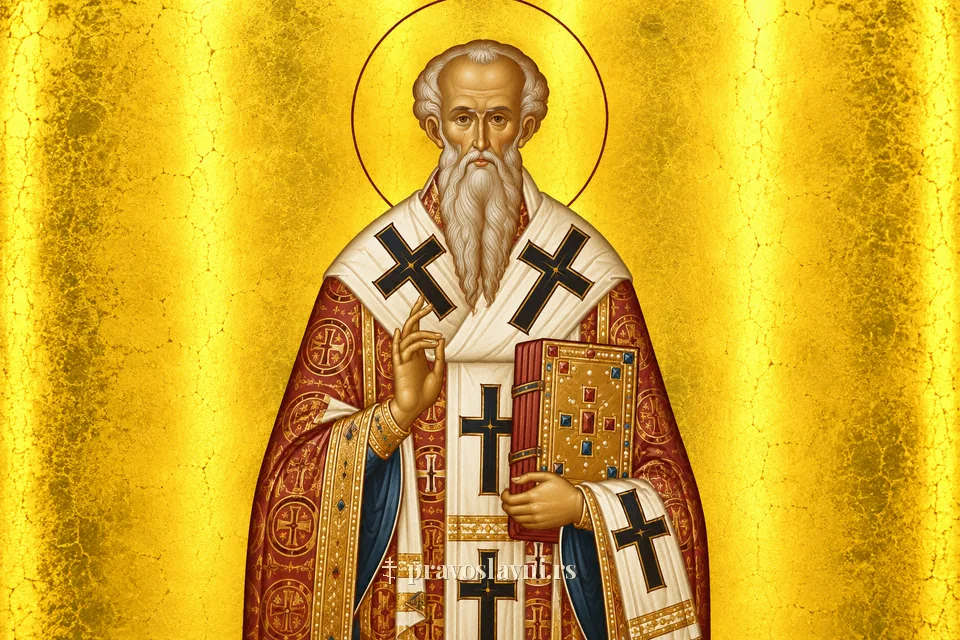
St Anthimus, Bishop of Nicomedia, confessed the faith by his love of truth as well. When the Emperor Maximian sent twenty soldiers to fetch him, he gave them hospitality and told them himself who he was, and when they suggested that he should flee, he refused, because no one was to lie on his account. On the way several of the soldiers came to believe in Christ, and he baptised them, according to his Life in a river.
He lived in the time of the persecution under Diocletian and Maximian. To his faithful he was a support: he encouraged them to persevere, and while he was hiding in a nearby village, he guarded them from faint-heartedness by his letters. One such letter reached Maximian. His Life says that the deacon Theophilus, who was carrying it, did not betray his bishop and that he suffered for it.
Before the emperor, according to his Life, he showed no fear either of tortures or of death, and he refused the offer to become the first among the pagan priests with the words that he was a priest of Christ. He was tortured long and cruelly, and his Life says that in prison he taught the prisoners the faith and baptised them. He was beheaded with an axe, according to the Prologue at the beginning of the fourth century, and his Life says that the Christians buried him in secret.
He was a native of Nicomedia, a Christian from childhood, and on account of his virtue he became bishop of his city.
St Anthimus teaches that love of truth and love for one's enemies are a confession of the faith.
Full Life
The truth before the soldiers
When Emperor Maximian sent twenty soldiers to seize Anthimus, the Bishop of Nicomedia, he welcomed them as guests. He entertained them at his own table and only after the meal did he admit who he was; his Life preserves his words: “I am he, he said, whom you are seeking.” The soldiers themselves suggested to him that he should flee, but he would not agree that anyone should speak an untruth on his account. He set out with them, and on the way to the city several of the soldiers accepted the faith, and Anthimus baptised them, according to his Life in a river.
A bishop in a time of persecution
Anthimus was a native of Nicomedia, a Christian from his earliest years; his Life describes him as a meek young man, mature beyond his years, self-restrained and calm, zealous for the glory of God. Because of his virtue he became a priest, and when Bishop Cyril died, he took over the governance of the Church of Nicomedia; his Life also mentions a light from heaven which then filled the church. His episcopate fell in the years of the fiercest persecution under Diocletian and Maximian, when in one church, on the feast of the Nativity of Christ, twenty thousand Christians were burnt.
Anthimus encouraged the faithful to persevere, and his Life says that almost the whole of his flock gained the martyr's crown. From a nearby village, where he had taken shelter, he sent them letters so that fear would not separate them from Christ. One of those letters, intended for the prisoners, fell into Maximian's hands; the deacon Theophilus, who was carrying it, according to his Life chose to suffer rather than betray his shepherd.
Without fear before the tortures
According to his Life, Anthimus told the emperor that the idols were laughable to him and the instruments of torture not frightening, for death would only free him from the body. He was tortured long and severely. His Life also records the words of the Prophet Jeremiah which he kept repeating at that time (Jer 10:11). According to his Life, not even fire harmed him: the wheel to which they had tied him stopped, the flame turned towards the torturers, and they told how they had seen three shining figures beside him. In prison, says his Life, his fetters fell from him in a light from heaven, and he taught the prisoners the faith and baptised them. Invited to become the head of the pagan priests, he answered, according to his Life, that he was the servant of Christ and that he was giving his life to God.
The last prayer
He was beheaded with an axe — according to the Prologue, at the beginning of the fourth century. His Life says that before this he asked to be allowed to pray and that he went to his death joyful, and that the Christians secretly carried away his body by night and buried it with honours.
Hieromartyr Anthimus shows that truthfulness and love for one's enemies are a confession of the faith: he did not let others lie on his account, and he brought his own guards to Christ.
Other saints of the day
Venerable Theoctistus
Venerable Theoctistus was a fellow ascetic of St Euthymius the Great, and according to the Prologue his disciple in everything. His Life says that he loved God from his childhood, left his family and his homeland and came to Jerusalem, where he lived in the Lavra of Pharan. Euthymius settled beside him; they were of one mind and one work, and every year from Theophany until Palm Sunday they withdrew into the desert. After five years they found a large cave, monks gathered around them, and a coenobitic monastery came into being. Theoctistus was the abbot of the monastery on the road from Jerusalem to Jericho. Euthymius used to send novices to him, among them St Sabbas the Sanctified. He reposed in deep old age, in the middle of the 5th century, and he was buried by Euthymius and Anastasius, the Patriarch of Jerusalem.
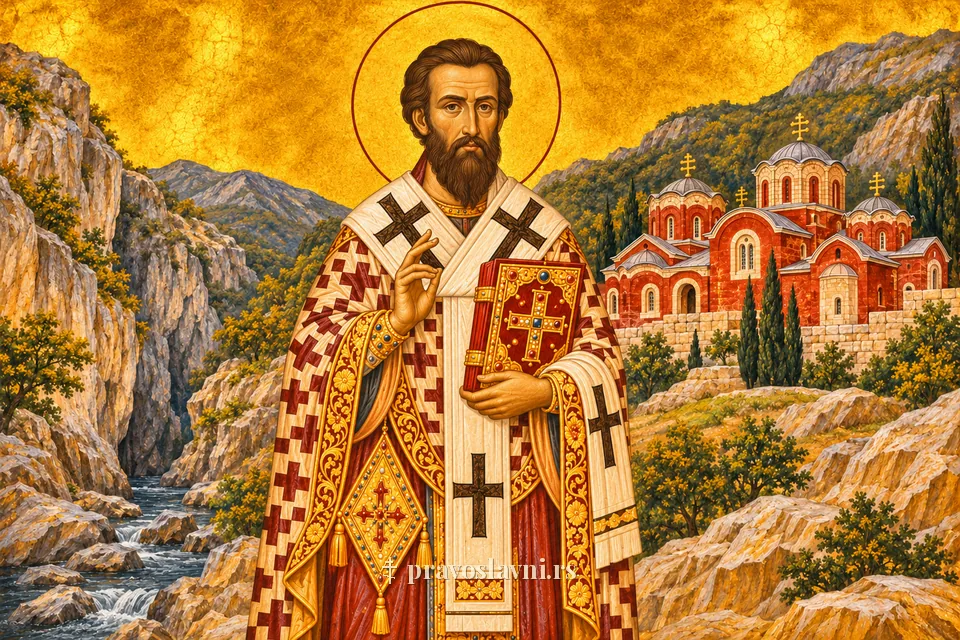
St Joanikije was born into a devout Serbian family; the Prologue says in Prizren, and his Life says probably in the surroundings of Prizren. At first he served at the court of King Dušan, according to the Prologue as a secretary, and according to his Life as logothete. He was elected archbishop while still a layman; he received the monastic tonsure and holy orders within a short time and took his seat on the throne of St Sava. As archbishop, as his Life says, he adorned the archbishop's church at Peć with icons, frescoes and church furnishings. When the Serbian archbishopric was raised to the rank of a patriarchate, Joanikije became the first Serbian patriarch. According to the Prologue, he governed the Serbian Church zealously; his Life adds that new dioceses were founded at that time and Serbian hierarchs were appointed. According to his Life, he gave icons and vessels to churches, and he also built churches on Carmel and on Tabor. His Life says that he fell gravely ill when he was summoned to Žiča, that he asked to be carried to Peć and that he passed away on the journey, at Polumir, near the present-day Ušće on the Ibar. His relics rest at Peć; his Life says in the church of the Holy Apostles of the Patriarchate of Peć, in a tomb which he had chosen himself. He placed his gifts at the service of the order and beauty of the Church.