Saturday16October 20273 October (according to the Julian calendar)
Illustration
Saint of the day
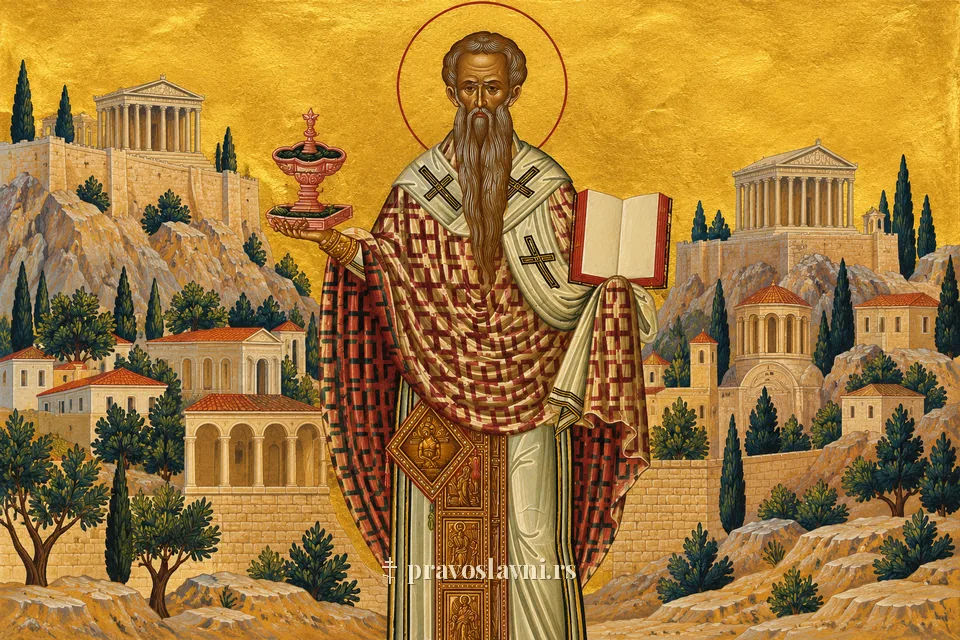
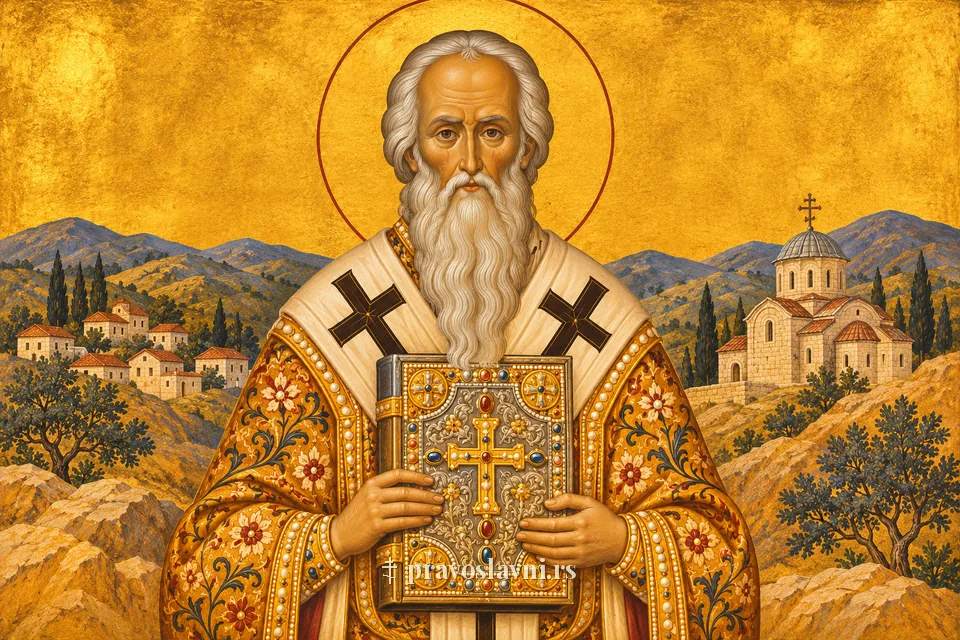
Hieromartyr Dionysius the Areopagite
What happenedAn Athenian judge who as a young man in Egypt saw the eclipse on the day of the Crucifixion, and later believed the Apostle Paul on the Areopagus.
St Dionysius the Areopagite sought the truth all his life, and when he found it, he gave everything for it.
He was born in Athens, into a distinguished pagan family, and devoted himself to philosophy early on. His studies also took him to Heliopolis in Egypt, where with his friend Apollophanes he occupied himself with the study of the heavens. It was there that the world before him sank into darkness in the middle of the day. That was the hour of Christ's crucifixion in Jerusalem. Dionysius knew nothing about the Crucifixion, but he sensed that something terrible was taking place. The Prologue records his words: “Either God, the Creator of the world, is suffering, or this world is coming to an end.”
In Athens he started a family with Damaris and entered the Areopagus, the highest court of the city, from which he takes his name. When the Apostle Paul spoke on the Areopagus, Dionysius did not wave it away as many others did. From Paul he heard that the “Unknown God”, to Whom the Athenians had raised an altar, was in fact Christ, born of the Virgin and crucified. Now he understood the darkness he had seen in Egypt. According to his Life, what finally convinced him was the healing of a blind man whom the whole of Athens knew, and he was baptised with his whole household.
The Prologue says that for the sake of Christ he left his family and his standing. He travelled with Paul, and Paul appointed him Bishop of Athens. According to the Prologue, he also went to Jerusalem, solely in order to see the Most Holy Theotokos, and the news of Paul's martyrdom awoke in him the desire to suffer for Christ himself. He handed Athens over to another bishop, and he himself, with the priest Rusticus and the deacon Eleutherius, went to Gaul, where he brought many to the faith, and in Paris he built a modest church.
In the persecution under Domitian, already in deep old age, he was brought to trial. He did not renounce Christ even under torture, and his Life says that God preserved them. He, Rusticus and Eleutherius were beheaded. Dionysius was ninety years old at the time; according to the Prologue, this was in the year 96.
A true mind, when it catches sight of the Truth, recognises it and sets out after it, even if it should lose everything.
Full Life
A Sage from Athens
Dionysius was an Athenian, from a distinguished pagan house, and he had been occupied with philosophy since childhood. He was not a man who is satisfied with shallow answers. He went to deepen his knowledge in Egypt, in Heliopolis, and there, with his friend Apollophanes, he studied the heavenly bodies.
There he lived through something that no science could explain: in the middle of the day the world sank into darkness. Dionysius could not have known that at that hour Christ was being crucified in Jerusalem, but, according to the Prologue, he cried out: “Either God, the Creator of the world, is suffering, or this world is coming to an end.” The Life sees in those words not learning, but a gift from above.
When he returned home, Damaris became his wife and bore him sons. His seat on the Areopagus, the highest court in Athens, also gave him the name by which the Church remembers him. He had everything a man could wish for, and yet something was missing.
The Unknown God
Then the Apostle Paul arrived in Athens. His preaching on the Areopagus sounded strange to most of the notables, but it did not leave Dionysius indifferent; according to the Life, he remembered those words. Later, the Life says, they talked in private, and the occasion was an altar with the inscription “To the Unknown God”.
Dionysius thought that this God was yet to appear and to reign for ever. Paul answered that there was no need to wait, for the One whom the Athenians do not know is Christ, born of the Virgin and crucified for mankind. Then everything fell into place. The darkness he had watched in Egypt took on its meaning, and Dionysius believed. So an inscription on a stone became for him the door of faith.
The final prompting, according to the Life, was a certain man blind from birth, known to all the Athenians: Paul healed him and sent him to Dionysius. That was enough. Dionysius was baptised, and with him his wife, his sons and all his household.
With Paul through the World
The Prologue stresses how great that sacrifice was: for Christ he renounced everything he had possessed until then. He became Paul's travelling companion — according to the Life, for three years — and then also Bishop of Athens, ordained by Paul's own hand. From a respected judge he became a wayfarer and a servant of the Gospel.
Among his journeys the Prologue singles out one in particular — his meeting with the Most Holy Theotokos in Jerusalem, about which he later also wrote. He also stood with the apostles beside her bier. When Paul suffered in Rome, Dionysius, according to the Prologue, was left with one wish — that he too might end in the same way.
Ninety Years and a Faith That Does Not Grow Old
He entrusted the Church of Athens to another bishop and set out for the west, to distant Gaul, taking with him the priest Rusticus and the deacon Eleutherius. The Prologue bears witness that neither hardships nor fruits were lacking there. He won many new Christians, and in Paris he built a modest church for them. His years did not keep him at home, nor did dangers frighten him.
At the time of Domitian's persecution the governor Sisinnius, according to the Life, looked for Dionysius first of all. They brought the old man before the court and rebuked him for destroying faith in the gods at such an age. Dionysius denied neither his years nor Christ: old age, he said, does not mean that faith has grown weak. All three confessed that they believed in one God. According to the Life, God preserved them in their torments, and at last they were condemned to death by the sword.
According to the Life, he walked to the place of execution with a prayer of thanksgiving on his lips. He was ninety years old. All three were beheaded, and the Prologue records that this was in the year 96 and that a Christian woman, Catulla, buried him. He also left behind theological writings, by which the Christian world remembers him to this day.
As a young man he gazed at the stars, and his whole life long he sought the One who made them. A true mind, when it catches sight of the Truth, recognises it and sets out after it, even if it should lose everything.
Other saints of the day
St Pajsije of Janjevo, Patriarch of Serbia
Pajsije was born in the middle of the sixteenth century in Janjevo in Kosovo, in the home of the priest Dimitrije and Dafina, and he became a monk in the Pustinja Anića hermitage. As a metropolitan he was known for his steadfastness and humility, and for never being parted from the Holy Scriptures. Jovan Kantul, the patriarch in whom Pajsije saw his teacher, was put to death in Constantinople, where he had been summoned in 1614, and the Serbian hierarchs then elected Pajsije as patriarch. The times were hard: the uprisings had been crushed, the relics of St Sava had already been burnt, and the Turks wanted to subdue the Serbs completely. Pajsije did not call for a rebellion without hope, but set his hand to the slow work of preserving. For thirty-three years he visited monasteries and dioceses throughout the Serbian lands, as far as Srem and the Banat. He loved books especially: wherever he found a damaged one, he saw to it that it was repaired, even if with his own hands at Peć. He composed a Life and a service to Tsar Uroš, a service to Stefan the First-Crowned, in monasticism Simon, and for Stefan Štiljanović, whose relics he venerated at Šišatovac, a short Life. Nor were the walls of the holy places any less important to him, and so through his care Gračanica and the Patriarchate of Peć received a lead roof. As a very old man he venerated the Tomb of the Lord, and he ended his earthly path at Peć in the year 1647. Under foreign rule the faith is defended by patient labour — by prayer, by the book and by remembering one's own saints.