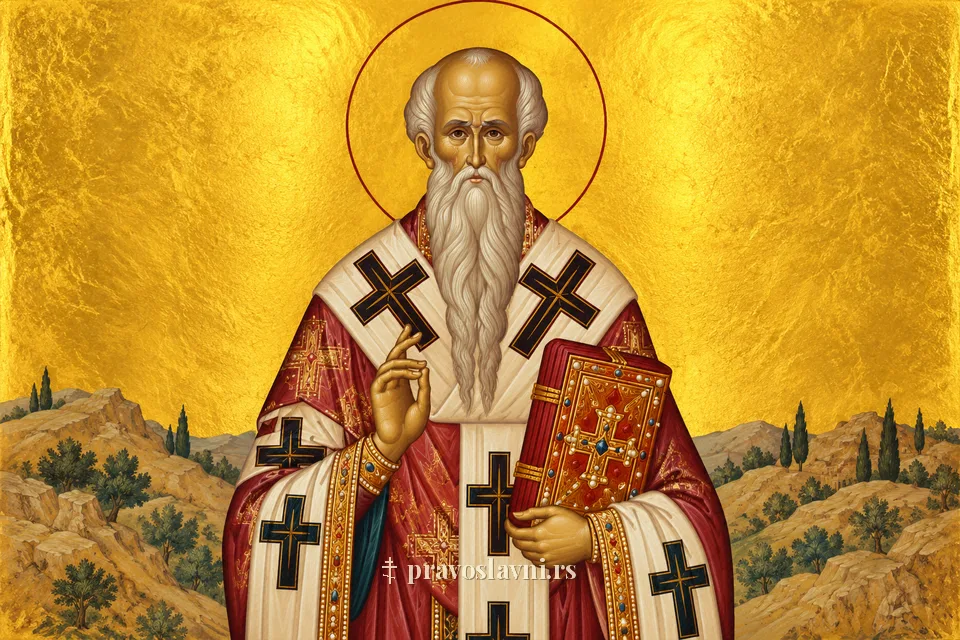
“Then He said to them, ”Therefore every scribe instructed concerning the kingdom of heaven is like a householder who brings out of his treasure things new and old.”“
— Mt 13:52
Life
Dorotheus, Bishop of Tyre, lived to the age of one hundred and seven, and he was a bishop from the time of Diocletian until Julian the Apostate. Under Diocletian, according to his Life, he withdrew from Tyre and stayed in hiding. When Constantine the Great gave peace to the Church, he returned to his flock and brought many to God. Under Julian the Apostate he once again had to flee.
He fled in obedience to the Lord's commandment, which his Life quotes from the Gospel: “When they persecute you in this city, flee to another” (Mt 10:23). Even so, he did not manage to remain hidden in Asia Minor. Julian's men caught him and tortured him, and he suffered for the Orthodox faith in the year 361.
He was very learned and wrote instructive works in Greek and Latin. The Prologue mentions his Greek and Latin Syntagma, and his Life mentions his lives of the prophets and apostles and other histories. According to his Life, he who wrote about the saints is now himself in their company, for his name is in the book of life.
St Dorotheus teaches that a Christian does not go looking for danger himself, but when God calls, he does not deny Christ even at the cost of his life.
Full Life
A bishop in a time of persecution
Dorotheus was bishop in Tyre from the time of Emperor Diocletian until that of Julian the Apostate. The Life says that, when Diocletian raised the persecution, he left his see and hid in unknown places. When Constantine the Great gave peace to the Church, he returned to Tyre and shepherded his flock, and he brought many from idolatry to God.
A learned writer
Dorotheus was a very learned man and wrote many edifying works in the Greek and Latin languages. The Prologue remembers him for his Greek and Latin Syntagma, and the Life says that he wrote the lives of the prophets and the apostles and other histories.
Flight and martyrdom
When Julian the Apostate came to the throne, the persecution returned. The Life says that at the beginning Julian did not act openly against the Christians, but his governors, on his orders, tortured and killed them. Dorotheus left Tyre once again, following the Lord's commandment: “When they persecute you in this city, flee to another” (Mt 10:23). He went to Asia Minor, but he could not remain hidden: Julian's men seized him in one of the cities there. He was tortured and suffered as a martyr for the Orthodox faith. He lived for one hundred and seven years and reposed in the year 361.
What he leaves us
The Life teaches that in a time of persecution the faithful should not rush into danger of their own accord, but should flee, as the Lord commanded. But when God calls, they accept martyrdom as well. The Life says that he who described the lives of the saints is himself among them, because his name is written in the book of life.
Other saints of the day
Venerable Peter of Koriša
Venerable Peter of Koriša is a Serbian hermit whose Life was written, from the accounts of eyewitnesses, by Teodosije of Hilandar. The Prologue says that he was born in Koriša, above the Monastery of St Mark near Prizren, alongside another tradition that his village was near Peć, while his Life says that he was born in the village of Unjemir, today's Ujmir near Peć. As a young man he worked in the field with a blind ox, and he was a meek man, without a trace of anger. Early on, together with his sister, who according to the Prologue was called Jelena, he went off to the ascetic life. His Life says that, seeking solitude, he came to the heights above Prizren, over the village of Koriša, and lived in a cave high up in the rock, feeding on wild plants and beech mast. There he withstood severe temptations from the demons, and according to his Life, after a forty-day fast the Archangel Michael appeared to him and drove away the serpent. In time many monks came to be with him, and he became their teacher. His Life records that, having received Holy Communion before his death, he said: “Glory to God for all things!” He died as an old man in his cave; that night a light shone in it as though a multitude of candles were burning, and the singing of angels was heard. Tsar Dušan built a church over his relics, and it became a metochion of Hilandar. Today his relics rest at Crna Reka, to which they were once secretly translated.