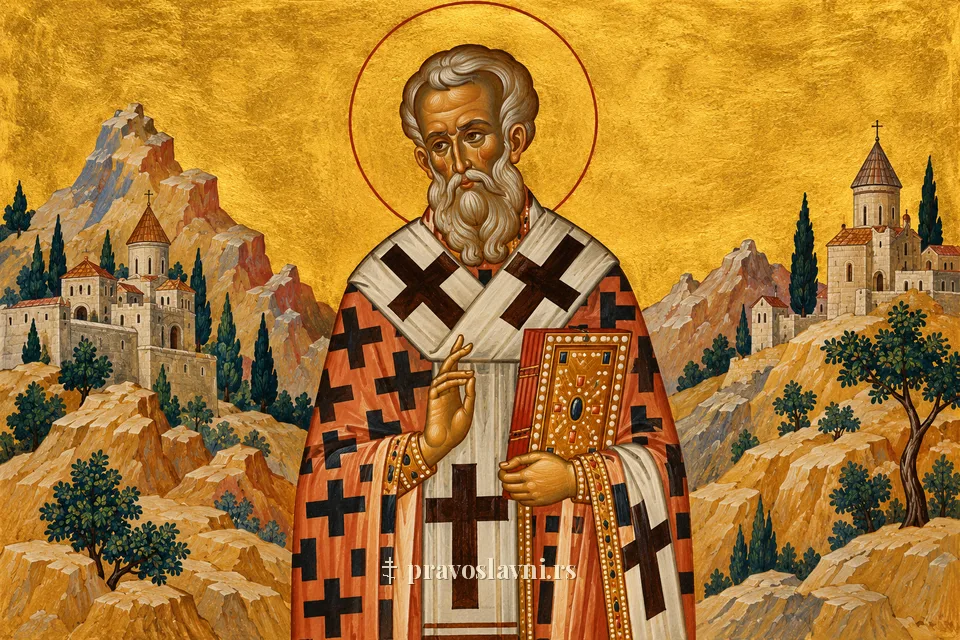
St Gregory, the Enlightener of Armenia, answered evil with good. His father Anak, a Parthian of the line of the Persian rulers, according to his Life pledged himself to the Persian king to do away with the Armenian king Kursar, and together with his brother he did just that. Before his death Kursar ordered that the whole family of Anak be wiped out. Only two little boys escaped, and one of them was Gregory.
He grew up in Caesarea in Cappadocia and was baptised there. When he learned that Tiridates, the son of the murdered king, was serving in the Roman army, he entered his service, keeping silent about his own origin. His Life says that by this honest service he wished to put right what his father had done. Tiridates, to whom Rome restored the throne, took him along to Armenia.
In Armenia the king demanded that Gregory serve the idols. He refused, for he worshipped Christ alone, and for this he was tortured. When it became known whose son he was, he was thrown into a pit in Artaxata. Fourteen years — that is how long, according to the Prologue, he remained in the pit, alive only by God's protection. His Life also mentions a widow who fed him and an angel who visited him. Not even such darkness put out his faith.
In the meantime Tiridates put to death some nuns who had taken refuge in his land. According to the Prologue, after that he went mad. Help, as was revealed to the king's sister in a dream, was to be sought in the pit. When they came to the pit, the imprisoned saint answered: “I am alive by the grace of my God.”
He did not seek revenge, although by human measure he had a right to it. The king was healed by prayer beside the relics of the nuns whom he himself had put to death, and before that Gregory buried the women martyrs and called the torturers to repentance. Ordained in Caesarea, Gregory came back, and the whole of Armenia, with the king at its head, received baptism; it also received churches, priests and schools. He spent his old age in the wilderness, and according to the Prologue he died around the year 335.
From his life we learn that faithfulness to Christ and service to our neighbours must not depend on how other people treat us.
Full Life
A child saved from the slaughter
Gregory's life begins with blood that he did not shed. His father, Anak, was a Parthian of the line of the Persian rulers. According to his Life, he promised the Persian king Artasir that he would do away with Kursar, the ruler of Armenia, and so he came to that land with his brother, pretending to be an exile. He won Kursar's trust, and then, as the Life tells it, the two of them killed him.
Vengeance was not long in coming. The murderers were caught and put to death, and Kursar on his deathbed ordered that the house of Anak be wiped out. Only two little boys survived, hidden by a relative. One of them was Gregory.
Service instead of revenge
Gregory grew up in Caesarea of Cappadocia, in the Roman Empire, and there he became a Christian. There he also started a family: he had two sons, Orthanes and Arostanes.
Serving in the Roman army at that time was Tiridates, the son of the murdered king, who as a child had managed to escape from Armenia. Gregory entered his service and did not tell him whose son he was. His Life explains why: he wanted by his service to set right, at least in part, the wrong that his father had done to the house of Tiridates. Tiridates grew attached to his servant. When he defeated a Gothic prince, Rome gave him back his father's kingdom, and Gregory accompanied him back to Armenia.
Fourteen years in the pit
The new king served idols and expected his servant to join him. Gregory refused, because for him there is only one God, Christ. At the king's command he was tortured, and even then, says his Life, he went on preaching. After a night in prison his wounds, according to his Life, had vanished by morning.
Soon, however, the secret that Gregory had kept for so many years came to light, and the king learned whose son he was. Anger did its work, and Gregory ended up in a pit in Artaxata.
The Prologue records that there, kept safe by God, he survived for fourteen years. According to his Life, he was kept alive by a widow, who fed him, and by an angel, who came to him.
Who saved whom
At that time thirty-seven nuns with their abbess Gaiana sought refuge in Armenia. Among them was Rhipsime, whom Diocletian wanted for his wife. Tiridates tried to take her by force, did not succeed, and all the nuns were killed. Punishment soon followed: according to the Prologue, the king lost his reason, and the Life adds that the same illness struck his commanders and soldiers as well.
The answer came through a dream of the king's sister. The cure for her brother, she was told, lay in the pit in which Gregory was lying. Hardly anyone believed that he was alive after so many years, but when they called down to him, he answered: “I am alive by the grace of my God.”
The man who had long since been written off was now the only hope of the court. Gregory, however, did not think of the king first. Before anyone heard his prayer for the king, he did two things: he saw to it that the women martyrs, whom no one had buried, were given a grave, and he called his torturers to repentance. At his word a church was built for the martyrs, and in it Tiridates, obeying Gregory, prayed — and recovered, and his soldiers with him.
The Enlightener of Armenia
Gregory was ordained bishop in Caesarea, and on his return all Armenia received baptism, with the king at its head. The new faith needed churches, shepherds and literate men, and he took care of all of this. According to his Life, his preaching went beyond the borders of Armenia, to the Persians, the Assyrians and the Medes, and many monasteries also remained after him. The Life also remembers that Tiridates lived with restraint, almost like a monk, to the end of his days.
Gregory spent his last years in the desert. According to the Prologue, he died in deep old age, around the year 335. The episcopal ministry was continued by his son Arostanes, who took part in the First Ecumenical Council.
The son of Anak repaid the house of Tiridates with good for evil: out of the pit into which the king had thrown him he brought salvation to that same king and to his people. He teaches us too that faithfulness to Christ and kindness towards our neighbours are not a reward that we give only to those who are good to us.
Other saints of the day
St Michael, first Metropolitan of Kiev
Michael was the first metropolitan in Kiev. The prince, only just baptised in Korsun (Chersonesus), asked Constantinople for pastors for his people, and the choice fell upon Michael. According to his Life, he took with him six bishops and many clergy. The Baptism of Russia began with the prince's court and the boyars, and then, at Vladimir's command, the people of Kiev too were baptised in the Dnieper. In the year 990 Michael was in Novgorod, and in the following year in Rostov; in both cities the idols disappeared and churches sprang up, and according to his Life countless people were baptised in Rostov. He also cared for the peoples beyond Russia, and so, according to the Prologue, he sent missionaries among the Bulgars and the Tatars as well, and in Kiev he laid the foundations of St Michael's Monastery. All this was contained in fewer than four years of ministry, for he died as early as the year 992. His Life says that Vladimir mourned him inconsolably. He was buried in the Church of the Tithes, whose building he had blessed, and his relics, found incorrupt in the twelfth century, are kept in the Kiev Caves Lavra. A short life, yet wholly given to God — and that is why his mark has lasted for centuries.
Separate page: St Michael, first Metropolitan of Kiev →