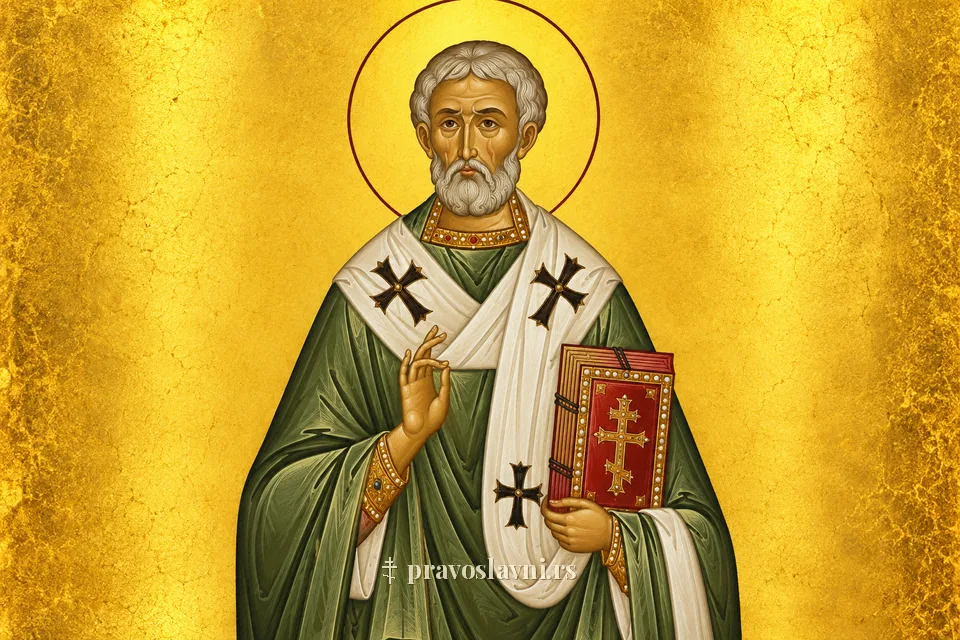
St Januarius, a bishop in Campania, in Italy, suffered in the persecution of Maximian. His Life says that the governor Timothy could not win him over to the idols either by fair words or by intimidation, and the Prologue that he bore his torments patiently and without malice. The fire into which he was thrown did him no harm, for an invisible dew cooled it, and in it he praised God.
The tears of his deacon Faustus and his reader Desiderius betrayed them too as Christians. All three ended up in prison in Puteoli, along with the deacons Proculus and Sosius and the laymen Eutyches and Acutius. When the seven were thrown to the wild beasts, not one of the beasts attacked them. His Life then tells that the governor went blind and that the prayer of Januarius restored the sight of his eyes, although spiritually he remained blind; seeing these miracles, about five thousand people came to believe in Christ. The martyrs were beheaded; the Prologue gives the year 305.
Naples gained its intercessor when the Christians of that city secretly brought the body of Januarius to their home and buried it in a church. His Life also mentions a glass vessel with his blood, which becomes liquid beside the saint's head, and Vesuvius, whose eruption ceased after prayer at his tomb. Both sources say that at the tomb the miracles have not ceased even today. They also remember a certain widow: when her only son died, she laid the saint's icon upon him and prayed in tears, and the child came back to life.
Januarius teaches that torments are to be borne with patience and without hatred, and that God does not abandon those who confess Him.
Full Life
The bishop and his companions
St Januarius was a bishop in Campania, in Italy, at the time when the Emperor Maximian was persecuting the Christians; his Life mentions Diocletian alongside him as well. His closest fellow workers, the deacon Faustus and the reader Desiderius, suffered together with him. The two of them followed his torture with tears — his Life says that at the same time they rejoiced at his courage — and it was precisely this that gave them away as Christians, so they too were bound.
In the prison at Puteoli, where all three were taken, they found four more: the deacons of Puteoli, Proculus and Sossius, and the laymen Eutyches and Acutius. So there were seven of them, and together they met their end.
Stronger than the court and the tortures
His Life relates that the bishop was tried by Timothy, the governor of Campania. First with fair words and then with threats he tried to bring him to bow down to the idols, but Januarius did not yield. The Prologue stresses that he bore the tortures patiently, bearing no malice towards his torturers. His Life mentions the device on which they stretched him, and beatings, while both sources mention iron combs — but not even that separated him from Christ.
Fire and wild beasts
When they threw the bishop into the fire — into a furnace, according to his Life — the flames did him no harm: his Life says that an angel sent an invisible dew. In the fire Januarius praised God, and the flames, according to his Life, did not touch even his clothing. Timothy saw in this nothing but sorcery.
On the following day the seven were thrown to the wild beasts. There too nothing happened to them: according to his Life, the animals lay down quietly at the bishop's feet. Then, according to his Life, the governor himself went blind. Januarius prayed for him, and the sight of his eyes returned to Timothy, but spiritually he remained blind. About five thousand people who were watching these miracles, as his Life records, accepted faith in Christ. The martyrs were then beheaded — outside Puteoli, according to his Life; the Prologue gives 305 as the year of their suffering.
An intercessor through the centuries
Each of the nearby places, according to his Life, wanted an intercessor of its own, and so the bodies of the martyrs ended up in different towns. In this way Januarius became the saint of Naples: the Christians there secretly brought his body to their city and laid it in a church. At Puteoli, according to his Life, his blood remained, which the faithful gathered from the ground into a glass vessel. His Life also records a miracle connected with it: beside the saint's head the dried blood becomes liquid again.
The Prologue and his Life bear witness that at his tomb the miracles have not ceased to this day. His Life tells that, when Vesuvius began to throw out fire and to threaten the settlements far and wide, the people gathered in prayer at his tomb, and the eruption stopped, and no one was hurt.
A miracle with an icon has also been preserved. A poor widow — Maximilla, according to his Life — was left without her only son. She sought help through the saint's icon: the wooden icon above the church doors, as his Life says, she carried away and laid upon the dead boy, and then she prayed in tears: “Servant of God, have mercy on me and comfort me in my grief.” Her son came back to life. His Life compares this with the miracle of the Prophet Elisha and the son of the Shunammite woman.
Januarius teaches us to bear sufferings with patience and without hatred. God guards those who confess Him, both in the fire and among the wild beasts, and His saint remains an intercessor on whom people rely through the centuries.