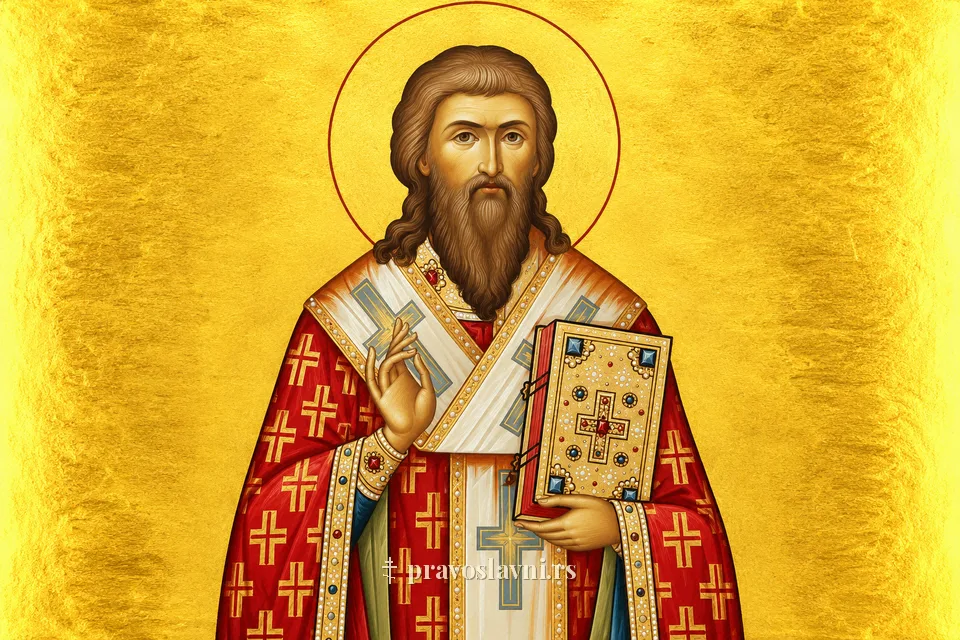
The Liturgy in the church of Ancyra was the last that Bishop Clement served: in the middle of the service soldiers burst in and beheaded him before the altar. It was the year 312. The Prologue and his Life reckon that his suffering had by then lasted a full twenty-eight years.
Clement was born in Ancyra in the year 258. His mother Euphrosyne was a Christian, and his father a pagan. He lost both his father and his mother early, and he was brought up by Sophia, a friend of his mother. He was a great faster, and when he was only about twenty years old he became bishop of his city. His Life says that in a time of famine he gathered abandoned children and brought them to the faith.
In the persecution of the Emperor Diocletian he was brought to trial. In Rome Diocletian himself set a choice before him: imperial gifts and honours, or torture. Clement chose torture, for Christ was dearer to him than everything. In all he passed through the hands of eleven torturers, in many cities and prisons. The Prologue also remembers his reply to a torturer who was striking him on the face: “You do me honour, O Domentian, and you do not torment me.” His testimony, as his Life gives it, was brief: “I am a servant of Christ.”
His Life tells that on the way a young man, Agathangelus, joined him and that together they experienced many miracles. Angels fed them and healed them, wild beasts did not touch them, and at Clement's prayer a spring flowed out in dry ground. Many, looking at them, received baptism. Sophia used to visit them in prison and bind up their wounds. Agathangelus suffered before Clement, and the faithful Sophia laid his body in a cave church. Before his death Clement, according to his Life, foretold the end of the persecution and a Christian emperor who would found the New Rome. He was buried in the same cave church, beside his fellow sufferer.
St Clement bears witness that no torment borne for Christ remains without a reward. Whoever perseveres in trust in God is not left alone even in the longest trial.
Full Life
Who Clement Was
Clement was Bishop of Ancyra, the chief city of Galatia. He was born in Ancyra in the year 258. His father was a pagan, and his mother Euphrosyne was a Christian. The Life records that his father died while his son was still an infant. The name Clement, which his mother gave the boy, means a young vine in Greek. Nor did his mother live long. Before her death she foretold his martyrdom and asked him not to falter in it; the boy was then about twelve years old. The orphan was not left without a home: Sophia, a wealthy friend of his mother who had no children of her own, adopted him and brought him up as a Christian.
The Life also remembers a time of famine in Galatia: Clement then gathered the abandoned pagan children, cared for them in Sophia's house and brought them to baptism. From his youth he lived as a strict faster. At about the age of twenty, after he had passed through all the lower degrees of church service, he became Bishop of Ancyra. He taught both children and adults and baptised many pagans.
The Choice before the Emperor
When the Emperor Diocletian ordered that the Christians be killed, the pagans accused Clement of forbidding the people to worship the idols. The governor of Galatia tried to turn him away from the faith, first by flattery and then by threats. Since he did not succeed, he handed him over to torture. The Prologue remembers how he answered the torturer who was striking him on the face: “You are doing me honour, O Domitian, and not tormenting me.”
Then he was sent to Rome, before Diocletian himself. According to the Prologue and the Life, there he could choose between the Emperor's favour and torture — and he chose torture. By this he showed that no honour of this world was worth more to him than Christ.
Twenty-Eight Years of Faithfulness
His suffering, according to the Prologue and the Life, lasted twenty-eight years, under eleven torturers. The Life, referring to the Greek historian Nicephorus, also names the cities in which he was tortured: Ancyra, Rome, Nicomedia, Amisus, Tarsus and others. Emperors and governors succeeded one another, and Clement remained the same. The Life also says that it was revealed to him how long he would suffer.
On that road he was not alone. According to the Life, on the ship that was taking him to Nicomedia he was joined by the young man Agathangelus, who had escaped Diocletian's executions. From then on they shared everything: prisons, torments and consolation. Agathangelus, having returned with Clement to Ancyra, was beheaded there, and Sophia buried him, in the cave church.
God's Help in Prison
According to the Life, God did not abandon His confessor even in the hardest hours. The torture on the wheel was broken off because the wheel stopped, and Clement stood up healed, although no one saw who was healing him. That same evening many people came to the prison, both men and mothers with children, to receive baptism from him. The bread and wine for the first Holy Communion of the newly baptised were brought to him at night by a radiant young man. At sea an angel fed him and Agathangelus, wild beasts did not touch them, in a red-hot furnace they remained unharmed, and in a dry region a spring flowed forth at Clement's prayer. Wherever they came, they preached and healed the blind, the paralysed and the possessed, and so many came to believe. The Prologue does not go into listing them: according to it, his miracles are without number.
The Last Liturgy
The Emperor Maximinus in the end sent him back to Ancyra, which was a joy to Clement, for he had been praying to God that his martyrdom might take place in his native city. The Life says that a guard, a secret Christian, let him out of the prison. Clement then served the Divine Liturgy in the cave church and foretold his own death, the end of the persecution and a Christian emperor who would found the New Rome. His end came in the church itself in Ancyra: soldiers cut him down before the altar, in the midst of the service. With him, according to the Life, the deacons Christopher and Chariton also suffered. This was in the year 312. Sophia and the faithful buried him in the cave church, beside Agathangelus.
Twenty-eight years of torment have passed, but what Clement gained by them does not pass away. Whoever, like him, trusts in God through years and decades remains faithful to the end.