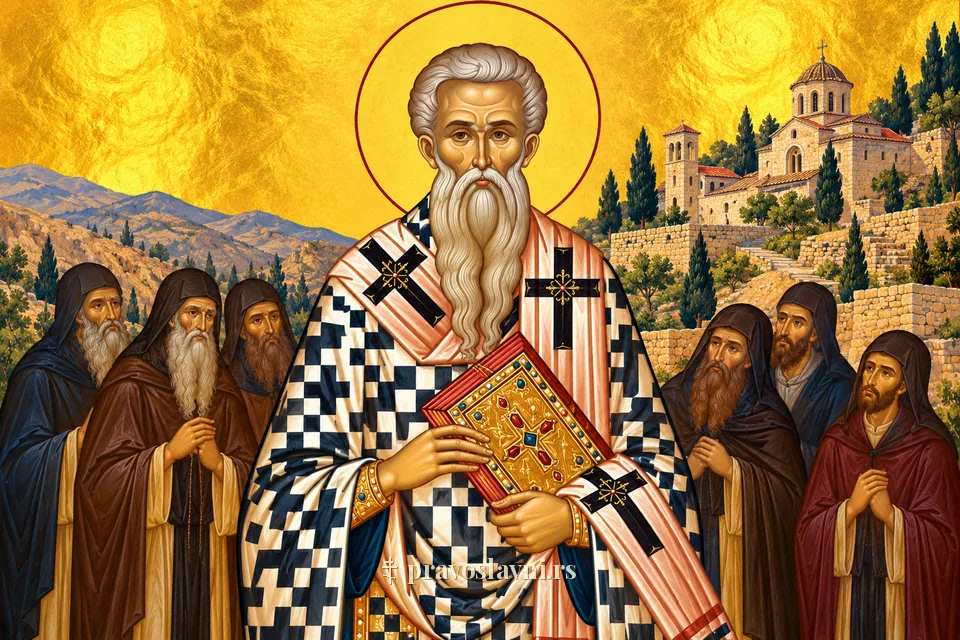
Nikon was a soldier twice over: first a Roman officer, a native of Naples, and then an ascetic of Christ and a bishop, who was followed by his former comrades from the army as well.
The turning point came in a battle. His unit found itself surrounded, and he, on the advice of his Christian mother, guarded himself with the sign of the cross and called upon Christ. The enemy, as the Prologue and his Life record, was routed, and Nikon returned with the cry: “Great is the God of the Christians!”
From then on he lived for Christ. He sailed away in secret and received baptism from Theodosius, Bishop of Cyzicus, with whom he remained in the monastery, devoted to books and to asceticism. Since it had been revealed to him in a vision that Nikon was to succeed him, Theodosius led him through all the degrees of the priesthood up to that of bishop. When he returned to Naples, he found his mother still alive, and nine former comrades from the army joined him. With them he crossed over to Sicily and, according to the Prologue, preached the Gospel; his Life says that with him there were also the monks whom Theodosius had entrusted to him.
The Sicilian governor Quintian, in the reign of Decius, arrested them all. The monks, according to the Life, confessed: “We are Christians, and we shall never abandon our faith”, and all of them were put to death by the sword — one hundred and ninety-nine in all. Nikon was tortured in many ways, and his Life says that an angel visited him in prison with the words: “Be valiant in God, Nikon, soldier of Christ, and be glad”. In the end he was beheaded, and his body was left in a field. His Life adds that Quintian soon perished, drowning in a river, as Nikon had foretold to him.
The last testimony came through a boy. An unclean spirit left a certain shepherd boy when he fell upon the martyr's body, and the boy's story brought the Christians to bury Nikon with honour. According to the Life, his disciples were buried then as well.
The life of St Nikon shows that the quiet faith of a mother can bear great fruit: a soldier saved by the sign of the cross became a soldier of Christ and, with his disciples, chose to give his life rather than renounce the faith.
Full Life
A Mother Who Taught Quietly
St Nikon owed his faith to his mother. She was a Christian and her husband a pagan, and so in Naples she secretly taught her son about Christ — especially, his Life says, about the power of the cross. Nikon became a Roman officer, whom his Life describes as handsome, cheerful and brave, but still unbaptised.
The opportunity to test his mother's words came on the battlefield: the enemy surrounded his soldiers and it seemed that there was no escape for them. Then, as the Prologue and his Life record, he did what his mother had directed him to do: he signed himself with the sign of the cross and called upon Christ. His Life also preserves the words of that prayer: “O Christ, almighty God, show upon me in this hour the power of Your cross.” New strength carried him into the charge and the enemy was routed. He came home with the cry “Great is the God of the Christians!” and told his mother everything, and according to his Life he said to her: “I will no longer bow down to stones, nor to any other created thing.” She, according to his Life, directed him to fast for forty days, to receive instruction, to renounce Satan and to be baptised, and she blessed him for the journey.
Nikon saw his mother once more, when he returned to Naples as a bishop. His Life says that, on catching sight of her son, she gave thanks to God, asked Him to receive her, and reposed in peace.
From Baptism to Hierarch
The road to baptism led across the sea, in secret — according to the Prologue, to Asia; his Life mentions Constantinople, Chios and Mount Ganos, as well as an angel in the form of a bishop who directed him to some sailors. He received baptism from Theodosius, Bishop of Cyzicus; his Life says that this bishop was living in hiding together with monks and that he knew beforehand from God of Nikon's coming. The former soldier became a monk, devoted to books and to asceticism; his Life mentions three years of humility, fasting and prayer by night. Theodosius received a command in a vision that Nikon should be his successor, and he gradually raised him to the rank of bishop. His Life adds that, before his own death, he handed over to him the care of one hundred and ninety monks.
The Brotherhood in Sicily
In Naples Nikon was joined by nine former comrades from the army, who were convinced, as his Life says, that he had saved their lives. With them and with the monks he went to Sicily, where, according to the Prologue, he preached the Gospel. According to his Life, the brotherhood settled in the interior, by an old stone bathhouse on the River Asinos, not far from Tauromenium; they cultivated gardens and orchards, and Nikon baptised the soldiers and received them as monks.
Faithful to the End
The peace was broken by Quintian, the governor of Sicily, who in the time of the Emperor Decius arrested the whole brotherhood. The monks, according to his Life, declared without wavering: “We are Christians, and we shall never abandon our faith.” All of them were beheaded — one hundred and ninety-nine monks and soldiers together.
Neither being tied to horses nor a fall from a cliff, which both sources mention, nor the beatings, of which the Prologue speaks, could break him. His Life speaks of those days as a series of miracles: an angel encouraged him in prison with the words “Be valiant in God, Nikon, soldier of Christ, and be glad,” the fire did not burn him, the horses grew calm before the sign of the cross, and an angel led him out of the ravine. His life was ended by the sword, and his body was left in a field.
A Witness after Death
According to his Life, the healing of a certain boy revealed where the martyr lay. He was a shepherd tormented by an unclean spirit, and he recovered when he fell upon Nikon's body; when he told of this, the Christians came and buried the martyr with honours. According to his Life, the Bishop of Messina then found the bodies of the disciples untouched as well and laid them all in a tomb. Quintian, as his Life says, perished just as had been foretold to him: on the road to Panormus, while he was crossing the River Psemithus, his own horses, gone wild, attacked him and he drowned.
St Nikon bears witness that the quiet faith of one mother can bring forth great fruit: a soldier saved by the sign of the cross became a soldier of Christ, and together with his disciples he chose to give up his life rather than renounce Christ.