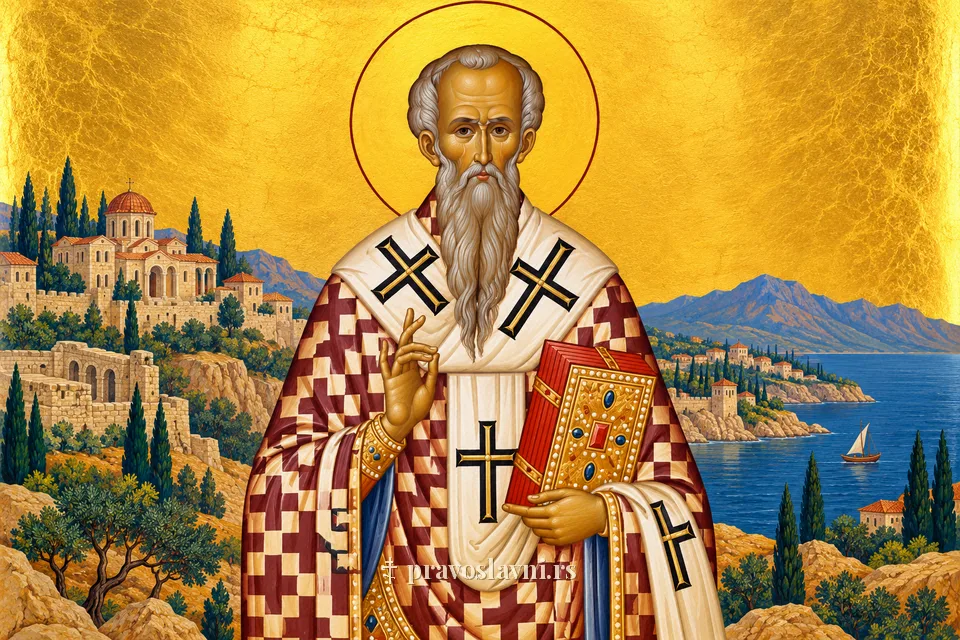
“Above all, taking the shield of faith with which you will be able to quench all the fiery darts of the wicked one.”
— Eph 6:16
Life
St Pancratius, Bishop of Tauromenium in Sicily, entrusted the defence of his city to the Cross. When the pagan commander Aquilinus set out to destroy the city that had accepted Christianity, the bishop calmed the frightened faithful and, with his clergy, went out before the army with a cross in his hands, and according to his Life also with icons of Christ and of the Mother of God. The attackers found themselves in darkness and fear and turned their weapons against one another. Those who survived, according to his Life, asked for forgiveness and were baptised.
Such faith had a deep root. Pancratius was born in Antioch in the time of Christ, and his parents took him to Jerusalem, where they saw Jesus and listened to Him. His Life says that his father came to believe that He is the Son of God. In Jerusalem the Apostle Peter came to know the boy. After the Ascension the family was baptised in Antioch; according to his Life, the father baptised the whole household. His Life says that his parents soon died and that Pancratius renounced his inheritance, and then withdrew to a cave in the Pontic mountains, for fasting and prayer.
Peter found him there and, according to his Life, took him to Cilicia, where they met the Apostle Paul. In agreement with Paul, Peter appointed him Bishop of Tauromenium. According to his Life, Crescens was appointed for Galatia and Marcian for Syracuse at the same time. His Life tells that on the voyage two of the ship's officers, Lycaonides and Romilus, were baptised. When he arrived in Tauromenium, the idols began to fall. The temple of Falcon, Lysippus and Scamadron by the sea collapsed into the waves, and so the governor of the city, Boniface, came to believe and built a church in thirty days. The city had gained a wise shepherd: his ministry was accompanied by miracles, according to his Life also by healings and the casting out of demons; the idols disappeared, and the unbaptised were baptised. According to his Life, the surrounding places received the faith as well.
After a long episcopate he was stoned by envious pagans, according to his Life in agreement with Prince Artagatus. The Prologue records that his relics are in Rome.
Full Life
A cross instead of weapons
When the pagan general Aquilinus learned that Tauromenium in Sicily had received the faith of Christ, he led an army against the city. The faithful were afraid, and their bishop Pancratius asked them to be at peace and to trust in God. With his priests he went out to meet the army, and in their hands they carried a cross, and according to his Life also icons of Christ and of the Mother of God. The attackers were left in darkness, without the strength to master their fear, and they began to kill one another. According to his Life, those who survived came to Pancratius, begged his forgiveness and were baptised.
That event shows best what kind of man Pancratius was: in trouble he relied on the cross, and not on force.
A childhood close to Christ
He was a native of Antioch and lived at the time of Christ's preaching. His parents, who had heard of the miracles, took the boy to Jerusalem. There the family saw Jesus and His works with their own eyes and listened to His word, and his Life says that his father came to believe that He is the Son of God. In Jerusalem the boy came to know the Apostle Peter.
He received baptism in Antioch after the Ascension, together with his parents; according to his Life, his father had the whole household baptised. His Life adds that his parents soon died and that Pancratius did not keep his inheritance. He went away to the Pontic mountains and lived in a cave in fasting and prayer.
The envoy of the apostles
There he was found by the Apostle Peter, who was preaching in that region. According to his Life, he recognised him and took him with him to Antioch, and then to Cilicia, where they met the Apostle Paul. Peter, in agreement with Paul, appointed him Bishop of Tauromenium. According to his Life, at that same time Crescens in Galatia and Marcian in Syracuse were also appointed bishops.
While he was still on the voyage, his Life says, two of the ship's officers, Lycaonides and Romilus, came to believe and were baptised. In Tauromenium the idols began to fall as soon as he arrived. The temple of Falcon, Lysippus and Scamandrus, on a height beside the sea, crashed down into the water when he drew near to it. The governor of the city, Boniface, saw this; he came to believe, was baptised and built a church in thirty days.
His service as bishop was accompanied by miracles; his Life mentions in particular healings of the sick and the casting out of demons. He wisely guided the Church, which was growing in the city, while idolatry was growing weak. According to his Life, both Tauromenium and the towns around it became Christian.
A martyr's death
According to his Life, he was bishop for many long years. He was stoned by envious pagans, according to his Life in agreement with the governor Artagatus. The Prologue records that his relics are in Rome.
Other saints of the day
St Theodore of Edessa
St Theodore, Bishop of Edessa, was according to his Life the son of Simeon and Mary of Edessa, who for a long time had no children and prayed for a son, giving alms. His Life says that in a vision the Apostle Paul and the martyr Theodore the Tyro promised them a son and told them to give him the name Theodore. As a boy he found learning hard, but, according to his Life, after a dream in church in which a radiant youth gave him honey, he became quick-witted and was made a reader. According to his Life, in his eighteenth year he lost his father, and a year later his mother as well; he gave away his property to the poor and provided for his sister, whose son Basil later became a bishop and wrote his Life. He was tonsured a monk in his twentieth year, according to his Life in Jerusalem, in the Lavra of St Sabbas. The Prologue says that he spent thirty-six years in monasticism, while his Life mentions twenty-four years of life as a hermit. According to his Life, his kinsman Michael, a monk who was with him, was put to death by the Saracen ruler because he would not deny Christ, and his body was brought to the Lavra. According to the Prologue, he was chosen as Bishop of Edessa in the time of Emperor Michael and Empress Theodora. As bishop, says his Life, he met with resistance from heretical groups, and the church estates were being seized. Together with him the Prologue mentions his teacher Theodosius the Stylite from Syria and Theodosius's brother John, as well as Ader, a nobleman who left his wife and his wealth and became a monk, according to the Life with the name Athanasius. According to the Prologue, he reposed in the year 848.