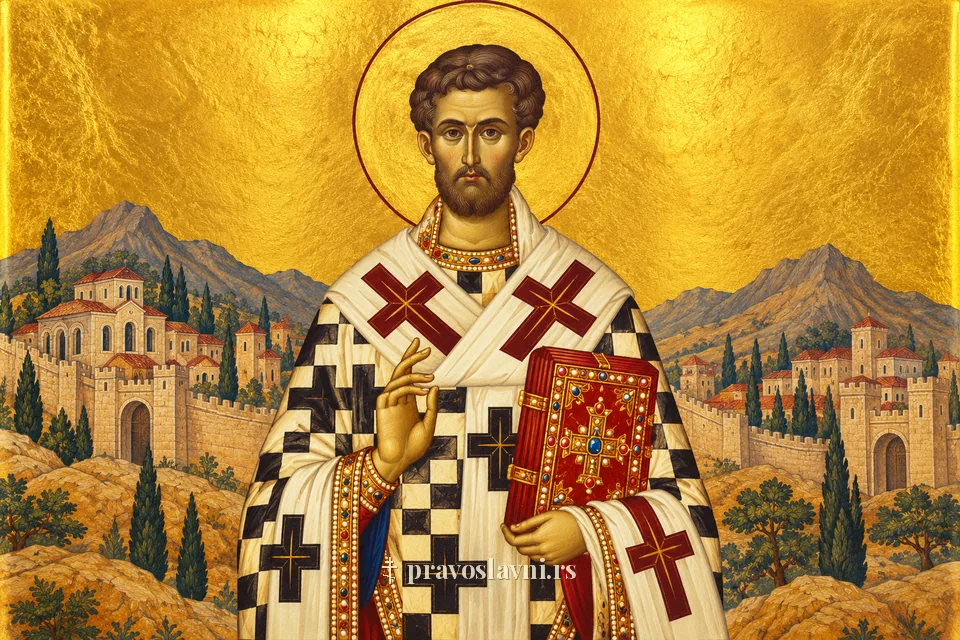
“For we cannot but speak the things which we have seen and heard.”
— Acts 4:20
Life
In prison, in chains, St Timothy, Bishop of Prusa, still went on teaching the faithful who came to him. Emperor Julian, who had renounced Christ, forbade him, according to his Life, to teach about the name of Jesus, but the bishop did not stop. And so the emperor sent an executioner, who beheaded him in the prison in the year 362.
Timothy was the shepherd of the city of Prusa, near Mount Olympus. Both sources see the gift of healing every illness as the fruit of his holy life. According to his Life, he taught his people and brought many unbelievers to Christ. The Life also remembers his victory over a huge dragon from a cave, which used to attack cattle and people: the bishop killed it with a covering from the altar. The same Life says that he healed a certain emperor of a deadly illness and a certain empress on her deathbed, whom he brought to the true faith.
When Julian began to persecute the Church, Timothy, according to his Life, preached even more, strengthened the faithful and exposed the errors of the pagans. For this he was thrown into prison, and even there he did not stop teaching; according to the Prologue, the faithful came to him for a word of instruction.
The faithful, according to his Life, buried his body with honour, and his relics and tomb, according to both sources, remained a source of miracles and healings.
St Timothy teaches us that the truth must not be passed over in silence, even under threat.
Full Life
The Shepherd of the City beneath Olympus
St Timothy was the bishop of the city of Prusa. His Life says that this city lay on the border of Bithynia, Phrygia and Mysia, near Mount Olympus. The Prologue and the Life say that he lived so purely and so holily that God endowed him with the power to work miracles, and there was no illness or trouble that he did not heal.
According to his Life, he tirelessly taught and enlightened his people, and he brought many unbelievers to Christ.
Miracles Remembered by the Life
The Life preserves several unusual events from his life. According to the Life, an enormous dragon that hid in a cave was destroying cattle and people. The bishop overcame it in an unusual way: he threw into its jaws the altar veil that had covered the holy bread.
The same Life says that he healed a certain emperor of a grave, deadly illness, and then also a certain empress who was at the point of death; in addition, he turned her away from idolatry to the true faith. The Prologue does not mention these events, but it too bears witness that Timothy was a great wonderworker.
Chains Did Not Stop the Word
Timothy lived in the time of the wicked Emperor Julian, who renounced Christ; the Life says that he worshipped idols and fiercely persecuted the Church. The bishop did not withdraw. According to the Life, he then preached even more, strengthened the faithful and exposed the errors of the pagans.
Julian ordered that he be seized and thrown into prison, as both sources record. Even there his word did not fall silent: the faithful came to him, and he, in chains, taught them. According to the Prologue, the faithful came to him in prison for the sake of his teaching, which was full of wisdom. According to the Life, the emperor forbade him to teach about the name of Jesus, but Timothy did not obey.
When Julian learned that the bishop was still teaching, he sent an executioner, who, as both sources say, beheaded him in the prison in the year 362.
A Tomb That Heals
According to the Life, the faithful took his body and buried it with honour. His relics and his tomb, according to both sources, remained a source of miracles and healings; the Prologue says that they revealed the power of God, and that the soul of St Timothy went to Paradise.
St Timothy did not agree to keep silent about Christ even in prison: neither chains nor the emperor's ban forced him to be silent. His example reminds us that a faithful word can teach even when the hands are in chains.