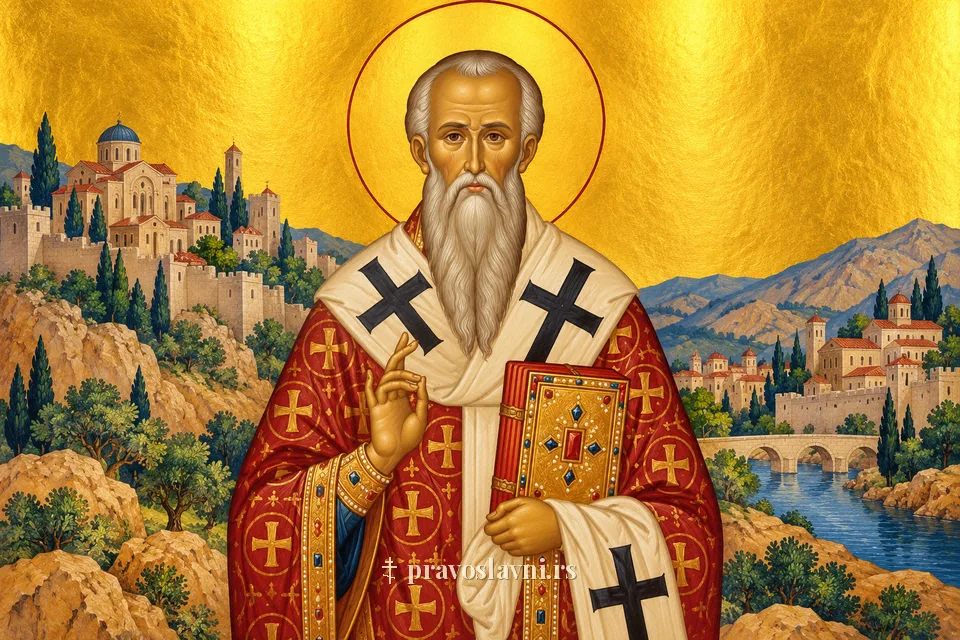
The Emperor Licinius offered Bishop Basil of Amasea a pardon, honours, and even the post of chief over the pagan priests, if only he would offer sacrifice to the idols. Basil, according to his Life, refused twice, and by doing so signed his own death sentence. The Emperor held one young woman against him: in Amasea Basil had given shelter to Glaphyra, who had fled from the Emperor's dishonourable intentions.
Glaphyra, according to the Life a Christian from Italy, was in the service of the Empress. When Licinius, who from a false Christian had turned into a persecutor, wanted to dishonour her, the Empress secretly sent her away from the court. The Life tells that she reached Amasea in men's clothing, where she was first taken in by a Christian named Quintius, and that the Empress, so that the Emperor would not search for her, said that the girl had died. The bishop received her, and she, according to the Life, gave her gold and silver for the church that he was building; the Empress also sent money for that church.
Licinius learnt of the hiding place from a letter handed to him by a eunuch, and he ordered that both Glaphyra and the bishop be brought to him in chains to Nicomedia. Glaphyra did not live to be taken away, so they brought only the bishop, and according to his Life the deacons Parthenius and Theotimus were with him. The night before the trial, the Life says, he spent in prayer and foretold his own death. He was tortured and then beheaded in the year 322; on the seashore, according to his Life, he took leave of his own people and said to the executioner: “Friend, carry out what you have been ordered to do.” His body was thrown into the sea.
The body was buried in Amasea, in the church for which Basil had laboured; before that, his faithful, following an angel's direction, had drawn it out of the sea near Sinope with fishing nets. The Life records that the head was found in its place and that the body gave off a sweet fragrance. Licinius was later defeated by Constantine and died as an exile in Gaul, and the Life adds that the East then gained the freedom to worship Christ.
Basil's life shows that faithfulness to Christ outweighs power, honours and life itself.
Full Life
The persecuting Emperor and the virgin Glaphyra
St Basil was Bishop of Amasea in Pontus at the time when the East was ruled by Licinius, the brother-in-law of the Emperor Constantine the Great. At first he pretended to be a Christian, but when he had made his power secure, he turned against the Church — covertly at the beginning, later without restraint — and spread idolatry. His Life states that he drove the Christians from the court and that he lived dissolutely, sparing neither the wives nor the daughters of senators.
One of those whom he wished to dishonour was the virgin Glaphyra, who served the Empress. His Life says that she was a Christian from Italy and that she refused the proposal brought to her by the eunuch Benignus. Glaphyra told the Empress everything, and she secretly sent her away from Nicomedia — to the region of Pontus according to the Prologue, and towards Armenia according to his Life, with gold, silver, jewellery, clothing and servants. According to his Life, the Empress Constantia, herself a Christian, spread word that Glaphyra had gone mad and died, and so the Emperor stopped looking for her.
A refuge in Amasea
His Life relates that Glaphyra, dressed in men's clothing, reached Amasea, where the Christian Quintius received her. Bishop Basil took her under his protection; according to his Life, when he heard her story, he advised her to stay hidden, so as not to endanger the Christians there. Basil was then building a church, and his Life records that Glaphyra gave all her gold and silver for it. The Empress too sent money for the church of Amasea, with a letter, according to his Life, in which she commended Glaphyra to the bishop.
The secret was betrayed by a eunuch, Benignus according to his Life, who got hold of the letter and took it to Licinius. The Emperor ordered that Glaphyra and the bishop be brought in chains to Nicomedia. Glaphyra died before that — on the way, the Prologue says — and so they brought only Basil, bound. His Life states that he was accompanied by the deacons Parthenius and Theotimus, who suffered with him on the journey.
Unshaken before the Emperor
In Nicomedia Basil was thrown into prison. His Life relates that the deacons stayed with the Christian Elpidephorus, who bribed the gaoler, so that they were able to serve and to pray in the prison at night. According to his Life, the bishop spent the night before the trial in prayer with tears, singing Psalms 131 and 138. He then foretold his death, named Eutychius, the son of Callistus, as his successor, sent the deacons back to Amasea, and entrusted the care of hospitality to Elpidephorus.
According to his Life, before the Emperor, who accused him of having hidden Glaphyra, he answered boldly. Licinius offered him pardon and honours, and even that he should become chief over the pagan priests, if he would offer sacrifice to the idols. Basil refused, and when he refused a second time as well, through the tribune, he was condemned. They tortured him, and his Life says that he bore the blows of the tribune's men with joy.
On the seashore, according to his Life, he prayed, kissed the deacons and Elpidephorus and said to them: “Greet my brethren and my children.” To the executioner he said: “Friend, carry out what you have been ordered to do.” He was beheaded in the year 322, and his body was thrown into the sea.
The sea gave back the body
His Life records that Elpidephorus wanted to ransom the body and the head, but they did not allow him to, and so the soldiers threw them into the sea from a fishing boat in different places. All this was seen by John, a presbyter of Nicomedia, who later wrote down the account of Basil's suffering. Near Sinope Basil's people drew the body out with fishing nets, and an angel showed them the place. His Life relates that the angel revealed it to Elpidephorus in a dream, and that the same dream came to the deacons; Theotimus's net came up empty, but Elpidephorus's net drew out the body. His Life adds that the body was fragrant and that it was whole: only a mark remained on the neck. Basil was laid in a tomb in Amasea, in the church that he himself had been building.
Licinius's end came from Constantine: defeated in war and, according to his Life, taken captive, he ended his life in exile in Gaul. His Life says that the East was then set free and that Christ was worshipped freely.
St Basil teaches that faithfulness to Christ outweighs earthly power, honours, and even life itself. God protects the innocent, reveals what is hidden and glorifies His steadfast witnesses.