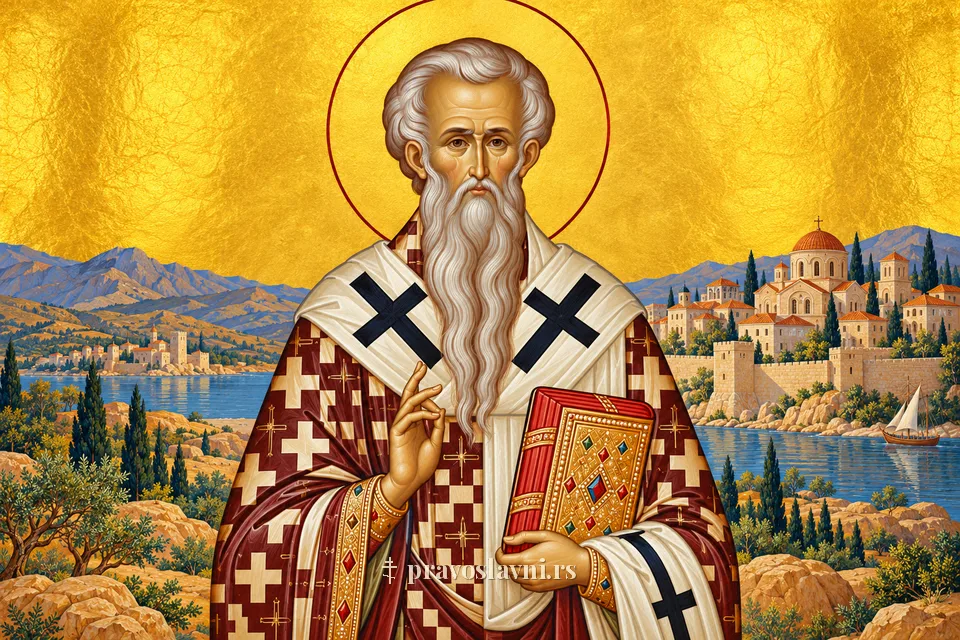
Theophylact, Bishop of Nicomedia, is numbered among the confessors from the time of the struggle for the holy icons. Because of his faithfulness to Orthodoxy he lost his see and spent thirty years as an exile, right up to his death, about the year 845.
The Prologue and the Life remember him above all as a merciful shepherd. The poor found help with him, and thanks to him Nicomedia received hospitals, houses for travellers and new churches. Even the most gravely ill, lepers among them, he did not leave to others, but cared for them himself.
His path led from the court to the monastery. The Life says that he came from the east to Constantinople and became close to Tarasius, who at that time was not yet a clergyman. When Tarasius, as patriarch, summoned the Seventh Ecumenical Council against iconoclasm, he also made Theophylact a monk, and afterwards appointed him to the see of Nicomedia. From his monastic years the Life mentions a miracle in a time of drought, when the prayer of two monks brought water.
Iconoclasm returned with the Emperor Leo the Armenian. Theophylact was among the bishops whom Patriarch Nicephorus led to bring the Emperor to his senses, and before him he did not give way. The Life preserves his prophecy: “Know that a cruel destruction will come upon you suddenly”. The Emperor banished him, and he himself, according to the Life, fell by the swords of his own soldiers, in church, on Božić (Christmas).
The relics of the confessor were later returned to Nicomedia, to the church which he himself had built. The Life says that the heresy fell and the truth prevailed. His life shows that mercy and truth go together: whoever serves the least has the strength not to give way even before the greatest.
Full Life
A Word Addressed to the Emperor
When the Emperor Leo the Armenian once again raised the struggle against the holy icons, Theophylact, the Bishop of Nicomedia, did not keep silent. He stood before the ruler and openly opposed him, as both the Prologue and his Life bear witness. When even after that the ruler did not give way, the bishop, as the Prologue records, warned him: “There shall come upon you, O Emperor, a bitter ruin, suddenly.” Those words cost him his see and his freedom, but, according to his Life, they came true.
That is why the Church honours him as a confessor — a man who endured exile and humiliation for the faith, and did not renounce it.
From Friend to Monk
His Life says that he came from the East to Constantinople at the time when the Church was torn by the dispute over the icons. There he gained a friend in Tarasius. Tarasius was not yet in holy orders at that time, but was the Emperor's closest counsellor at court. At that time, his Life records, the Emperor Leo died, and the throne was inherited by his son Constantine, who reigned together with his mother. The Patriarch of that time withdrew of his own will, and Tarasius was chosen in his place. As Patriarch, he convened the Seventh Ecumenical Council, which condemned iconoclasm.
Tarasius tonsured Theophylact a monk. The Prologue records that at the same time he also tonsured several of his friends and admirers, and his Life mentions one of them, with whom Tarasius sent him to a monastery on the Black Sea coast. There, according to his Life, a miracle took place: while a severe drought prevailed, the two monks prayed, and from a copper vessel in which there was nothing they received as much water as they needed. His Life compares this with the water that Moses brought out of the rock and with the spring that God opened for Samson.
The Shepherd Who Washed Wounds
Tarasius then appointed him Bishop of Nicomedia, and his companion bishop in another city. The Prologue remembers Theophylact as a good shepherd, very merciful towards the poor and the unfortunate. His Life shows this by his deeds. Nicomedia received from him new churches, hospitals and shelters for travellers, and the poor received abundant alms. The sick, the blind, the lame and the lepers he tended in person, and he himself cleaned their wounds.
Before the Iconoclast Emperor
After the death of Tarasius, Nicephorus became Patriarch. Then Leo the Armenian took over the imperial power. Iconoclasm, which the Seventh Council had condemned, he brought back to life and tried to impose in place of Orthodoxy. His Life says that Patriarch Nicephorus gathered six bishops, among them Theophylact and his former brother from the monastery, and that they entreated the Emperor with the words of Holy Scripture, but the Emperor would not listen to them.
Then Theophylact uttered his warning. The enraged Emperor removed the bishops and sent them into exile. The Prologue records that he deposed Theophylact from his see by imperial decree and banished him; his Life adds that the Patriarch was banished to Proconnesus, and Theophylact to a fortress on the sea coast.
Thirty Years of Exile
The exile lasted thirty years, as both the Prologue and his Life record. Hardships and mockery followed him through all those years, but he did not renounce the faith. There he also died, around the year 845.
His prophecy, according to his Life, was fulfilled: Leo the Armenian was suddenly killed with swords by his own soldiers, and that in church, on the Nativity of Christ. After him other iconoclast emperors reigned, until the Empress Theodora with her son restored Orthodoxy, and Methodius became Patriarch. The body of St Theophylact was later brought back from exile to Nicomedia and laid in the church that he himself had built.
His Life sees in his life how heresy passes away, while the truth remains. St Theophylact teaches that the faith is defended in two ways: by a bold word before the powerful and by humble service to those who suffer.