Monday18January 20275 January (according to the Julian calendar)
Illustration
Saints of the day
Krstovdan
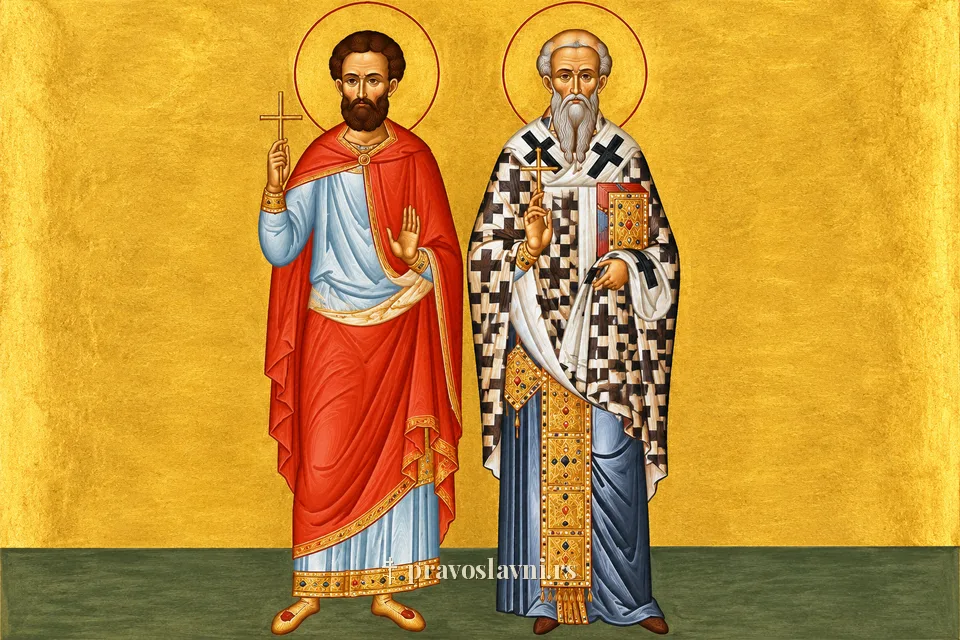
Sts Theopemptus and Theonas
What happenedThe sorcerer Theonas, summoned to overcome Bishop Theopemptus by his spells, saw that not even poison could harm the bishop, fell at his feet and confessed himself a Christian.
“Therefore with joy you will draw water From the wells of salvation.”
— Is 12:3
About this day
Krstovdan is the name for the Eve of Theophany, the day before the feast itself. It should not be confused with the Exaltation of the Precious Cross: in the Menaion this Krstovdan is written in black letters and is not a feast but a forefeast, by which the Church prepares for Theophany. The link with the cross comes from folk custom, because at the blessing of the water the cross is lowered into the water, and so it is said of this day that it is more a folk than a church one.
It is usual on that day to serve the Royal Hours, as on Badnji dan (Christmas Eve), and then the Liturgy of St Basil joined with Vespers, although in some years the order of these services shifts. After the Prayer behind the Ambo the Great Blessing of Water is performed, most often at a river or a spring, in memory of Christ's Baptism in the Jordan. The rite has hymns, three Old Testament readings, the Epistle and the Gospel, a litany, a prayer and the threefold immersion of the cross, and the blessed water is called the Great Agiasma, and with it the church and homes are sprinkled. Since the Vespers of Theophany has already been served, the water blessed on Krstovdan is already Theophany water and is used in the same way as that from the feast itself, without a special prayer. In the calendar the holy martyrs Theopemptus and Theonas are also commemorated on that day.
In some regions people greet one another with the words “Hristos se krsti” (“Christ is baptised”), to which the reply is that truly He is baptised. After Christmas there follows a period in which there is no fasting, and it is interrupted by Krstovdan, the first fasting day after Christmas; for more on fasting, see the guide “Fasting — simply explained”.
Life
This story has two heroes from opposite sides: a bishop whom the Emperor wanted to break, and a sorcerer whom he summoned to do it. In the end both of them died as Christians.
Theopemptus, Bishop of Nicomedia, was the first to be struck by Diocletian's persecution of the Christians. His Life says that the Emperor was at that time, after his arrival from Rome, staying in Nicomedia itself, and that he set up many idols there, which he himself also worshipped. Not even under the threat of death would the bishop renounce Christ and offer sacrifice to Apollo; he called the idols powerless and recalled the Gospel saying that one should not fear those who are able to kill only the body.
Of the torments that followed the Prologue speaks briefly — beatings, hunger and other things. His Life is fuller: the bishop was overcome neither by the fire of the furnace nor by a long imprisonment in which he was given neither food nor water, and after every attempt the Emperor found him alive, praising God.
That is why Diocletian resorted to sorcery and brought in Theonas, who, according to the Life, was an Egyptian. Neither the bread made from bewitched flour, which the Life mentions, nor the poison dissolved in water had any effect: the Prologue says that the bishop, before he drank, blessed the cup with the sign of the cross and remained unharmed. That sight changed the sorcerer himself, who declared before the Emperor: “I too am a Christian, and I worship the Crucified One.”
The Emperor threw them both into prison, and for Theonas, as the Life says, it became the place of his baptism: the bishop instructed him, baptised him and gave him the name Synesius.
Theopemptus, according to his Life, received the news of his execution with joy and gave thanks to God. He was put to death by the sword, confessing the Holy Trinity. Nor did Theonas let himself be turned back to the idols, whatever the Emperor promised him or threatened him with; according to the Prologue, he was buried alive. Both of them suffered in Nicomedia.
Faithfulness to Christ proved stronger than both fear and sorcery: the man whom the Emperor had summoned to defeat the bishop became his brother in the faith.
Full Life
The first in the persecution
Among the Christians struck by Diocletian's persecution, Theopemptus, Bishop of Nicomedia, was the first in line. Nicomedia at that time, according to the Life, had the Emperor within its walls: Diocletian set up many idols there and honoured them himself. He was soon seized in the surroundings of the city and brought before the ruler.
Before him lay a choice: a sacrifice to Apollo or death. Theopemptus did not consent to forsake Christ, and of the idols he said that they have no power at all. He also answered with the words of the Gospel that one should not fear those who kill the body but cannot kill the soul (the Life cites Mt 10:28).
What was meant to destroy him
The Prologue does not dwell on the details: it says only that the bishop endured beatings, hunger and other torments. The Life lists more of them, and according to it not one of them did him harm. The furnace which was stoked from morning until noon did not burn him, although a dog thrown into it afterwards did not survive. Nor did twenty-two days of prison without food and water overcome him: he remained alive and cheerful. Even the eye which, according to the Life, they took from him God restored to him during prayer in the prison, in a light which lit up the cell.
The Life also remembers one night from that time. While the soldiers believed that the bishop was already dead in the furnace, at midnight he was standing beside the Emperor's bed, and no doors, according to the Life, were able to hold him back. Diocletian, awakened, heard from him: “I am Bishop Theopemptus, a man of Jesus Christ”. Then he returned to the place of torment, and the Emperor found him there unharmed, glorifying God. The Emperor nevertheless concluded that he had a sorcerer before him.
The sorcerer who came to believe
Since the tortures had not helped, the Emperor turned to sorcery. The Life says that heralds throughout the whole empire promised a reward and that Theonas, an Egyptian, came forward. He first showed his power, according to the Life, on a wild bull, by whispering something into its ear.
Before the bishop, however, his spells were worth nothing. According to the Life, Theonas also gave the bishop bread made from enchanted flour, but it did him no harm. Nor did poison mixed with water bring him down: the Prologue records that he made the sign of the cross over the cup before he drank it. Theonas then fell at the bishop's feet and confessed before the Emperor himself: “I too am a Christian, and I worship the Crucified One”.
The prison into which the Emperor then cast them became for Theonas the place of his baptism. The Life says that there the bishop instructed him in the faith, baptised him and gave him a new name, Synesius.
The crown of martyrdom
The Life mentions two more attempts to break the bishop, with a heavy stone and with hanging, and both remained without effect. The death sentence, according to the Life, he received with joy, as something he had long desired; he gave thanks to God and prayed the Lord to remember him. He was beheaded, confessing the Holy Trinity.
The Emperor tried to bring Theonas back to the old gods both with fair words and with threats, but in vain. The Prologue says that he was buried alive in the earth. Both suffered in Nicomedia, and about the year the sources do not agree: the Prologue places their suffering in the year 298, while the Life gives 303 as the year of Theonas's death.
Faith stronger than fear
Faithfulness to Christ overcame both the fear of torments and the power of sorcery. The Emperor had on his side authority, prisons and sorcerers, and the bishop only faith — and it turned out that this was enough. The Emperor brought his sorcerer to break the bishop, and the sorcerer, seeing his steadfastness, himself came to believe. The bishop whom the Emperor persecuted and the sorcerer whom the Emperor summoned ended as brothers, both faithful to Christ unto death.
Other saints of the day
Venerable Mother Syncletica
St Syncletica was of Macedonian descent, and she grew up in Alexandria. As a rich and distinguished young woman she had many suitors, but she refused them all, because she longed only for the Heavenly Bridegroom. She had two brothers and a sister who was of the same mind, and who was deprived of her sight. When her parents died, she called a priest to tonsure her a nun, and then she settled in the tomb of one of her relatives, far from the city. There she lived until her eightieth year in the greatest abstinence, vigil and prayer. She did not gain her wisdom from books, but through suffering and spiritual communion, and so her teachings to the nuns were always highly valued. Of hiding one's virtue she used to say: “Just as a treasure that is uncovered is quickly carried off, so virtue too, when it is made known, grows dim and is lost.” Towards the end of her life she bore heavy sufferings, and she reposed in the year 350.