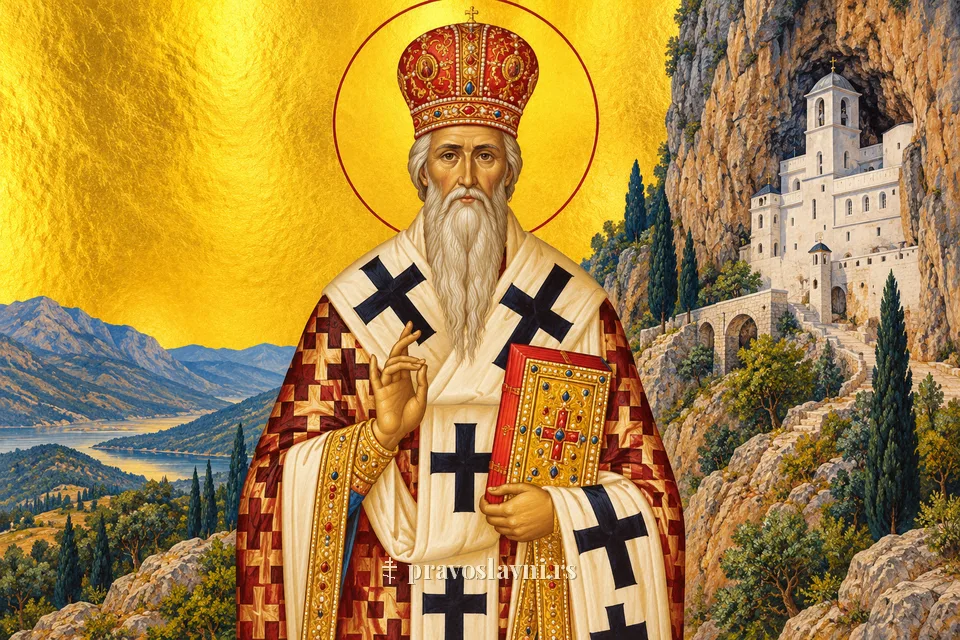
St Basil of Ostrog is close even today to everyone who approaches him: at his tomb the miracles cannot be counted, and both Christians and Muslims turn to him for healing. Both the Prologue and his Life say that his body has not decayed and that God works miracles through it. Every year a great gathering of the people assembles at Ostrog.
He was born in Herzegovina, in a devout family; his Life states that this was in 1610 at Mrkonjići in Popovo polje, and that at baptism he was called Stojan. He loved the church from his earliest years, and he studied at the monastery of Zavala with his uncle, Abbot Serafim. He became a monk at Tvrdoš, near Trebinje, and received the name Basil. The Prologue records that he was a strict ascetic, who constantly took ever harder labours upon himself.
As a priest and archimandrite he was, according to his Life, a zealot for Orthodoxy: he went round the villages, helped the poor, opened schools and restored churches. He travelled to Russia, from where he brought books, vestments and liturgical vessels, and he spent a year on the Holy Mountain (Mount Athos), mostly at Hilandar. He became a bishop — the Prologue says against his will, as Bishop of Zahumlje and Skenderija, while his Life states that in 1638 he was consecrated Metropolitan of Trebinje at Peć. He defended the people both from Turkish pressure and from Latin propaganda, and according to his Life miracles were already being told of him at that time.
Ostrog became his home after he was, according to his Life, driven out of Tvrdoš. According to the Life, he settled in the cave of an earlier ascetic, Isaija, restored the church of the Entry of the Theotokos and carved a new one into the rock, and from there he helped his people most of all by prayer. He reposed in peace on 29 April 1671. The Life records that his tomb was opened in 1678, after a vision in a dream, and that his body was found glorified, with the fragrance of basil. According to the Life, in troubled times the relics were moved to safety more than once, among other places to Cetinje.
St Basil teaches that the prayer of a faithful shepherd is a protection for the people in every age.
Full Life
A boy from Herzegovina
St Basil of Ostrog was born in Herzegovina, in a simple and devout family. His Life says that he came into the world on 28 December 1610 in the village of Mrkonjići in Popovo Polje, in the land of Hum, of his father Peter Jovanović and his mother Anastasija, and that at baptism he was given the name Stojan. He loved the church from childhood. According to his Life, as a boy he tended the livestock, shared his meagre food with others and endured the hostility of neighbours who had turned Turk. He studied at the Zavala Monastery, with his uncle, Abbot Serafim.
He became a monk at the Monastery of the Dormition of the Theotokos near Trebinje, at Tvrdoš, and was given the name Basil, in honour of St Basil the Great according to his Life; later he was ordained deacon and priest. The Prologue records that he was a strict ascetic, who constantly took upon himself ever heavier labours.
A zealot for Orthodoxy
His Life relates that he went to Metropolitan Mardarije of Cetinje, but parted ways with him because of the Latin, Uniate propaganda that Mardarije tolerated. He returned to Tvrdoš and became renowned as a zealot for Orthodoxy. As an archimandrite he went round the villages as a missionary, helped the poor, opened schools and restored churches, until Turkish and Uniate hostility drove him out of there. He also travelled to Russia, from where he brought back liturgical vessels, vestments, books and money. Patriarch Paisije Janjevac of Peć recognised his virtue and sent him to the Holy Mountain, where he spent a year, mostly in the Serbian monastery of Hilandar.
A shepherd in hard times
He was elected and consecrated a bishop. The Prologue says that he became Bishop of Zahumlje and Skenderija, and that against his own will, while his Life says that in 1638, in Peć, Patriarch Paisije ordained him Metropolitan of Trebinje with his seat at Tvrdoš, before he had reached the age of thirty. He protected his faithful both from the Turks who oppressed them and from the Latins who were drawing them into the Unia, and his Life records that even then people were telling of his miracles and his gift of clairvoyance.
When the Turks killed Metropolitan Paisije Trebješanin, Patriarch Gavrilo Rajić entrusted to him, according to his Life, the eastern diocese as well, with Onogošt, Morača and other regions. He lived in the Monastery of St Luke in the Župa of Nikšić and restored churches, until the Turkish army drove him out. He found his last refuge at Ostrog. He came there after Tvrdoš, according to the Prologue, had been destroyed by the Turks, or, according to his Life, after the Turks had driven him out of it; and from there he guarded his people, now above all by prayer.
Ostrog
His Life states that he settled in the cave of an earlier ascetic, Isaija, and from there governed the diocese for fifteen years. He restored the Church of the Entry of the Theotokos in Upper Ostrog, hewed another church out of the rock, and appointed as abbot Isaija's grandson, also named Isaija. According to his Life, he foretold to the knez (local headman) Raič, whose sons were troubling the monastery, their death, which indeed came, and later also that the knez would have sons again, which was fulfilled.
He reposed in peace on 29 April 1671; his Life states that he died in the cell that he had above the cave. According to his Life, a vine grew out of the rock at the place of his death, and the cell shone with light; he was buried beneath the Church of the Entry of the Theotokos.
Relics that heal even today
Since 1678 his body has rested in the church. His Life explains how this came about: Abbot Rafailo Kosijerevac saw him three times in a dream, after seven days of fasting the grave was opened, and the body was found glorified. Among the signs his Life also mentions the fragrance of basil. Both the Prologue and his Life bear witness that his body has not decayed even today and that through it God works miracles.
His Life also follows their later fate. They were moved to safety before Numan Pasha Ćuprilić in 1714 and were hidden for a year near the Zeta, and the water did them no harm. In the winter of 1852 some thirty Montenegrins under Mirko Petrović defended Upper Ostrog for nine days against Omer Pasha; the relics were taken to Cetinje until the spring of 1853, and the Turks burned Ostrog and destroyed the writings from his time. They were moved to Cetinje for safety in the war of 1876–1877 as well, and were brought back in 1878. In February 1942, during the bombardment of Ostrog, a shell fell on the church in the rock but did not explode, and it is kept in Upper Ostrog.
The miracles at his tomb are without number; both Christians and Muslims seek help there. His Life records many healings in the twentieth century, among them that of the Muslim woman Fatima, who said: “Thanks be to God and St Basil, I have recovered. Nothing hurts me.” Every year a great gathering of the people assembles at Ostrog.
St Basil was a steadfast shepherd who prayed for his flock in hard times. God gives His people saints in every age, and his intercession even today brings healing to all who come to him.