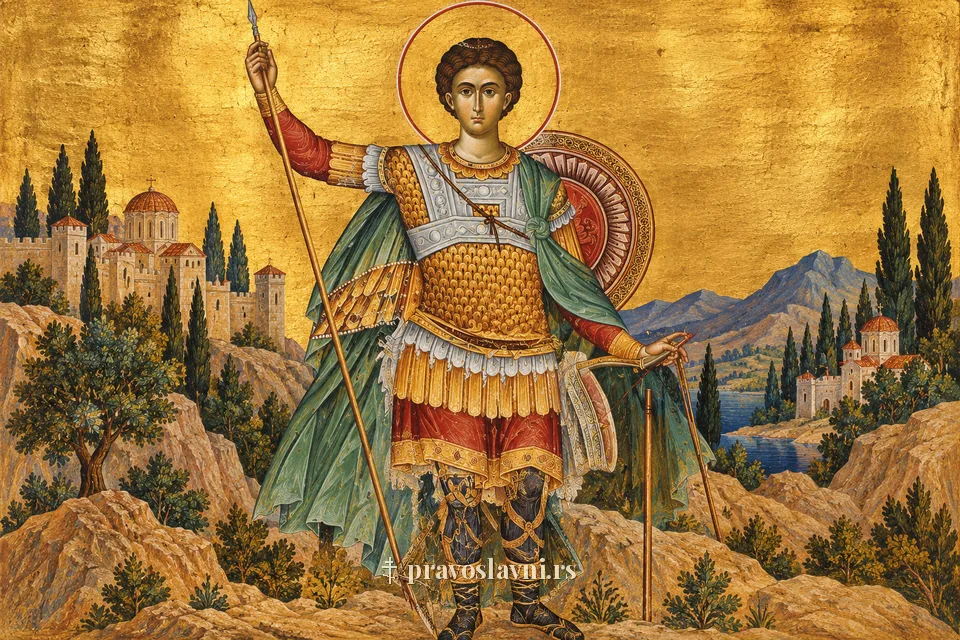
Mitrovdan, 26 October by the old calendar, that is, 8 November by the new one, is in many Serbian homes the Krsna slava (family patron saint's day). On that day we celebrate Demetrius of Thessalonica, a man who had everything that the world can offer — and gave all of it to Christ.
His parents, respected and devout people, had long been without children, so Demetrius was the answer to their prayers and their only son. He inherited the rule of Thessalonica from his father, the commander of that city: Maximian handed it over to him with one order — that he should not leave a single Christian in Thessalonica. That order he never carried out. Instead of persecution, the city heard from him the preaching of Christ, many came to believe, and the people of Thessalonica, as his Life says, saw in him a second Paul.
Earthly treasure did not mean much to him. Before the Emperor arrived in Thessalonica to look into what was happening in person, everything that Demetrius had inherited had already gone to the poor, and it was his servant Lupus who saw to that. Not even before Maximian himself did he keep silent about his faith, nor did he spare the Emperor's gods; the answer was prison. His imprisonment, according to both sources, was lightened by the coming of an angel with a crown from paradise; the Prologue also gives the angel's greeting: “Peace to you, sufferer for Christ; be brave and be strong!” Death found him in the midst of prayer, from the soldiers' spears, and his body was buried by Christians, far from the eyes of the persecutors.
Not even death separated him from his city. His grave became a place of healings. One of those who recovered there, the Illyrian Leontius, a man of standing, gave thanks by raising a great church in place of the modest little chapel. Both sources also mention the healing myrrh, although they do not link it to the same time. Thessalonica kept its relics even against the will of an emperor: Justinian wanted them for Hagia Sophia, but his envoys were stopped by a flame from the reliquary and a voice saying, “Stop, and do not touch!” His Life also remembers that he saved the starving city by ships laden with grain which he himself directed towards Thessalonica, that he brought captives back from foreign lands, and that during a siege he stood upon the walls.
St Demetrius teaches us that power, possessions and life are worth as much as we give of them to God — and that a true guardian does not abandon his own even when he departs from this world.
Full Life
The Order That Was Not Carried Out
Demetrius stood before the Emperor Maximian as the heir of his father, the commander of Thessalonica. The Emperor gave him his father's authority, and even more than that — according to his Life, he became the imperial governor of the whole region of Thessalonica. But the honour had a price: Maximian expected the new governor not only to defend his province, but also to wipe out every trace of Christians in it.
The Emperor did not know whom he was sending. Demetrius was himself a Christian.
The Secret of One Home
His story begins in a house where the faith was hidden. His Life reveals that the commander lived a double life: before the world he was the Emperor's man, at home a Christian, of one mind in the faith with his wife. One room, which strangers did not enter, was set apart for two icons, of Christ and of the Theotokos, with oil lamps and incense.
They were given their only son only after long prayers, and the whole of Thessalonica rejoiced with them. It was in that hidden room, according to his Life, that Demetrius came to know Christ, and in it that he received baptism.
The Governor Who Preaches
In Thessalonica, where he was welcomed with honours, he did not raise the sword against the Christians. He did the opposite: he spoke of Christ openly, before the whole city. His Life records that so many pagans came over to Christianity that the people of Thessalonica compared him with the Apostle Paul.
The Sarmatian war was over when Maximian, already informed of everything, entered Thessalonica to settle the matter in person. Before he arrived, Demetrius's inheritance was already in the hands of the poor; Lupus had given it away, by the will of his master.
Prison was the Emperor's answer to what he heard from Demetrius's own lips: that he was a Christian and that the Emperor's gods were worthless.
The Prison and the Arena
According to his Life, in his cell he glorified God unceasingly with psalms. Not even the devil, who according to his Life appeared to him as a scorpion, could shake him: the cross was stronger. Both the Prologue and his Life remember the angel who brought him a crown from Paradise. According to his Life, the angel greeted him with the words: “Peace be to you, sufferer for Christ; be brave and be strong!” The prisoner answered him that all his joy was in the Saviour.
According to his Life, the Emperor was meanwhile holding games, at which his wrestler Lyaeus threw those he had defeated onto spears. The young Nestor, Demetrius's disciple in the faith, resolved to put a stop to this and came to the prison for a blessing. Demetrius made the sign of the cross over him and said: “You will defeat Lyaeus, but you will suffer for Christ.” And so it was: calling upon the God of Demetrius, Nestor threw Lyaeus down, and for this the Emperor cut off his head.
Then came the turn of the one who had given the blessing. The punishment was measured by the death of Lyaeus: spears. His Life also states when the soldiers came: on 26 October, at dawn. The prayer that Demetrius began was also his last: in it he gave up his soul to the Lord. The Christians did not allow the martyr to remain without a grave, even though this had to be done in secret.
The Guardian of Thessalonica
Peace for the Christians brought the grave its first, modest church, and with it healings as well. One of those healed, by the testimony of both sources, was Leontius of Illyria, a man of high standing and gravely ill, who recovered that very hour. He showed his gratitude as a builder: the old little church was pulled down to make room for a great temple. According to his Life, the body was then uncovered whole, with myrrh that healed the sick; the Prologue, however, mentions the myrrh already after the burial.
Thessalonica did not give up its holy treasure to anyone. Both sources record that not even the Emperor Justinian received the relics — according to his Life, at least a part of them — for his new Hagia Sophia: fire drove the envoys away from the reliquary, and with it came the command: “Stop, and do not touch!” The relics remained in Thessalonica.
His Life also remembers the many miracles by which he defended his city. In the great siege by the Avars and the Slavs, according to his Life, the saint defended the walls in person, and in the end the enemy scattered for no visible reason. When famine then set in, the saint, according to his Life, directed ships carrying grain across the sea towards his city.
Mitrovdan (St Demetrius's Day), 26 October by the old calendar, that is, 8 November by the new, is the Krsna slava (family patron saint's day) in many Serbian homes. St Demetrius teaches us that power and wealth are worth only as much as they serve Christ. He was given a sword to persecute the faithful, and he used the word to multiply them. He gave away his property and laid down his life — and not even after death did he abandon his city: he defended it, fed it and healed it.