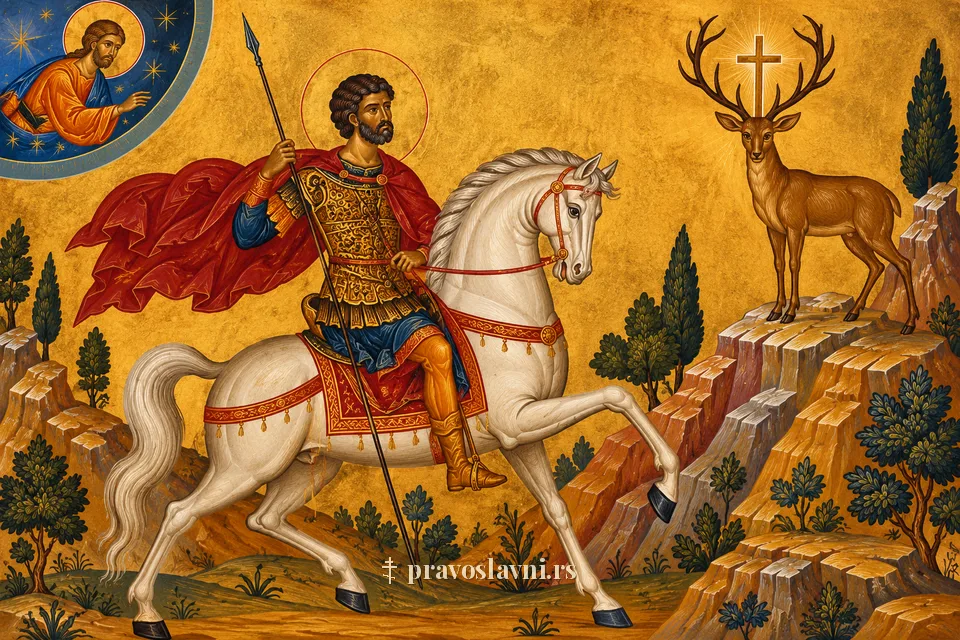
Placidas was one of the most renowned Roman generals in the time of the Emperor Trajan — there were few who surpassed him in that. He had honour, wealth, a wife and two sons. Although he was a pagan, he was merciful to the poor and to those in trouble. The Prologue compares him to Cornelius from the Acts of the Apostles, who was pleasing to God even before he came to know Him.
The turning point came on a hunt, while he was chasing a stag. That chase led him to Christ: he saw a cross with the crucified Lord upon it and heard a voice, which his Life records in these words: “Why do you pursue Me, Placidas?” That same night, according to his Life, the same message came to his wife in a dream. Soon the whole family was baptised and all of them received new names: he became Eustathius, his wife Theopiste, and his sons Agapius and Theopistus.
It was revealed to Eustathius that, like Job, he would pass through heavy trials, and he accepted them, asking only that God would not forsake him. He was left without servants, cattle and estate, yet he blessed God. He set out with his family for Egypt, and on that journey he lost both his wife and both his sons. The tears flowed, but his faith did not run dry.
In Vadisis he spent fifteen years working for another man's bread, not knowing that his children had been saved and that his wife was alive. When war threatened the empire, his old comrades-in-arms Antiochus and Acacius found him and recognised him by a scar. Victory on the battlefield brought him an even greater joy: God gave him back his sons and his wife.
The new Emperor Hadrian wished to give thanks to the idols for the victory. Eustathius refused, for he owed his thanks to Christ alone. The whole family was condemned to death. The wild beasts did not touch them. They were put to death by fire, inside a metal bull, but the flames did not harm their bodies. The people, seeing this, glorified the God of the Christians.
He had everything, he lost everything, he received everything back — and in the end he gave everything to Christ. Whoever keeps the faith when he has lost everything will, in the end, lose nothing at all.
Full Life
He had everything that a man could wish for: glory, wealth and a fine family. Then he lost everything. And in the end, of his own free will, he gave all of it to Christ. This is the story of the holy Great Martyr Eustathius, who until his baptism was called Placidas.
A Commander Who Was Seeking God
Placidas was one of the most distinguished Roman commanders in the time of the Emperor Trajan. He had won his glory earlier, in Judea, under the Emperor Titus, and according to his Life his enemies feared him for a long time. He had noble birth, a great fortune, a wife and two sons.
He was a pagan, but his heart was not hard. He did not remain indifferent to the suffering of others, and so many people in trouble felt his help. The Prologue compares him to Cornelius from the Acts of the Apostles — a man who served God by good deeds even before he came to know Him.
The turning point came during a hunt. Placidas became separated from his company while chasing a stag, and that chase led him to a meeting with Christ. Before him there appeared a cross, and on it the crucified Lord. He heard a voice, and his Life records the question: “Why do you persecute Me, Placidas?” Placidas fell from his horse. When he came to himself, he understood who was calling him: Christ, to whom all his works of mercy had been dear. That same night, according to his Life, his wife also received the same message in a dream.
The whole family was soon baptised, and each one received a new name. Placidas became Eustathius, his sons Agapius and Theopistus, and his wife was named Theopiste, which means “faithful to God”. Then it was revealed to him that great trials awaited him, like those of the righteous Job. Eustathius agreed that they should begin at once. He prayed for one thing only: that God would not abandon him in them.
To Lose Everything
The misfortunes came one after another. His servants, his livestock and his property were gone. Eustathius did not complain, but kept repeating the words of Job: “The Lord gave, and the Lord has taken away; blessed be the name of the Lord.”
One night the family left Rome, without possessions and without a name, heading for Egypt. A ship's captain took Eustathius's wife away from him, because he had nothing with which to pay for the crossing. Nor did he manage to keep his sons — wild beasts carried them off. He was left alone. He wept, but he did not abandon God, and he turned every tear into a prayer.
His solitude lasted a full fifteen years: in Badyssus in Egypt he worked as a day labourer and guarded other people's fields. He did not know that God had preserved both his sons and his wife.
To Find Everything Again
Then war threatened the empire, and in Rome they wished for the old commander to return. The search ended in Badyssus, where two of his former comrades, Antiochus and Acacius, found him. They recognised him by a scar from some battle of long ago.
Eustathius returned to Rome, led the army and was victorious. And in that victory the greatest gift was waiting for him. Among the soldiers there were two young men who, in conversation, discovered that they were brothers by birth. Their conversation was overheard by a woman who lived there — their mother. She soon recognised her husband as well. The family that misfortune had scattered was together once again.
To Give Everything
Trajan had died in the meantime, and Hadrian had taken the throne. The new Emperor wanted to thank the idols for the victory. Eustathius did not go with him to the temple. He said that he was a Christian and that he owed thanks for everything he had to Christ alone.
Because of this he lost his rank, and the whole family was condemned to death. The wild beasts did not touch them. They were put to death by fire, in a metal bull, but the fire did not damage their bodies. The people, seeing this, glorified the God of the Christians.
The Prologue observes that he served the Emperor faithfully, but that he did not withhold from God what is God's. Eustathius teaches us that faith does not depend on what we have. Whoever keeps the faith when he has lost everything loses nothing in the end.