Monday11January 202729 December (according to the Julian calendar)
Illustration
Saints of the day
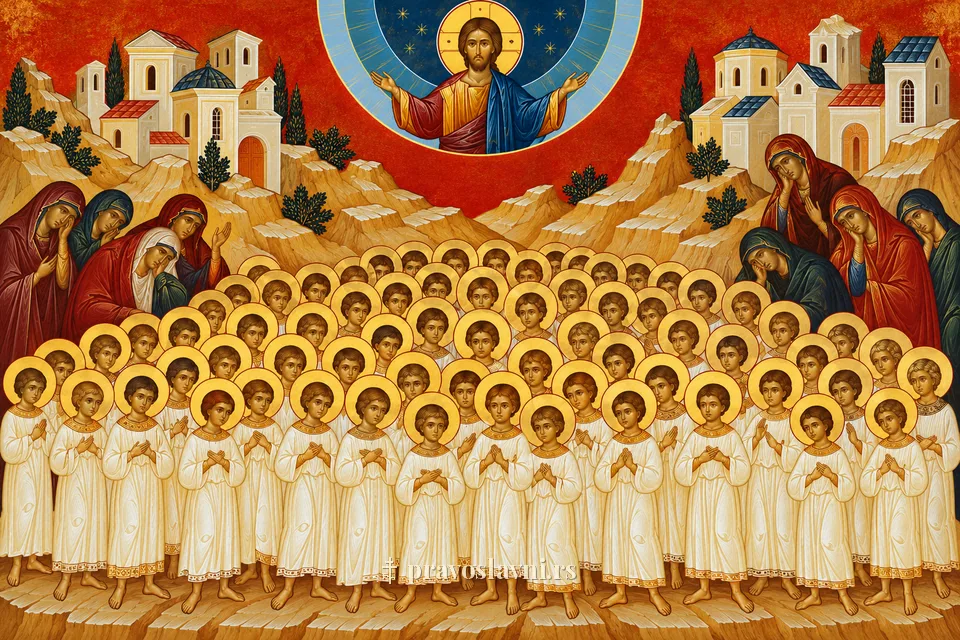
Holy 14,000 Infants of Bethlehem
What happenedKing Herod, searching for the newborn Christ, ordered the killing of all the male children in Bethlehem and its surroundings, from two years old and under.
“A voice was heard in Ramah, Lamentation, weeping, and great mourning, Rachel weeping for her children, Refusing to be comforted, Because they are no more.”
— Mt 2:18
Life
The Holy Infants of Bethlehem are the fourteen thousand little children whom King Herod slew as he searched for the newborn Christ. They are the first who died in His place.
The wise men worshipped the Child in Bethlehem, but they did not return to Herod, because an angel directed them to another road. Herod, according to the Life, at first believed that they had simply not found the Child, until he realised that he had been tricked. Then he also heard about the Meeting of the Lord, when the elder Simeon and the prophetess Anna spoke about Christ in the temple. But Joseph, obedient to his dream, had already taken the Child and Mary away to Egypt, and Herod did not find them.
Fear for his throne and anger drove Herod to a crime: death was decreed for every male child in Bethlehem and its surroundings who had not yet reached the age of two. The bloodshed took place on 29 December, one year after the birth of Christ. The order was carried out without exception, and the number of children slain reached fourteen thousand. The weeping of the mothers, who in vain begged the soldiers and lifted up their voices to God, fulfilled the prophecy about Rachel weeping for her children.
According to the Prologue, Herod saw in John, the son of Zacharias, a possible future king; the priest Zacharias would not give him up to Herod, and so he paid with his life. The bloodshed did not end there: the high priest Hyrcanus perished, seventy members of the Sanhedrin perished, and in the end Herod also put to death three of his own sons, his wife, his sister and his brother. The Life says that in this way the scribes and Pharisees who had sought the death of Christ also perished at his hands.
The massacre did not remain long without an answer from heaven: Herod was struck by an illness in which the punishment of God could be seen, and his body began to decay while he was still alive. He wanted the people to mourn all the same at the hour of his death, and so he ordered that distinguished Jews should be executed at that moment — malice did not leave him even on his deathbed. The Life sums this up in the words: “Herod was slain by God, and they were slain by Herod.”
The Life numbers these innocent victims among the dwellers of heaven, in the company of the angels — for, according to the words of Christ, the Kingdom of Heaven belongs to children. And Herod's fear and anger brought judgement upon himself.
Full Life
Fourteen thousand little children of Bethlehem and its surroundings are the first who died in the place of Christ. Their suffering is bound up with the fear and the wrath of King Herod.
The king who was afraid of a Child
It all began with the coming of the wise men. From them Herod, in Jerusalem, learned at what time the star had appeared — and the Life, relying on Chrysostom and Theophylact, holds that the star shone forth even before the Nativity. The wise men found the Child in Bethlehem and worshipped Him, but they did not return to Herod: an angel directed them to set out for home by another way.
The Life says that Herod at first believed that the wise men had simply not managed to find the Child; only later did it become clear to him that they had tricked him. Then word also reached him of the Meeting of the Lord — of how the elder Simeon and the prophetess Anna had spoken in the temple about the Child. But the Child was already far away: Joseph, obedient to the dream, had taken Him and Mary into Egypt, and Herod's searching for a whole year brought nothing.
Herod's worries, according to the Life, also had a political side: a journey to Caesar in Rome awaited him, and leaving Judea carried the risk that in the meantime this new king would seize power. The Life says of this: “The tormentor did this, for fear and fury met together in him.”
Weeping in Bethlehem
Wrath prevailed, and death was decreed for every male child in Bethlehem and its surroundings who had not yet reached two years of age. Why exactly two years? The Life answers that Herod went by what the wise men had told him about the appearance of the star. The bloodshed took place on 29 December, a year after the birth of Christ. The order was carried out without exception, and the number of slaughtered children reached fourteen thousand.
The mothers wept, implored the soldiers and cried out to God. Their weeping fulfilled the prophecy of Rachel weeping for her children. The Life also explains why the prophecy mentions Rachel and Ramah: Rachel's tomb is in Bethlehem, and Ramah is a nearby hill town in the land of the tribe of Benjamin.
Not even the righteous were spared
The priest Zacharias paid with his life for not revealing to Herod his son John, in whom the king, as the Prologue records, sensed a new king. The sources describe the place of the murder differently — the Prologue says in the temple, the Life between the temple and the altar. Zacharias, according to the Life, was denounced to Herod by the scribes and Pharisees; it galled them that he had earlier given the Virgin Mary a place in the temple among the women and that he had borne witness to her virginity.
Simeon the God-receiver, the Prologue notes, Herod did not manage to harm only because the elder departed to God not long after the Meeting of the Lord. Not even to the dead Simeon, according to the Life, did the scribes show the honour of a worthy burial.
With what measure you use
The Jewish elders fared no better, although it was precisely from them that Herod received the answer about the place of the Messiah's birth. Here are the high priest Hyrcanus and the seventy members of the Sanhedrin — the Life mentions that only one of them remained alive, and he was blind. Among Herod's victims the Life also names Judas Avrifeus and Matthew Gargulotius, whom, together with their friends, he put to death by fire. Herod did not spare even his own household: the Life lists by name his sons Antipater, Aristobulus and Alexander, his wife Mariamne, his sister Salome and his brother Pheroras. Thus, in the words of the Life, the scribes and Pharisees who sought the death of Christ themselves also suffered at the hands of Herod: “With what measure they measured, with that it was measured out to them.”
The slaughter in Bethlehem did not long remain without an answer from heaven. Herod was struck by an illness in which God's punishment could be seen: his body began to rot away while he was still alive. Not even the death that was drawing near to him quenched his malice. He wanted to mark his departure with the death of others: prominent Jews were to perish as soon as he breathed his last, so that no one would have any reason for joy. In the judgement of the Prologue, the end of such a life was the eternal ruin of his soul. The Life sums it up in this way: “Herod was slain by God, and they were slain by Herod.” The Life adds that an angel then announced to Joseph in Egypt that those who sought the Child's life were dead.
With the angels
The holy children of Bethlehem were the first to suffer for Christ. Christ's words that the Kingdom of heaven belongs to children were, according to the Life, fulfilled in them to the full: those children now live with the angels. Herod sought to kill Christ, and brought judgement only upon himself. Fear and wrath in the end destroy the one who gives himself over to them, while the innocent who suffer for Christ receive eternal life.
Other saints of the day
Venerable Marcellus
A native of Apamea in Syria, Marcellus came from a distinguished and wealthy Christian family, and he lost his parents while still young. He mastered secular learning quickly and very well, studying first in Antioch and then in Ephesus. Later we find him in Constantinople, in the monastery of the Unsleeping Ones, which received that name because God was glorified there day and night with unceasing chanting of psalms. There he was appointed abbot. He was clairvoyant, a healer and a great wonderworker, so that he healed the monk Elpidius with a single touch. The Prologue says of the holy abbot that “he conversed with angels, and easily defeated the demons and drove them away”. He spent sixty years in the monastic struggle and in the year 486 gave up his soul into the hands of God. After his repose he appeared to his brother, St Lucian, and told him that he had asked God to take him too into the Kingdom soon.