Sunday, 10 January 2027no fast · Sunday — a festive day · 28 December (according to the Julian calendar)
Sunday10January 202728 December (according to the Julian calendar)
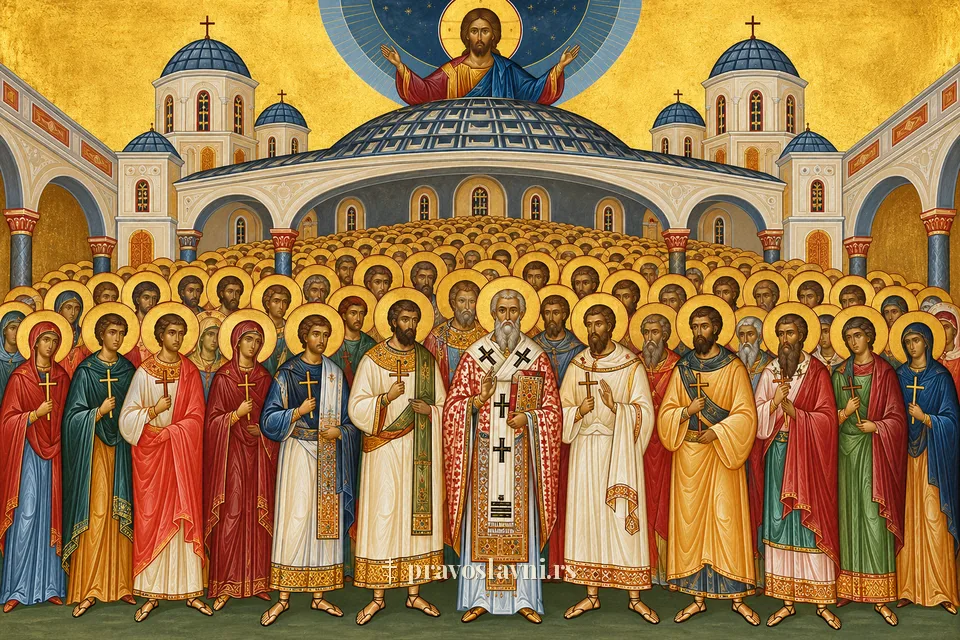
Illustration
Saints of the day
Holy 20,000 Martyrs of Nicomedia
What happenedOn the very feast of the Nativity of Christ, about twenty thousand Christians in Nicomedia chose to be burned in their church rather than deny Christ.
“Who shall separate us from the love of Christ? Shall tribulation, or distress, or persecution, or famine, or nakedness, or peril, or sword?”
— Rom 8:35
Life
The martyrs of Nicomedia did not suffer one by one, but all together, in a single church. The Prologue records that there were about twenty thousand of them, of every age and of both sexes, and that in the year 302 they were burned to death without ceasing to praise God.
The number of Christians in Nicomedia was at that time growing constantly. The Emperor Maximian Herculius knew this and in his anger sought a way to destroy them all. He heard that on the Nativity of Christ they would all be gathered together in the church, and he devised that this temple should become their pyre.
On the festal night, when the service after midnight had already begun, the church was blockaded by an armed guard. The Emperor's envoy brought those assembled an ultimatum that allowed no delay: idolatry or death in the fire.
The answer was given to the people by a certain archdeacon whose name the Prologue does not give, but of whom it says that he was a brave soldier of Christ. As an example he set before them the three youths in the Babylonian furnace, and then he directed them to the altar, where the Lord had just been offered in sacrifice for them: the answer to that sacrifice, he said, is that they too should give their lives for the Lord. Those assembled did not hesitate. The catechumens who were still unbaptised became, before the end, full members of the Church through baptism and chrismation.
The fire engulfed the whole temple. The Prologue also mentions two signs: a radiance like gold and a sweet fragrance that could be sensed for days afterwards, while the burnt ruins were still smouldering. Thus the feast of the birth of Christ became for them the day of their entry into the eternal glory of His Kingdom.
Full Life
On this day the Church does not commemorate a single name, but a whole community. About twenty thousand Christians of Nicomedia, of every age, from the old to the children, suffered together, in one and the same church. The Prologue records that this took place in the year 302.
Who they were and why they were gathered together
They were the faithful of one living Church, whose number was growing without ceasing. It was precisely this growth that was the greatest thorn in the side of the Emperor Maximian Hercules, and in his rage he resolved to wipe out the Christians to the very last one. They had gathered for the most beautiful of reasons: to greet the Nativity of Christ together. The Emperor learned of this and ordered that the church be surrounded at that time and set on fire. When the festal service began after midnight, the army already held the church in a ring.
What they chose
The price of life was a sacrifice to the idols, and that without delay. The answer of the whole assembly was death rather than denial, and the Prologue says that they accepted it readily. Their courage was strengthened by a certain archdeacon, whose name the Prologue does not give. He set before them the example of the three youths in the Babylonian furnace, and then, with the words “Look, brethren”, he turned them towards the altar and the sacrifice of Christ, to which they now answered with their own. In those last hours baptism and chrismation were received also by those who were still only preparing to enter the Church. When the soldiers set the church alight, the flames found them as one body, singing to God.
What they left to the Church
The Prologue also mentions two signs. The first was for the eyes: a radiance like gold. The second was for the sense of smell: a fragrance which did not fade even days later, while the burnt ruins were still smouldering. In this way those whom God crowned with eternal glory in His Kingdom were glorified. To us they left the example of a community which, even in its hardest hour, did not cease to be the Church.
A lesson for us
The night on which the birth of Christ is celebrated became for them also a birth into heaven. Their example asks us what the feast means to us: only a custom and a festive table, or a meeting with Christ, to Whom we belong. May their boldness teach us not to leave our faith at the church door, not even when it is hard.