Save your slava — you'll get a reminder a week and a day before.
Saturday11September 202729 August (according to the Julian calendar)
Illustration
Great feast
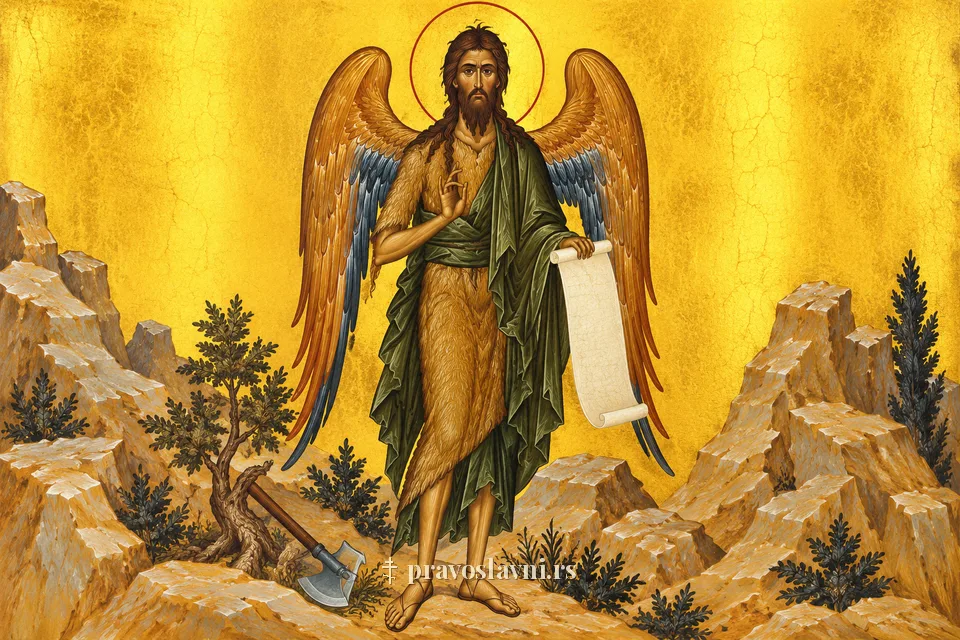
Usekovanje — Beheading of St John the Baptist
Beheading of St John the Baptist
What happenedAt Herod's feast, at the demand of the daughter of Herodias, St John the Baptist, who had openly denounced Herod's sin, was beheaded in prison.
Sung at the Slava (family patron saint's feast) and on the saint's feast day. The same troparion is also sung on the Beheading of St John the Baptist (11 September).
The memory of the righteous is with praises, but for thee the testimony of the Lord sufficeth, O Forerunner; for thou wast shown forth truly more honourable even than the prophets, since thou wast counted worthy to baptize in the streams him who had been proclaimed. Wherefore, having suffered for the truth, rejoicing, thou didst proclaim the good tidings even to those in hades of God manifested in the flesh, who taketh away the sin of the world and granteth us great mercy.
Usekovanje is the folk name of the feast of the Beheading of St John the Baptist, and the name itself means the cutting off of the head. The Church counts this day among the great feasts of the saints, although it is not one of the twelve great feasts. Many families celebrate Usekovanje as their Krsna slava (family patron saint's day).
The feast is filled with sorrow and reminds us that faithfulness to God's truth may ask for life itself. On the same day, fallen Orthodox soldiers are also remembered in prayer, who, like John, suffered for the truth.
On that day, by folk custom, no work is done in the fields. Also by folk custom, nothing red is eaten.
Life
St John the Baptist did not keep silent before sin even when the sinner was a ruler. Herod Antipas, who governed Galilee, had left his lawful wife and brought into his house Herodias, the wife of his brother Philip, while Philip was still alive. John publicly rebuked him for this, and Herod put him in chains and shut him up in prison.
For a long time Herod hesitated to do more. The Life says that he knew that John was a righteous man and that he feared the people. The opportunity came at the feast for Herod's birthday. The daughter of Herodias danced before the guests and Herod promised her whatever she might wish, even half of his kingdom. Her mother taught her what to ask for: the head of John. Herod did not want to break his oath, and so John was beheaded in the prison, and his head was brought on a platter. His disciples carried the body away secretly, by night, and buried it with honour.
Punishment did not pass Herod by either. King Aretas, the father of the wife he had sent away, defeated him heavily, and the Emperor Caligula sent him and Herodias into exile, where they lived in poverty. Salome, as the Prologue calls the daughter of Herodias, met a violent end in the River Sikoris, and Herod and Herodias, as the Prologue and the Life record, were in the end swallowed up by the earth.
The Prologue adds that a church was later built over the tomb of John in Sebaste, the work of the Emperor Constantine and the Empress Helen, and that the feast also commemorates its consecration.
The death of John teaches that a man is often brought down by the very sin he loves most, and that purity is given only by the blood of Christ.
Full Life
The voice that did not keep silent
At the time when St John was preaching, Galilee was governed by Herod Antipas, the son of that Herod who slew the children in Bethlehem. He put away from his house his lawful wife, the daughter of the Arabian king Aretas, and in her place he brought Herodias, the wife of his brother Philip, although Philip was alive. John rebuked that sin publicly. The Life quotes his words: “You cannot have the wife of Philip, your brother.” For this Herod ordered that he be bound and thrown into prison.
The Life says that Herodias desired John's death, but that Herod wavered: he knew that John was righteous and holy, he listened to him gladly and he feared the people, who held John to be a prophet (Mt 14:5). From prison, according to the Life, John sent two disciples to Jesus to ask Him whether He was the One who is to come (Mt 11:2–3), so that they might see His works for themselves.
The oath at the feast
At the celebration of Herod's birthday the daughter of Herodias danced — the Prologue gives her name, Salome — and she pleased Herod and the guests. Herod swore to her that he would give her whatever she asked, even half of his kingdom. At her mother's prompting, she asked for the head of John. Not wishing to break his oath, Herod ordered that John be beheaded in the prison and that the head be brought on a platter; the girl carried it to her mother. Herodias hid the head under the ground, in an unclean place; the Life says that this was in her palace, apart from the body. The body was left to the disciples: under cover of night they carried it away and buried it with honour, according to the Life in Sebaste.
The Life adds that in death, as in life, John went before Christ and that he preached to the souls in hades.
What befell Herod
Aretas, avenging his daughter, attacked Herod and defeated him heavily. Emperor Caligula sent Herod and Herodias into exile, first to Gaul and then to Spain, where they lived in poverty; the Life also names the cities of Lyons and Ilerda. Salome met a violent end in the river Sicoris; the Life says that in winter she fell through the ice. In the end, as both sources record, the earth opened and swallowed Herod and Herodias.
The church over the tomb
The date of the feast itself, according to the Prologue, is also connected with a later event: Emperor Constantine and Empress Helen built a church on the site of John's tomb in Sebaste, and the feast remembers its consecration. The relics of the prophets Elisha and Obadiah rested there too. The Finding of the Head of John is celebrated on another day.
The Prologue observes that people are often brought down by the very sin they loved most: Salome, who asked for the head of the prophet, herself lost her head. Only the blood of Christ cleanses what is unclean.
Other saints of the day
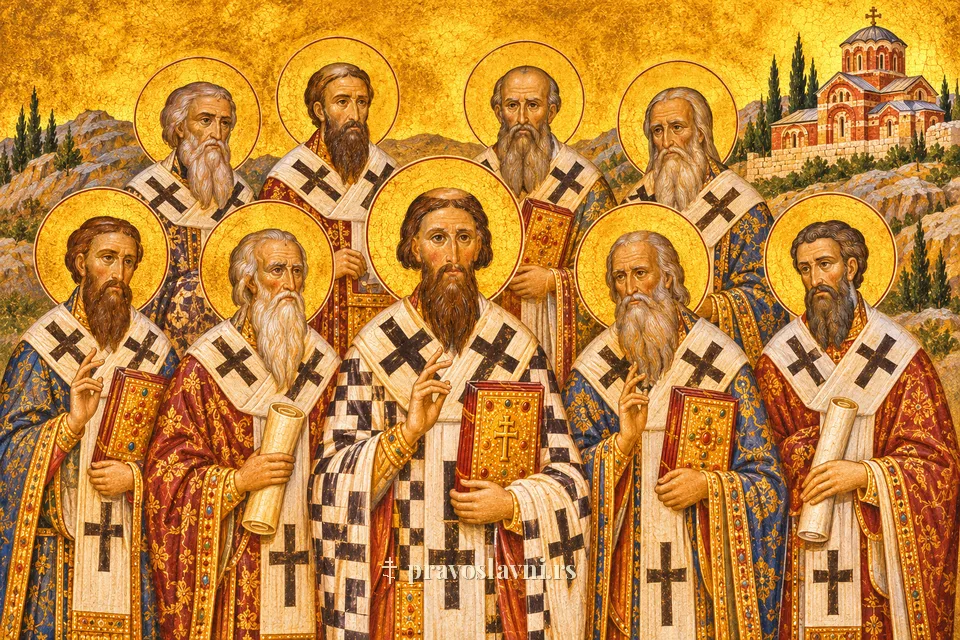
Synaxis of the Serbian Saints
In this commemoration the Church does not list all the Serbian saints, but singles out several archbishops and patriarchs. In the first place is St Sava, the first Serbian archbishop, whom the Church calls Equal-to-the-Apostles. Together with him is celebrated his successor Arsenije, a great hierarch and wonderworker. Sava II, the son of Stefan the First-Crowned, lived for a long time in Jerusalem, and for his meekness he is compared with Moses. Nikodim was an ascetic of the Holy Mountain and abbot of Hilandar, and afterwards archbishop of all the Serbian and coastal lands. Joanikije was at first archbishop, and from 1346 the first patriarch; he reposed in 1349. The ascetic Jefrem did not desire the patriarchal throne, but he was nevertheless elected to it in 1375; in the time of Prince Lazar he crowned that prince, and afterwards he left the throne and went away into solitude. His successor Spiridon reposed in 1388. Under Patriarch Makarije, who died in 1574, many ancient endowments (zadužbine) came back to life, a refectory was built at Peć, and church books came out of the printing houses in Skadar, Venice, Belgrade and other places. Gavrilo, of the Rajić family, took part in the council in Moscow, in the time of Patriarch Nikon, and he suffered as a martyr in 1656. Also mentioned are Jevstatije, Jakov, Danilo, Sava III, Grigorije, Jovan, Maksim and Nikon, many of whom lived on the Holy Mountain. The Prologue calls them good and faithful labourers in the vineyard of the Lord, teachers and shepherds of their flock.