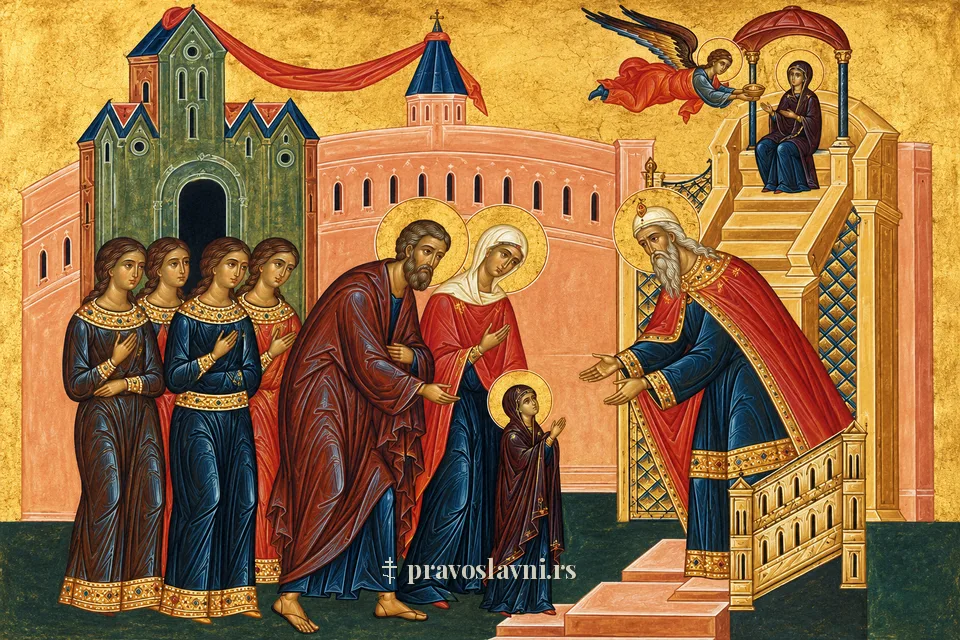
The Entry of the Most Holy Theotokos into the Temple is a great feast. We remember the day when the high priest Zacharias, the father of John the Forerunner, led the three-year-old Most Pure Virgin Mary into the Holy of Holies, where normally only he entered, and that once a year. The Prologue records Theophylact's explanation that Zacharias was then “beside himself and possessed by God”.
In this way the righteous Joachim and Anna fulfilled their vow that they would give their child to God. After a three-day journey from Nazareth, accompanied by relatives and a multitude of candles, the little girl in royal clothing arrived before the temple. Maidens sang psalms, and Anna, according to the Life, called her daughter with the words: “Come, my daughter, to Him who gave you to me!” According to the Prologue and the Life, all Jerusalem watched the celebration, and among those taking part there were also angels, whom no one saw. The fifteen steps in front of the temple were no obstacle to her: her parents lifted her only on to the first, and the rest of the way, strengthened by the power of God, she climbed quickly and by herself. At the top Zacharias was waiting for her and took her by the hand. Her parents offered a sacrifice and returned home, while Mary remained.
The Life says that in the temple she learned the Scriptures and handiwork, and most of all she prayed in the Holy of Holies, and that an angel fed her with heavenly food. Visits from her parents, especially from her mother, were frequent. The Prologue mentions nine years spent in the temple, and the Life says that she lived there until about her twelfth year.
She herself promised God virginity for her whole life. According to the Prologue, she was the first in Israel to dedicate her life to virginity, and in the Church thousands of virgins later followed her.
The feast is celebrated on 21 November by the Julian calendar, that is, on 4 December by the Gregorian calendar. Mary was given to God as a small child, and then she herself also chose a life of virginity and prayer. In this way she was being prepared in the Holy of Holies to become the living temple of God. That is why this feast calls the faithful to glorify the Holy Trinity and the Most Holy Theotokos.
Full Life
Where only the high priest entered
The Entry of the Most Holy Theotokos into the Temple is a great feast, marked in the calendar in red letters. At its centre stands a single act of the high priest Zacharias, the father of John the Forerunner: he led the three-year-old Most Pure Virgin Mary into the Holy of Holies, the place into which the law admitted only the high priest, and even him only once a year. The Prologue records how Theophylact explains this unprecedented act: Zacharias was then “beside himself and possessed by God”. Her Life adds that it was precisely there that he appointed her a place for prayer, while the other maidens prayed between the nave of the temple and the altar.
Promised to God
What led to that day was the vow of Joachim and Anna, her righteous parents, who had dedicated their daughter to God. Her Life says that Joachim was descended from kings, and Anna from priests. They fulfilled their promise when the little girl reached the age of three.
A celebration watched by Jerusalem
The Prologue and her Life describe a celebration which the whole of Jerusalem watched at that time, and in which the angels, too, took part unseen. After a three-day journey from Nazareth, accompanied by many relatives, little Mary, in splendid royal clothing, walked towards the temple surrounded by the light of candles; her Life says that Anna herself asked the maidens to walk before her daughter with lighted candles. The maidens sang psalms, and of Joachim and Anna it is said that they sang the verses of Psalm 44 about forgetting one's own people and one's father's house. To Anna her Life also ascribes words addressed to the child: “Come, my daughter, to Him Who gave you to me!” This procession with candles and chanting is presented by her Life as the pattern of the feast itself.
Jerome, to whom the sources refer, says that on each of the fifteen steps before the temple the clergy sang one psalm. The little girl climbed them quickly and without anyone's help, except that her parents set her on the first one, for, the sources say, the power of God was strengthening her. Zacharias, filled with wonder, met her at the top and took her by the hand, and Anna, according to her Life, asked him to receive her daughter into the sanctuary. In the hymn of praise which her Life ascribes to him, Zacharias, filled with the Spirit, glorifies her purity and sees in her the end of Adam's curse: “Come, fulfilment of my prophecy!”
For Joachim and Anna the day ended with a sacrifice according to the Law, a blessing and the return home, where, according to her Life, they held a feast; their daughter they left in the temple.
The years in the temple
Her Life also describes her life in the temple: she lived with the older maidens, who taught her the Scriptures and handiwork, spinning and sewing, but most of all she was at prayer in the Holy of Holies. Jerome, whom her Life quotes, describes her day as an alternation of prayer and work, which ended only when an angel brought her food. Of this heavenly food, according to her Life, Zacharias also bore witness; angels came to her every day, and Gabriel is mentioned as her guardian. The visits of her parents, especially of her mother, were frequent for as long as they were alive.
As to how long she remained there, the sources differ: the Prologue speaks of nine years, while her Life says that she lived there until about the age of twelve. Virginity for her whole life she promised to God herself, and after the death of her parents she wished neither to leave the temple nor to marry. According to the Prologue, she thereby became the first in Israel to dedicate her life to virginity, and in the Church thousands of virgins later followed her. The law and custom of Israel did not allow a maiden to remain unmarried, and so, as the Prologue records, at the age of twelve she was entrusted to her kinsman Joseph in Nazareth, to live beside him as his betrothed, in virginity.
The living temple of God
The Entry is celebrated on 21 November according to the Julian calendar, that is, 4 December according to the Gregorian calendar. Little Mary was given to God while still a child, and then she herself also chose a life of virginity and prayer. In the Holy of Holies she was preparing to become the living temple of God. That is why this feast calls us to glorify the Holy Trinity and the Most Holy Theotokos.