Thursday10June 202728 May (according to the Julian calendar)
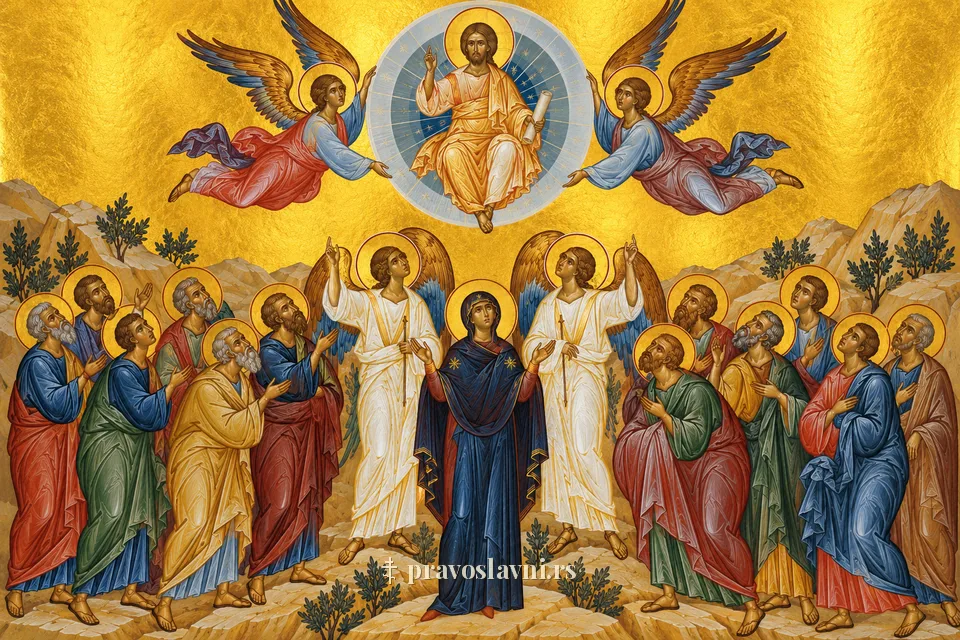
Illustration
Great feast
Spasovdan — Ascension of the Lord
Ascension of the Lord
What happenedSpasovdan (Ascension of the Lord), the fortieth day after Vaskrs (Pascha), celebrates the ascension of the Lord Jesus Christ into heaven and His sitting at the right hand of the Father.
“Who also said, ”Men of Galilee, why do you stand gazing up into heaven? This same Jesus, who was taken up from you into heaven, will so come in like manner as you saw Him go into heaven.”“
Sung at the Slava (family patron saint's feast) and on the feast day.
Thou art ascended up into glory, O Christ our God, having made joyful thy disciples by the promise of thy Holy Spirit, the blessing which was announced unto them. For thou art the Son of God, the Redeemer of the world.
Spasovdan (the Ascension of the Lord) is, in the life of the faithful, the boundary of the paschal season. From Pascha the faithful greet one another with “Christ is Risen!” and reply “Indeed He is Risen!”, and this greeting, by custom, lasts right up to Spasovdan. The day before the feast, on Wednesday, the Church takes leave of Pascha in the temple with a service called the Leavetaking of Pascha; its beginning and end are served as on Pascha itself.
Spasovdan is also one of the better-known Serbian Krsna slavas (family patron saint's day); it has no fixed date, because it is always reckoned forty days from Pascha. The city of Belgrade also celebrates it as its Slava: it was established by the holy Despot Stefan Lazarević in 1403, when Belgrade became his capital. On that day the Spasovdan litija (procession), led by the Patriarch, sets out from the Church of the Ascension and goes through the streets of the city to the Church of St Sava on Vračar; icons and relics of saints are carried in it. No fast is kept on that day.
As one of the twelve great feasts, Spasovdan does not last only one day: the troparion of the Ascension is sung at the Liturgy right up to the leavetaking, on the Friday of the seventh week after Pascha. From Spasovdan the gaze of the faithful turns towards Duhovi (Pentecost), just as the apostles in Jerusalem, in prayer, awaited the Comforter, whose power Christ had promised them before the Ascension.
Life
The Ascension of the Lord, Spasovdan, is one of the twelve great feasts. It comes on the fortieth day after Vaskrs (Pascha), always on the Thursday of the sixth week after Vaskrs, and on that day there is no fasting.
After the Resurrection Christ appeared to His disciples for forty days and taught them about the Kingdom of God. Before parting from them He said: “But you shall receive power when the Holy Spirit has come upon you” (Acts 1:8). Then, according to the Acts of the Apostles: “Now when He had spoken these things, while they watched, He was taken up, and a cloud received Him out of their sight” (Acts 1:9). Two men in white garments — according to the holy Bishop Nikolaj, angels of God — told the disciples that the Lord would return in the same way in which they had seen Him go. And so the feast, together with Christ's sitting at the right hand of the Father, also points forward to His second coming.
The disciples returned to Jerusalem full of joy. They praised God in the temple and waited for the Holy Spirit, Who came down after ten days. From the mount called Olivet they went down into the city, and there, together with the women, they continued with one accord in prayer.
St Nikolaj writes that Christ ascended “not to the stars but above the stars”, and compares Him to a bird that leads the flock: “Like a swallow that goes in front, showing the flock the way and breaking the heavy resistance of the air.”
On the eve of Spasovdan the Leavetaking of Pascha is served, and the feast itself lasts until its own leavetaking, nine days later. In the hymns of the feast, alongside the promise of the Holy Spirit, there stand both the sorrow of the apostles at the parting and their joy at the glory they had seen.
By custom, the Paschal greeting “Christ is Risen!” is kept until Spasovdan, and Spasovdan is also one of the better-known Serbian Slavas (Krsna slava, a family patron saint's day).
Full Life
Forty days after Pascha
The Ascension of the Lord, in Serbian Spasovdan, is counted among the twelve great feasts. Since it is reckoned from Pascha, it has no fixed date: it comes on the fortieth day after the Resurrection, and that is always the Thursday of the sixth week after Pascha. There is no fasting on that day.
The Acts of the Apostles record that after His Passion Christ came among His disciples for forty days and spoke to them about the Kingdom of God (Acts 1:3). Before parting from them He assured them: “But you shall receive power when the Holy Spirit has come upon you” (Acts 1:8). Then, He said, they would be His witnesses.
A cloud took Him out of their sight
The moment itself is described by Scripture in a single sentence: “Now when He had spoken these things, while they watched, He was taken up, and a cloud received Him out of their sight” (Acts 1:9). The holy Bishop Nikolaj (Velimirović) adds some details in his text on the feast: the Lord led the disciples as far as Bethany and, lifting up His hands, blessed them before He ascended. The two in white garments, who were then found standing beside them, were according to St Nikolaj angels of God. Their question was: “Men of Galilee, why do you stand gazing up into heaven?” At once they added a promise as well: “will so come in like manner as you saw Him go into heaven” (Acts 1:11). That is why the feast does not end with a parting; it also looks ahead, towards Christ's second coming.
From the mount called Olivet the disciples went down to Jerusalem and there, together with the women, continued with one accord in prayer (Acts 1:12–14). In the words of St Nikolaj, they did not go back sad, but full of great joy; they praised God in the temple and waited for the Holy Spirit, Who came down upon them after ten days.
Above the stars
The holy Bishop Nikolaj sees in the Ascension the opening of the road by which man returns to God. Christ, he writes, ascended “not to the stars but above the stars”, all the way to the throne of the Father. To show how the Lord goes first, and His own after Him, St Nikolaj takes an image from nature: “Like a swallow that flies ahead, showing the flock the way and breaking the heavy resistance of the air.” He also recalls Christ's words to the disciples that it is better for them that He should go away, for then the Comforter will come (Jn 16:7). In the Ascension we see the summit of God's plan for man.
From Pascha to the leave-taking
In church Spasovdan is seen off only after a number of days; according to the Liturgics handbook, “The Leave-taking of the Ascension is nine days later, on the Friday of the 7th week after Pascha.” Right up until then, at the Divine Liturgy the troparion of the Ascension takes the place of one of the Paschal hymns. The feast itself is preceded by a farewell to Pascha: on the Wednesday, the day before Spasovdan, the Leave-taking of Pascha is served, and the service on that day begins and ends as on Pascha itself. At the vigil of Spasovdan the Paschal hymns are no longer sung; the order is the same as at the other great feasts of the Lord. In the hymns of the feast the promise of the Holy Spirit stands beside two feelings of the apostles: sorrow that they are parting from their divine Teacher and joy at the glory that they have seen.
Other saints of the day
Venerable Nicetas the Confessor, Bishop of Chalcedon
St Nicetas chose to go into exile rather than agree to communion with the iconoclast Patriarch Antony. According to his Life, that condition was put to him by the imperial envoy Theodosius, and Nicetas answered that he would not give up the veneration of the holy icons, and that they might do with him whatever they wished. He was exiled that very hour.
He became a monk while still a young man, because he had come to love Christ more than the world. For his God-pleasing life he was chosen as Bishop of Chalcedon. In his ministry he was known for his mercy: the Life says that he took orphans and the wronged under his protection, and gave help to everyone in need, from the hungry to travellers.
Under the Emperor Leo the Armenian, when iconoclasm prevailed, he rose up in defence of the icons. The Prologue says that he did not hesitate to point out the Emperor's error to him and to explain the meaning of the icons, and the Life that he taught the faithful to venerate the icons of Christ, of the Theotokos and of the saints. He paid for this with exile, humiliation and ill-treatment, and according to the Prologue with prison as well.
After long labours he departed to the Lord, and from his relics, according to the Life, there came many miracles and healings.
St Nicetas shows that God crowns faithfulness under persecution with glory, and that mercy is the duty of every shepherd.