Thursday29April 202716 April (according to the Julian calendar)
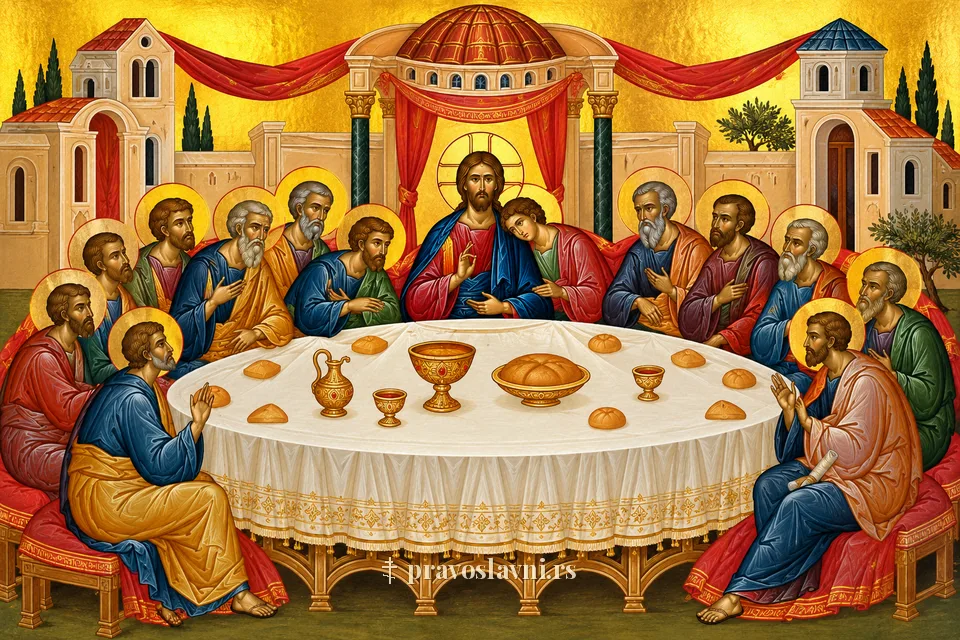
Illustration
Holy Week
Great and Holy Thursday
What happenedThe Church devotes Great and Holy Thursday to the washing of the feet, the Mystical Supper, the institution of the Holy Mystery of Communion, Christ's prayer in Gethsemane and the betrayal by Judas.
“And when He had given thanks, He broke it and said, ”Take, eat; this is My body which is broken for you; do this in remembrance of Me.”“
— 1 Cor 11:24
About this day
Great and Holy Thursday is celebrated by the Church as the remembrance of the Mystical Supper and of the Lord's humility, so it is good for the faithful to come to Communion on that day. The Liturgy of St Basil the Great is served together with Vespers. In cathedral churches the bishop performs the rite of the washing of the feet, and the twelve priests who take part in it stand in the place of the apostles. On that day the holy chrism is also consecrated; prepared throughout Holy Week, it is used at chrismation and when churches are consecrated. In the evening the people come to church to listen to the twelve Passion Gospels, about the sufferings of Christ. The faithful listen to them kneeling, with lit candles in their hands.
Life
On Great and Holy Thursday the Church remembers four events which, according to the Synaxarion of Holy Week, the holy fathers handed down to her: the washing of the feet, the Mystical Supper, the handing down of the dread Mysteries, and Christ's prayer in Gethsemane, together with the betrayal. Christ rose from supper and washed the feet of His disciples, even those of Judas, teaching them that whoever wants to be first must be the last of all. Peter at first would not let the Teacher wash his feet. The supper took place on Thursday evening, before the Passover of the Law, and the Synaxarion notes that there was no roasted lamb and no unleavened bread on the table, but bread and water. At the table the Lord took bread and the cup and gave them to His disciples, and He called the bread His Body; the Synaxarion says that by this He Himself became the true Passover. The Apostle Paul hands on the Lord's words: “Take, eat; this is My body which is broken for you; do this in remembrance of Me.”
Christ revealed that one of the disciples would betray Him, the one to whom He would hand the piece of bread that He had dipped. According to the Synaxarion, Judas received Communion before he went out, and then he made his bargain with the chief priests for thirty pieces of silver. In the Garden of Gethsemane the Lord prayed three times to the Father, while the disciples slept. Judas betrayed Him with a kiss, Peter cut off the ear of the servant Malchus, and Christ healed the servant and forbade violence. That night Peter denied his Teacher three times and, when the cock crowed, wept bitterly.
On that day the Liturgy of St Basil the Great is served, in cathedral churches the bishop performs the rite of the washing of the feet, and the holy chrism is also consecrated. In the evening the twelve Gospels of Christ's Passion are read. Humility and Holy Communion go together: the Lord who kneels before His disciples and washes their feet is the same One who gives them His Body and Blood.
Full Life
Four commemorations
The Synaxarion of Holy Week says that the holy fathers handed down to us four events which we celebrate on Great and Holy Thursday: the sacred washing of the feet, the Mystical Supper, the handing down of the dread Mysteries, and Christ's prayer in Gethsemane, together with the betrayal. The Synaxarion calls these events dread and ineffably mysterious, and the Church remembers them with fear and reverence. The Liturgics handbook describes this day as the commemoration of the Mystical Supper and of the Lord's humility.
The Lord washes the disciples' feet
Christ rose from supper, laid aside His garments and washed the feet of the disciples. By this, according to the Synaxarion, He showed them humility and warned them not to seek the first place: whoever wishes to be first, let him be last of all. He washed the feet of Judas too. Peter at first would not let the Teacher wash his feet.
The Mystical Supper
Christ ate the supper with His disciples on Thursday evening, before the Passover of the Law, which according to the Law was eaten on Friday. The Synaxarion observes that there was no lamb roasted in the fire and no unleavened bread on the table, but bread and water, and so it was not the paschal supper of the Law. The Lord took bread and the cup and gave them to the disciples, and He called the bread His Body; the Synaxarion stresses that it was leavened and not unleavened bread. In this way, according to the Synaxarion, He anticipated the Jewish Passover and Himself became the true Pascha.
The Apostle Paul hands on what he received from the Lord: on the night in which He was betrayed, the Lord took bread, gave thanks, broke it and said: “Take, eat; this is My body which is broken for you; do this in remembrance of Me.” (1 Cor 11:24) And he adds: “For as often as you eat this bread and drink this cup, you proclaim the Lord's death till He comes.” (1 Cor 11:26)
At the table Christ revealed that one of them would betray Him, the one to whom He would give the dipped morsel. According to the Synaxarion, Judas received Communion before he went out, and Satan entered into him through an ordinary piece of bread. Judas went to the chief priests and agreed with them to betray Christ for thirty pieces of silver.
Gethsemane and the betrayal
Christ went with His disciples to the Mount of Olives, to the Garden of Gethsemane, and three times He prayed to the Father, while the disciples slept. The Synaxarion quotes His words: “My Father, can this cup not pass from Me, that I may not drink it?” He foretold to Peter that he would deny Him three times. According to the Synaxarion's interpretation, in Peter's fall is reflected the sin which strikes all people, and the remedy for it is repentance.
Judas gave the sign with a kiss. Peter cut off the ear of the servant Malchus, and Christ healed him and forbade violence. They led the Lord away to Annas and Caiaphas. In the courtyard of the high priest Peter denied Him, and when the cock crowed, he wept bitterly.
The services of Great and Holy Thursday
On that day the Divine Liturgy of St Basil the Great is served, joined with Vespers. In cathedral churches the rite of the washing of the feet is performed by the bishop, and twelve priests stand in the place of the apostles at that service. The holy chrism is also consecrated; it is prepared during Holy Week and is used for chrismation and for the consecration of churches. In the evening the twelve Gospels of Christ's Passion are read.
Other saints of the day
Holy Martyrs Agape, Chionia and Irene
St Anastasia the Deliverer from Bonds buried together three sisters — Agape, Chionia and Irene — who suffered for Christ about the year 304, in the time of the Emperor Diocletian. The Prologue says that they came from the country round Aquileia.
Their suffering was foretold in advance. The Prologue and their Life record that their spiritual guide Chrysogonus, whom the Emperor had put to death in Aquileia, appeared after his death to the old presbyter Zoilus and said that the maidens would suffer within nine days. The same was revealed to Anastasia, who, according to the Life, visited them and prepared them for their struggle, and later ministered both to them and to other prisoners.
Before the Emperor the sisters would not agree to serve the idols. Irene told the Emperor that it is madness to serve idols which mortal men have made for money, and the Emperor threw them into prison. Before the governor Sisinius, according to the Life, Agape said: “Our faith is invincible”, and Chionia: “Our faith is unchangeable.” Irene answered him: “I will not, for I am a Christian, a handmaid of the almighty God.”
God kept them from dishonour. When the governor Dulcitius, to whom the Emperor had handed them over as he set out for Macedonia, came to them by night with an impure intent, his mind, as the Prologue and the Life record, was darkened: instead of the maidens, his passion fell upon sooty pots and pans, and he went away black and put to shame. Irene, who was sent among the soldiers, was delivered, according to the Prologue and the Life, by the angels of God, who led her to a hill which the tormentor could not reach, and so he ordered that she be shot with arrows.
Agape and Chionia died in the fire; the Life says that they prayed to the end and that the flames touched neither their bodies nor their clothing. Their bodies, according to the Life, were carried away by night by Anastasia's servants, who laid them in a new tomb. Irene, according to the Life, died giving thanks to God, saying that she was going to Christ and to her sisters.
The Prologue compares them to lilies, pure in body and in soul. Their example teaches that the faith which a person carries within cannot be taken away.