Saint of the day
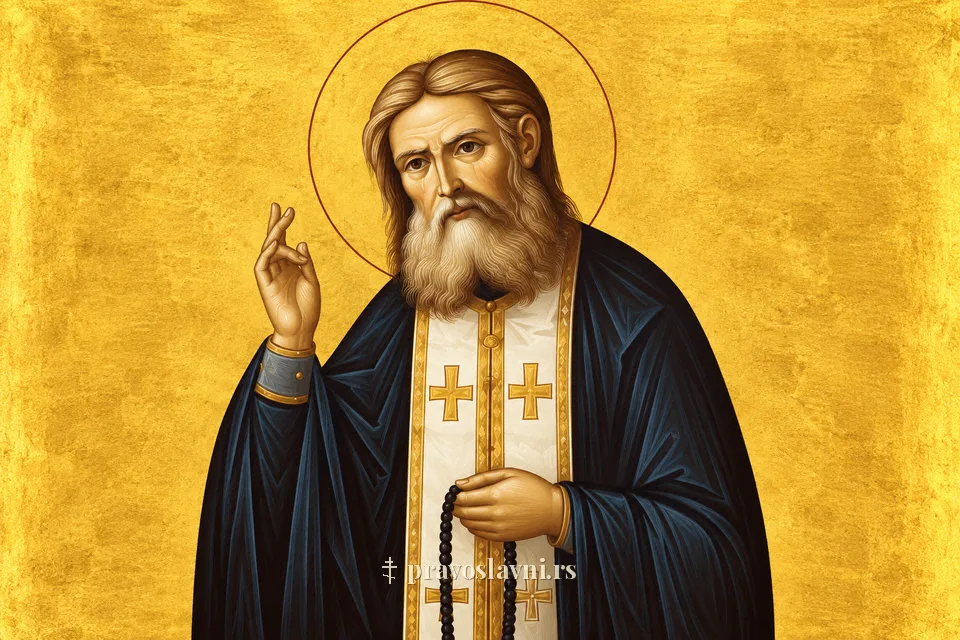
Venerable Seraphim of Sarov
What happenedThe humble monk Seraphim of Sarov, who called himself “poor Seraphim”, greeted thousands of people with the words “Christ is risen, my joy”.
Read the LifeOrthodox Calendar · 2 January according to the Julian calendar
Thursday, 15 January 20262 January (according to the Julian calendar)What happenedThe humble monk Seraphim of Sarov, who called himself “poor Seraphim”, greeted thousands of people with the words “Christ is risen, my joy”.
Read the Life
You may eat meat, eggs, milk and dairy products, as well as any other food — but try to be moderate.
More about the fast →
Today the Church keeps the commemoration of a saint · not a Red Letter day.
More about the feast →
“Therefore humble yourselves under the mighty hand of God, that He may exalt you in due time.”
— 1 Pet 5:6Few people in Russia have won as much veneration as Seraphim of Sarov. The Prologue remembers him briefly for his humility: the name he gave himself was “poor Seraphim”, however much people honoured him. The Prologue and his Life do not agree on the year of his birth, while for the year of his death both give 1833.
According to his Life, he was born in Kursk as Prokhor Moshnin. Agathia, his widowed mother, taught him piety; his Life also mentions her blessing, a copper cross with which Seraphim was buried. His Life relates that the Theotokos twice restored his health: as a boy, when his mother carried him out before the Kursk Root Icon, and as a young novice in Sarov, when She appeared to him with the Apostles Peter and John.
He became the monk Seraphim and, according to his Life, went off to live alone in the forest: he worked in the garden, kept bees and prayed for a long time on a rock. Three peasants beat him severely for the sake of money, and he was the one who begged that they should not be punished. Years of silence and seclusion followed.
Then, according to his Life, at the command of the Theotokos he began to receive people. Every visitor, and there were thousands of them, he greeted with the words “Christ is risen, my joy”. According to his Life, another's trouble was known to him before the first word was spoken, and he healed the sick with oil, with blessed water and with his prayer. The landowner Motovilov, who was paralysed, walked again, and Seraphim, according to his Life, explained to him what a Christian should strive for: to acquire within himself the grace of God and the Holy Spirit.
Of his grave he said: “I shall fall asleep in Sarov, and I shall awake in Diveyevo.” His Life records that he died kneeling in prayer before the icon of the Theotokos “Tenderness”. His relics, according to his Life, were uncovered in the year 1903, in the presence of the imperial family, and after years in which they had been removed from Sarov they were translated to Diveyevo.
His life teaches that grace is acquired by keeping the commandments, by prayer, fasting, repentance and good works.
Few in Russia have gained such veneration as Seraphim of Sarov, known for his ascetic labour, his gift of clairvoyance and his miracles. The Prologue devotes only a few lines to him, and in them it gives most room to humility: fame did not change him, and he still spoke of himself as “poor Seraphim”. Everything else that we know comes from his Life, which tells the story at length and which is not entirely consistent even in the years: for the year of his birth the Prologue and his Life give different information, and they agree that he passed away in the year 1833.
His name was Prokhor Moshnin and, according to his Life, he came from Kursk, the town from which St Theodosius of the Caves also came. His father Isidore died before he had finished the church of St Sergius of Radonezh, and so that care too, like the bringing up of her son in piety, fell to his mother Agathia. From her, according to his Life, he also received the copper cross with which he was buried.
His Life records several appearances of the Theotokos in his life. The first was a promise in a dream to the sick boy; it was fulfilled when his mother carried her son to the Kursk Root Icon, which was being borne in procession past their house. He was directed to Sarov, where he arrived in 1778, by the clairvoyant Dositheus of the Kitaev Hermitage, and there for three years he was tormented by dropsy and immobility. From that illness, according to his Life, the Most Holy One raised him up, appearing with the Apostles Peter and John; only a scar remained to him as a trace. Later, together with St Onuphrius the Great and Peter of Athos, she asked him to break his silence and receive people, and his Life also attributes to her a healing spring in the forest. The witness of the last appearance, on the Annunciation in the last year of his life, was the Diveyevo sister Evdokia Efremovna: with the Theotokos, according to his Life, came John the Baptist, John the Theologian, angels and twelve virgin martyrs.
He received the monastic tonsure and the name Seraphim, according to his Life, in the year 1786, and in 1793 the priestly rank as well. His Life also speaks of the heavenly visions which were granted to him during the services; they did not, it says, puff him up, but humbled him still more. Then he chose solitude in the forest. He spent his days in work and prayer, and saw the brethren at the Sunday Liturgy. From those years his Life also singles out the prayer on the stone, in which he persevered for a thousand days.
A trial came from men as well. He forgave, according to his Life, even the three peasants who in the year 1804, for the sake of money, beat him severely: although he offered no resistance and barely survived, he asked that they should not be punished. When Abbot Isaiah, his spiritual father, died, Seraphim, according to his Life, withdrew into silence and seclusion which lasted for years. For a time no one saw him; later people were able to approach him, but he did not speak to them either.
For about twelve years, as his Life says, thousands came to him every day. His Life attributes to him a clairvoyance from which other people's troubles, sins and past did not remain hidden. He welcomed everyone with the same greeting: “Christ is risen, my joy”. He helped the sick by praying for them, anointing them with oil and giving them blessed water. His Life begins the series of healings with the landowner Manturov, and also mentions the paralysed landowner Motovilov, who walked again. With Motovilov, according to his Life, he also spoke about the aim of the Christian life and revealed to him that a man should acquire the grace of God and receive the Holy Spirit within himself.
The women's community in Diveyevo had been on his heart ever since the day when Abbot Pachomius, on his deathbed, entrusted it to him, and there he also showed in advance the place of his grave. He foretold: “I shall fall asleep in Sarov, and I shall wake up in Diveyevo.” Death found him, according to his Life, on his knees, in prayer before the icon of the Theotokos “Tenderness”. In the celebration of the year 1903, when, according to his Life, his relics were uncovered, the imperial family also took part: Tsar Nicholas as one of the bearers of the coffin, and Tsarina Alexandra with a covering which she had embroidered herself. The journey of the relics did not end there: the Bolsheviks took them away from Sarov, and his Life records that they were afterwards found in Petrograd and translated to Diveyevo.
Grace, his Life teaches, is acquired by keeping the commandments, by prayer, fasting, repentance and good deeds. And Seraphim's life reminds us that humility is the true measure of holiness, even when the whole world is praising him.
St Sylvester was a Roman; early on he came to know both the learning of his time and the faith of Christ, and his measure was the Gospel. His Life remembers him as a hospitable man who washed the feet of travellers with his own hands. Timothy of Antioch, a confessor who preached in Rome, stayed with him; the Prologue says that Sylvester was present when Timothy was put to death for the faith, and his Life adds that he secretly buried his relics. Later he became bishop of the city of Rome. His Life records that he forbade the clergy to engage in trade. The Prologue and his Life also ascribe to him a rule about fasting: from that time Saturday was not kept as a regular fast, but only Great and Holy Saturday, and according to the Prologue also the Saturdays that fall within the fasts. Both sources also say that the Emperor Constantine and the Empress Helen came to the true faith and to baptism through his prayers and miracles. His Life describes a public debate in Rome, in which, before the Emperor, the senate and Helen, he answered the Jewish teachers from the Scriptures, saying: “We do not put our trust in a multitude of people.” The Prologue also mentions that he helped Helen when she was searching for the Precious Cross. When Arius appeared, Sylvester, according to his Life, stood by the Orthodox faith, and to Nicaea, to the First Ecumenical Council, he sent men who would represent him. He passed away in peace, at a great age. His life bears witness that the truth, defended by Holy Scripture and prayer, overcomes both falsehood and persecution.


