Saturday, 1 May 2027strict fast (no oil) · 18 April (according to the Julian calendar)
Saturday01May 202718 April (according to the Julian calendar)
Illustration
Holy Week
Great and Holy Saturday
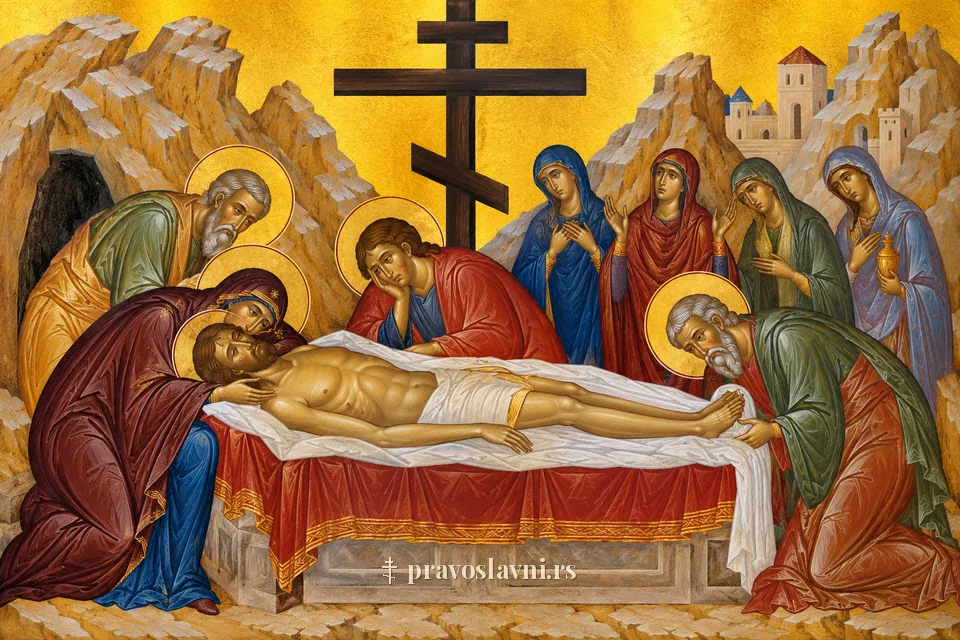
What happenedOn Great and Holy Saturday the Church celebrates the burial of the divine Body of the Lord Jesus Christ and His descent into Hades, where He destroyed the power of the devil.
“Therefore we were buried with Him through baptism into death, that just as Christ was raised from the dead by the glory of the Father, even so we also should walk in newness of life.”
— Rom 6:4
About this day
Great and Holy Saturday is a day of quiet vigil beside the Lord's tomb. On that day, according to Liturgics, the faithful gather in church for a prayerful vigil. Matins is accompanied by psalms and the singing of the Lamentations at the tomb, and then the Epitaphios (plaštanica, the burial shroud of Christ) is carried out of the church in procession, taken around the church and laid in the tomb again. The Liturgy of St Basil the Great is served later than on other days and begins with the Vespers of Pascha, which follows. Fifteen paroemias, Old Testament readings, are read, and while the singing is still going on the clergy change their black vestments for white, Paschal ones. Great and Holy Saturday is a fasting day; the kind of fast is given in the calendar beside the date. Church tradition says that every year on that day, after the prayers of the patriarch, the Holy Fire appears in the cave of the Lord's Tomb in Jerusalem.
Life
On Great and Holy Saturday the Church celebrates the burial of the divine body of the Lord Jesus Christ and His descent into Hades. The Lord's body was laid in a new tomb in the garden and did not see corruption, and His soul descended into Hades. The Synaxarion of Holy Week explains that Sabbath means rest: this is the day on which Christ rests after He has accomplished the work of salvation. At one and the same time, according to the Synaxarion, He was in the tomb, and in Hades, and in Paradise with the robber. Joseph closed the tomb with a great stone, and the chief priests asked Pilate for a guard, and so the tomb was sealed and watched.
Before the Saviour's sacrifice all the people of the Old Testament were in Sheol. Having taken upon Himself the sins of all people, Christ destroyed the devil's power over the human race and led the righteous of the Old Testament out of Hades, together with those who received His preaching. The holy prophets and the righteous of the Old Testament are now in the Kingdom of Heaven. The Apostle Peter writes: “For Christ also suffered once for sins, the just for the unjust”, and he adds that Christ also “went and preached to the spirits in prison”. According to the Synaxarion, Hades was not able to hold Christ.
On that day the faithful gather beside the Lord's tomb. At Matins, with the Lamentations at the tomb, they mourn the dead Lord, and the epitaphios (plaštanica) is carried in procession around the church and returned to the tomb, as a sign of the Lord's descent into Hades. The Liturgy of St Basil the Great begins with the Vespers of Pascha; fifteen Old Testament readings are read, and the priests put on white vestments instead of black ones. According to Church tradition, on that day in Jerusalem, in the cave of the Lord's tomb, the Holy Fire appears after the prayers of the patriarch. The Church calendar marks a strict fast (no oil). The silence of the tomb is already full of hope.
Full Life
The Blessed Sabbath
The Synaxarion of Holy Week begins with the words: “On Great and Holy Saturday we celebrate the burial of the divine body of our Lord and Saviour Jesus Christ, and His descent into Hades.” The Lord's body was laid in a new tomb in the garden and did not see corruption, while His soul descended into Hades. The Synaxarion explains the name of the day by the meaning of the word: Sabbath means rest, and this is the day when Christ rests after accomplishing the work of salvation. The Synaxarion adds that Christ was not confined to one place: at one and the same time He was in the tomb, and in Hades, and in Paradise, where the thief was with Him.
The sealed tomb
Joseph closed the entrance to the tomb with a great stone. The chief priests went to Pilate and asked for a guard, for they were troubled that Christ, whom they called a deceiver, had announced while He was still alive that He would rise again. Pilate answered them that they should make the tomb secure themselves, and so the tomb was sealed and placed under guard. According to the Synaxarion, Hades could not hold the One whom it had received: soon it would have to let Him go.
The descent into Hades
The Church's handbooks explain that before the Saviour's sacrifice and His descent into Hades all the people of the Old Testament, both the righteous and sinners, were in Sheol, the underworld. Taking upon Himself the sins of all people, Christ destroyed the devil's power over the human race and led the righteous of the Old Testament out of Hades, together with those who accepted His preaching. The holy prophets and the righteous of the Old Testament are now in the Kingdom of Heaven. The Apostle Peter writes: “For Christ also suffered once for sins, the just for the unjust”, and in the spirit He descended, “by whom also He went and preached to the spirits in prison” (1 Pet 3:18–19).
The vigil by the tomb
According to the Liturgics handbook, on Great and Holy Saturday the faithful gather by the Lord's tomb and keep vigil in prayer, remembering Christ's rest in the tomb and His descent into Hades. At Matins psalms and the Lamentations at the tomb are sung, and the faithful mourn the dead Lord. Then the Epitaphios (the Holy Shroud) is carried in procession around the church and returned to the tomb; this procession signifies that after His death the Lord descended into Hades.
The Divine Liturgy of St Basil the Great begins only at a later hour of the day, and it begins with the Vespers of the following day, Pascha. At it fifteen paroemias are read, Old Testament readings which contain prophecies of the redemption of the human race. While the singing is still going on, the priests take off their black vestments and put on white ones, which announce Pascha.
The Holy Fire and the fast
According to Church tradition, every year on Great and Holy Saturday in Jerusalem, in the cave of the Lord's tomb, after the prayers of the Patriarch of Jerusalem, the Holy Fire appears, a great confirmation of the Orthodox faith. The Church calendar for Great and Holy Saturday prescribes a strict fast (no oil). The silence of the tomb is already full of hope.
Other saints of the day
Venerable John, disciple of St Gregory of Decapolis
When Venerable John reposed, St Joseph the Hymnographer laid him with honour close to his teacher, St Gregory of Decapolis. Thus the teacher and the disciple remained side by side.
From his youth, as his Life says, John loved Christ more than the world, and for that reason he came to Gregory. Gregory tonsured him a monk. Humility, according to the Life, was the chief trait of this disciple, and the elder gave thanks to God for him.
Thus the disciple, at his teacher's side, became an ascetic himself. They lived in the time of the Emperor Leo the Armenian, who renewed iconoclasm and persecuted the Church. According to the Prologue, the Emperor tortured John together with Gregory and Joseph. The Life remembers that in Constantinople, together with Joseph, he encouraged the Orthodox to persevere in the faith.
After Gregory's death John, according to the Prologue, became abbot of the Decapolite's monastery in Constantinople and gave himself still more to the ascetic life; the Life says that there he cared for his own salvation and for that of others. He reposed in peace about the year 820. The Life adds that Joseph later translated the relics of Gregory and John to the Church of St Nicholas the Wonderworker, which he himself had built.
John teaches that the faith is kept by humility and obedience, and that one who is himself established in the truth can establish others also.