Holy Week
Great and Holy Saturday
What happenedOn Great and Holy Saturday the Church celebrates the burial of the divine Body of the Lord Jesus Christ and His descent into Hades, where He destroyed the power of the devil.
Read the LifeOrthodox Calendar · 29 March according to the Julian calendar
Saturday, 11 April 202629 March (according to the Julian calendar)What happenedOn Great and Holy Saturday the Church celebrates the burial of the divine Body of the Lord Jesus Christ and His descent into Hades, where He destroyed the power of the devil.
Read the Life
No meat, dairy products, eggs, fish or oil — food cooked in water.
This is a recommendation — for your own fast, consult your priest or spiritual father.Prayer of St Ephraim the Syrian →More about the fast →

“Therefore we were buried with Him through baptism into death, that just as Christ was raised from the dead by the glory of the Father, even so we also should walk in newness of life.”
— Rom 6:4Great and Holy Saturday is a day of quiet vigil beside the Lord's tomb. On that day, according to Liturgics, the faithful gather in church for a prayerful vigil. Matins is accompanied by psalms and the singing of the Lamentations at the tomb, and then the Epitaphios (plaštanica, the burial shroud of Christ) is carried out of the church in procession, taken around the church and laid in the tomb again. The Liturgy of St Basil the Great is served later than on other days and begins with the Vespers of Pascha, which follows. Fifteen paroemias, Old Testament readings, are read, and while the singing is still going on the clergy change their black vestments for white, Paschal ones. Great and Holy Saturday is a fasting day; the kind of fast is given in the calendar beside the date. Church tradition says that every year on that day, after the prayers of the patriarch, the Holy Fire appears in the cave of the Lord's Tomb in Jerusalem.
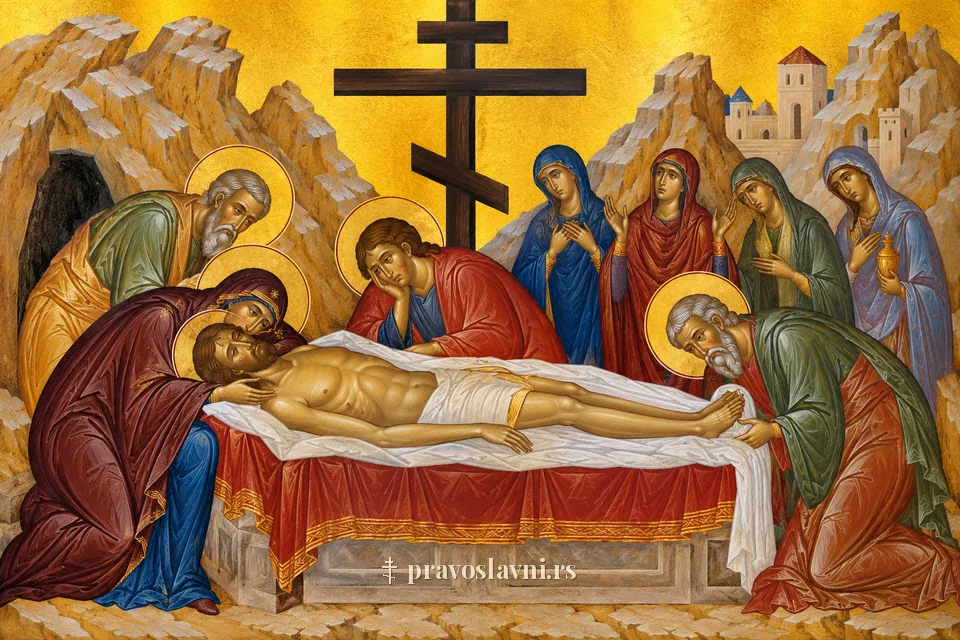
On Great and Holy Saturday the Church celebrates the burial of the divine body of the Lord Jesus Christ and His descent into Hades. The Lord's body was laid in a new tomb in the garden and did not see corruption, and His soul descended into Hades. The Synaxarion of Holy Week explains that Sabbath means rest: this is the day on which Christ rests after He has accomplished the work of salvation. At one and the same time, according to the Synaxarion, He was in the tomb, and in Hades, and in Paradise with the robber. Joseph closed the tomb with a great stone, and the chief priests asked Pilate for a guard, and so the tomb was sealed and watched.
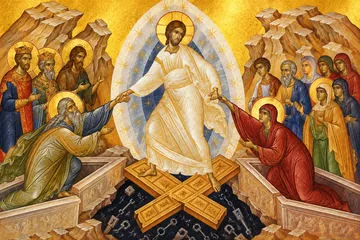
Before the Saviour's sacrifice all the people of the Old Testament were in Sheol. Having taken upon Himself the sins of all people, Christ destroyed the devil's power over the human race and led the righteous of the Old Testament out of Hades, together with those who received His preaching. The holy prophets and the righteous of the Old Testament are now in the Kingdom of Heaven. The Apostle Peter writes: “For Christ also suffered once for sins, the just for the unjust”, and he adds that Christ also “went and preached to the spirits in prison”. According to the Synaxarion, Hades was not able to hold Christ.
On that day the faithful gather beside the Lord's tomb. At Matins, with the Lamentations at the tomb, they mourn the dead Lord, and the epitaphios (plaštanica) is carried in procession around the church and returned to the tomb, as a sign of the Lord's descent into Hades. The Liturgy of St Basil the Great begins with the Vespers of Pascha; fifteen Old Testament readings are read, and the priests put on white vestments instead of black ones. According to Church tradition, on that day in Jerusalem, in the cave of the Lord's tomb, the Holy Fire appears after the prayers of the patriarch. The Church calendar marks a strict fast (no oil). The silence of the tomb is already full of hope.
The Synaxarion of Holy Week begins with the words: “On Great and Holy Saturday we celebrate the burial of the divine body of our Lord and Saviour Jesus Christ, and His descent into Hades.” The Lord's body was laid in a new tomb in the garden and did not see corruption, while His soul descended into Hades. The Synaxarion explains the name of the day by the meaning of the word: Sabbath means rest, and this is the day when Christ rests after accomplishing the work of salvation. The Synaxarion adds that Christ was not confined to one place: at one and the same time He was in the tomb, and in Hades, and in Paradise, where the thief was with Him.
Joseph closed the entrance to the tomb with a great stone. The chief priests went to Pilate and asked for a guard, for they were troubled that Christ, whom they called a deceiver, had announced while He was still alive that He would rise again. Pilate answered them that they should make the tomb secure themselves, and so the tomb was sealed and placed under guard. According to the Synaxarion, Hades could not hold the One whom it had received: soon it would have to let Him go.
The Church's handbooks explain that before the Saviour's sacrifice and His descent into Hades all the people of the Old Testament, both the righteous and sinners, were in Sheol, the underworld. Taking upon Himself the sins of all people, Christ destroyed the devil's power over the human race and led the righteous of the Old Testament out of Hades, together with those who accepted His preaching. The holy prophets and the righteous of the Old Testament are now in the Kingdom of Heaven. The Apostle Peter writes: “For Christ also suffered once for sins, the just for the unjust”, and in the spirit He descended, “by whom also He went and preached to the spirits in prison” (1 Pet 3:18–19).
According to the Liturgics handbook, on Great and Holy Saturday the faithful gather by the Lord's tomb and keep vigil in prayer, remembering Christ's rest in the tomb and His descent into Hades. At Matins psalms and the Lamentations at the tomb are sung, and the faithful mourn the dead Lord. Then the Epitaphios (the Holy Shroud) is carried in procession around the church and returned to the tomb; this procession signifies that after His death the Lord descended into Hades.
The Divine Liturgy of St Basil the Great begins only at a later hour of the day, and it begins with the Vespers of the following day, Pascha. At it fifteen paroemias are read, Old Testament readings which contain prophecies of the redemption of the human race. While the singing is still going on, the priests take off their black vestments and put on white ones, which announce Pascha.
According to Church tradition, every year on Great and Holy Saturday in Jerusalem, in the cave of the Lord's tomb, after the prayers of the Patriarch of Jerusalem, the Holy Fire appears, a great confirmation of the Orthodox faith. The Church calendar for Great and Holy Saturday prescribes a strict fast (no oil). The silence of the tomb is already full of hope.
“Are we not ashamed, O Emperor, to put this old man to such torments?” So, according to the Life, the prefect of Arethusa, himself a pagan, spoke to the emperor. He added that in a victory over such an old man there is neither glory nor honour. The old man he was speaking about was St Mark, a bishop in Syria, according to the Prologue already a very old man.
The pagans hated him because of the temple he had torn down under Constantine the Great and because of the many whom he had turned away from idols and brought to Christ. When Julian the Apostate took power, and some of the citizens, according to the Prologue, turned back to the idols, a persecution began. The Life records a bitter coincidence here: this same Julian Mark had once, when Julian was a youth, saved from murderers.
At first, according to the Life, he withdrew, chiefly because of Christ's word about fleeing before persecutors. When he heard that others were suffering on his account, he came back of his own accord.
They demanded compensation from him for the demolished temple, in money or in a new building. He did not agree. Beatings, being dragged through the city — in which, says the Life, both the city magistrate and the leading men of the city took part — and the honey with which they smeared him so as to expose him to the stings of insects did not break him. The Prologue says that he did not utter a sound, and the Life that he saw honour in his torments.
The price was then lowered again and again, until it became trifling, and even then Mark did not pay. The Life sees in this the proof that he was defending the faith and not money. His steadfastness turned the city round: according to the Prologue, in the end the citizens cared only that he should stay alive, and so they let him go; for this the Life refers to Theodoret. Those who had fallen away began to listen to him and, according to the Prologue one by one, became Christians again.
The sources do not say where and when he died; we remember him as a confessor. St Mark teaches us that patience without hatred brings back to God even those who have fallen away.