Great feast
Vaskrs — Pascha (Easter)
Resurrection of Christ
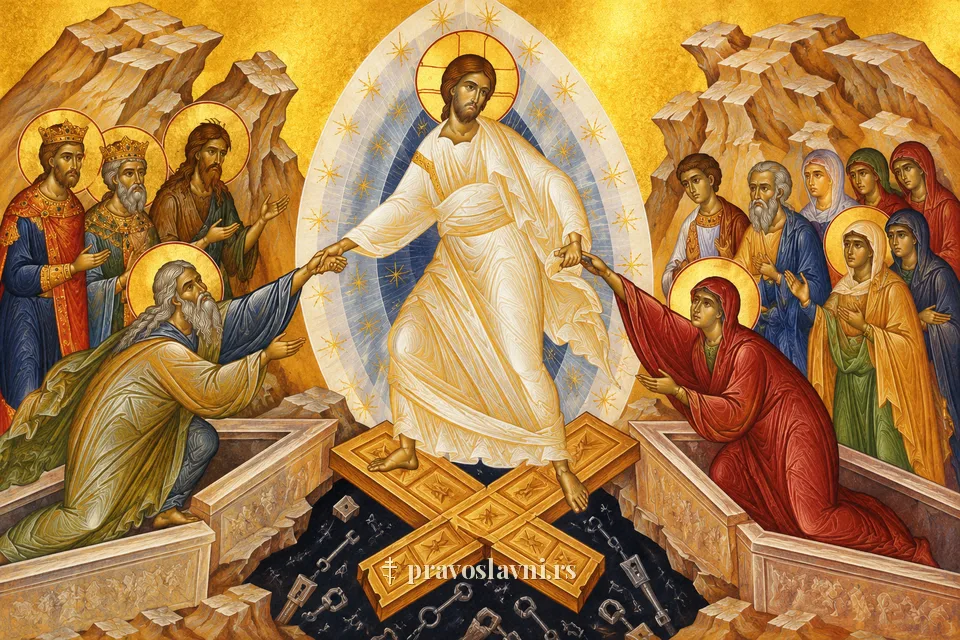
What happenedVaskrs (Pascha, Easter) is the greatest Christian feast, the day when the Lord Jesus Christ rose from the dead and conquered death, sin and the devil.
Read the LifeOrthodox Calendar · 30 March according to the Julian calendar
Sunday, 12 April 202630 March (according to the Julian calendar)What happenedVaskrs (Pascha, Easter) is the greatest Christian feast, the day when the Lord Jesus Christ rose from the dead and conquered death, sin and the devil.
Read the Life
You may eat meat, eggs, milk and dairy products, as well as any other food — but try to be moderate.
More about the fast →
Red Letter day — great feast; by custom, no work is done
More about the feast →
“But now Christ is risen from the dead, and has become the firstfruits of those who have fallen asleep.”
— 1 Cor 15:20By custom, at Vaskrs (Pascha, Easter) the head of the house goes with his household to church for the holy Paschal service. After the service people greet one another with the words “Hristos Vaskrse!” (“Christ is risen!”) and reply “Vaistinu Vaskrse!” (“Truly He is risen!”). By custom, this greeting lasts right up to Spasovdan (Ascension).
At home, after prayer, the members of the household also greet one another with the Paschal greeting, and then gather around the festive table. By custom, the first thing tasted is a boiled Paschal egg, and after it come the other dishes. Then the egg tapping begins. The head of the house leads the way in it, and after him the other members of the household take an egg too, one after another, and compete to see whose egg will prove the strongest. While they tap eggs, they say the Paschal greeting to one another.
The eggs were dyed red back on Great and Holy Friday, and the first egg dyed, the čuvarkuća (“guardian of the house”), is kept until the next Pascha. According to tradition, the custom of dyeing eggs has its origin in Mary Magdalene and her egg which turned red before the emperor. The egg is a sign of new life, and the red colour is a reminder of Christ's shed Blood. Pascha is a non-fasting day, without a fast.
Among all the Christian feasts Vaskrs (Pascha) is the greatest: it is the day on which life conquered death. It is the greatest because on that day the Lord Jesus Christ rose from the dead. By the Holy Spirit He has set us free from the power of sin, death and the devil. Vaskrs always falls on a Sunday, because the risen Christ first appeared early on the first day of the week. The Apostle Paul bears witness: “But now Christ is risen from the dead, and has become the firstfruits of those who have fallen asleep.” And he cries out: “O Death, where is your sting? O Hades, where is your victory?”
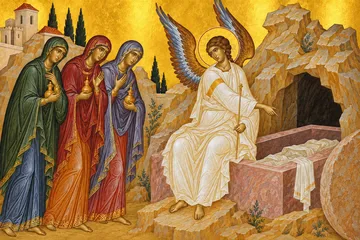
Paschal Matins begins at midnight, in a church full of incense and of the light of all the candles that have been lit. The clergy and the people go around the church in procession, in memory of the myrrh-bearing women and their early coming to the tomb, and when the closed doors of the church are opened, the faithful go in as into the open tomb of Christ. At every service the Paschal troparion is sung again and again: “Christ is risen from the dead, trampling down death by death, and upon those in the tombs bestowing life.” At Matins the rector reads the Paschal Homily of St John Chrysostom. At the Liturgy the first passage of the Gospel according to John is read, all the bells are rung, and the artos is blessed, a sign of the invisible presence of the risen Lord. Red eggs are blessed as well.
According to tradition, Mary Magdalene brought an egg to the Emperor Tiberius with the Paschal greeting, and the white egg turned red before the Emperor; ever since then Christians have dyed eggs at Vaskrs. The egg is a sign of new life, and the red colour recalls the blood that Christ shed. The greeting “Christ is Risen!” — “Indeed He is Risen!” is a confession of the victory over death, which the faithful carry from the church into every home, and by custom it lasts right up to Spasovdan (Ascension).
Among all Christian feasts Vaskrs (Pascha) is the greatest: it is the day when life conquered death. It is the greatest because on that day the Lord Jesus Christ rose from the dead. Rising from the tomb, the Lord freed us by the Holy Spirit from the power of sin, death and the devil. Vaskrs always falls on a Sunday because, according to the Gospel, the risen Christ first appeared early on the first day of the week (Mk 16:9).
The Apostle Paul bears witness: “But now Christ is risen from the dead, and has become the firstfruits of those who have fallen asleep.” (1 Cor 15:20) Of the same victory he writes: “knowing that Christ, having been raised from the dead, dies no more. Death no longer has dominion over Him.” (Rom 6:9) And he cries out: “O Death, where is your sting? O Hades, where is your victory?” (1 Cor 15:55) He calls Christ our Passover: “For indeed Christ, our Passover, was sacrificed for us.” (1 Cor 5:7)
Paschal Matins begins at midnight. The clergy and the people go out of the church through the royal doors and walk around it in procession, in memory of the myrrh-bearing women and their early coming to the tomb. The procession stops in front of the church, whose doors have been closed since before the beginning. When they are opened, the faithful go in as though they were entering the open tomb of Christ.
Most often that night one hears the paschal troparion, which is sung again and again at every service: “Christ is risen from the dead, trampling down death by death, and upon those in the tombs bestowing life.” At Matins the whole paschal canon is sung, and the rector of the church reads the Paschal Homily of St John Chrysostom. At the Liturgy the first pericope of the Gospel according to John is read, and as soon as it has been read, all the bells ring out. In the evening, at Paschal Vespers, the Church listens to the Gospel of how the risen Lord appeared to His disciples that same evening.
For this night the church is prepared more festively than for any other: all the candles are lit, the church is fragrant with incense, and the priests are in their most festive vestments. The artos, the paschal bread, is blessed at the end of the Liturgy, after the prayer behind the ambo; it is a sign that the risen Lord is invisibly present among the faithful. After the Liturgy the eggs dyed red are also blessed in the narthex.
According to tradition, St Mary Magdalene, while preaching in Rome, brought Emperor Tiberius a hen's egg with the paschal greeting. The Emperor doubted and said that the resurrection was just as impossible as for a white egg to turn red, and the egg in his hand began to turn red. Ever since then Christians have dyed eggs at Vaskrs. The egg is a sign of new life, and the red colour recalls the blood that Christ shed and the dignity of the Saviour.
Among the books which the Church received from the desert-dwellers, one is named after steps: “The Ladder”. It was written by John, a monk of Mount Sinai, to show how the soul, step by step, climbs towards God. The Prologue says that it was written during his years of stillness in a cave, and his Life that John, the abbot of Raithu, asked him to write it.
Nothing is known about his childhood. At the age of sixteen he came to Sinai and stayed there to the end of his life. His biographer Daniel saw in that arrival the beginning of an ascent far higher than the mountain itself. He spent nineteen years in obedience under Abba Martyrius, and after his death another twenty in a cave, in fasting, weeping and prayer. Anastasius the Sinaite and John the Sabbaite, according to the Life, saw the future abbot of Sinai in him while he was still a young monk.
To the slander that he was a chatterer he replied with a year of complete silence, which he broke only when the brethren asked him to. His prayer saved his disciple Moses — the disciple leapt up from the place where he was sleeping, a moment before a rock came crashing down on it. The Life also says that by his prayer he freed the monk Isaac from a passion and obtained rain in a time of drought.
At the insistence of the brethren he became abbot. The Prologue says that he led them with zeal and love. The Life tells that once, while guests were sitting at table, there was among those serving an unknown young man who afterwards disappeared. John said to the brethren: “Let him be, do not look for him; it was the holy Prophet Moses who served in his own place.”
In the end he handed over the governance to his own brother George, who outlived him by only ten months, just as John had promised. John reposed around the year 649. The Life compares him with the Prophet Moses, for whom the promised land remained out of reach, whereas John arrived in the heavenly Jerusalem.
His life teaches that a person climbs towards God slowly, step by step — through humility, obedience, silence and prayer.