Great feast
Bright Tuesday
What happenedBright Tuesday, the third day of Vaskrs (Pascha), continues the paschal joy of Bright Week, in church and in the homes of the faithful.
Read the LifeOrthodox Calendar · 1 April according to the Julian calendar
Tuesday, 14 April 20261 April (according to the Julian calendar)What happenedBright Tuesday, the third day of Vaskrs (Pascha), continues the paschal joy of Bright Week, in church and in the homes of the faithful.
Read the Life
You may eat meat, eggs, milk and dairy products, as well as any other food — but try to be moderate.
More about the fast →
Red Letter day — great feast; by custom, no work is done
More about the feast →
“And they said to one another, ”Did not our heart burn within us while He talked with us on the road, and while He opened the Scriptures to us?”“
— Lk 24:32By folk custom, in most of our regions Vaskrs (Pascha, Easter) is celebrated for three days, so on Vaskrsni utorak (Bright Tuesday) too people sit down to a festive table. Relatives, kumovi (godparents and wedding sponsors), neighbours and friends come to visit, and kinsfolk arrive from more distant places as well. Among the people it is said of this day that it is the best Tuesday of the year.
By folk custom, in an occasional village weddings are also arranged for this day: it is believed that the Paschal season is blessed, and so that grace is called down upon the new married couple.
In church the service is as on the first and second day of Pascha, with the Royal Doors open. The day is non-fasting, like the whole of Bright Week.
Bright Tuesday is the second day after Vaskrs (Pascha), and the celebration of Pascha continues both in church and in the homes of the faithful. The divine service does not differ from that of the first two days of Vaskrs, and the royal doors still stand open, as a sign of the empty tomb of Christ. Bright Week is celebrated as a single day, and so there is no fasting in it.
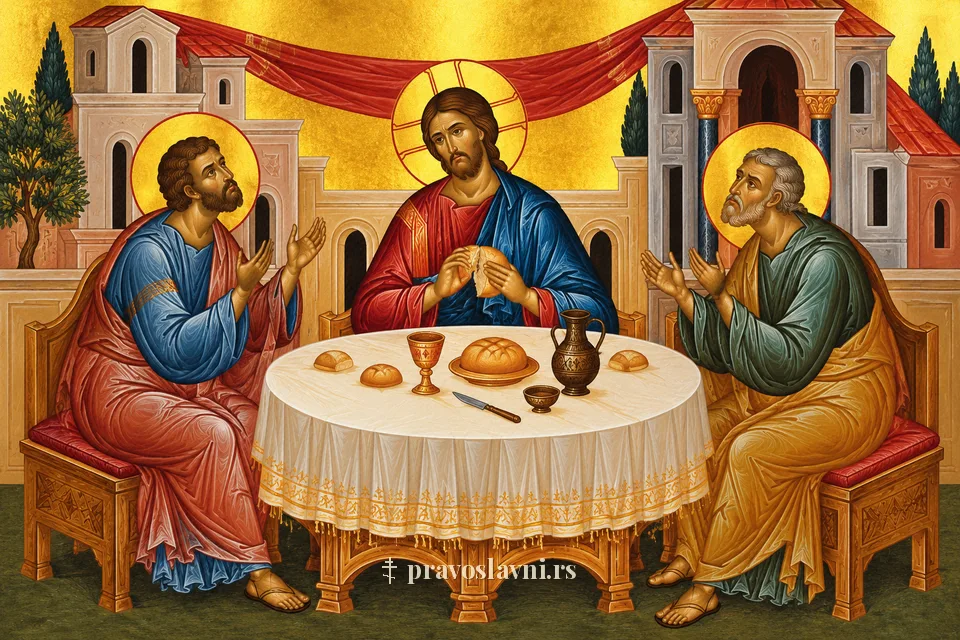
The Evangelist Luke describes how two disciples, on the very day the Lord rose, were going to the village of Emmaus, sixty stadia distant from Jerusalem. The risen Jesus drew near and went with them, but they did not recognise Him. On the way, beginning at Moses and all the prophets, He expounded the Scriptures to them. When they sat down at table, He took bread, blessed it and broke it, and then they knew Him: “Then their eyes were opened and they knew Him; and He vanished from their sight.” They returned to Jerusalem and heard from the eleven: “The Lord is risen indeed, and has appeared to Simon!”
According to the Life, the Iveron Icon of the Most Holy Theotokos is also commemorated in Bright Week, the icon which came by sea to the Iveron Monastery on the Holy Mountain (Mount Athos); according to the Prologue, it was received by St Gabriel of Iveron. It received the name Portaitissa, the Gate-keeper, from its place beside the monastery gate.
By folk custom, the Paschal feast lasts three days in most of our regions, and so on this day too relatives, godparents, neighbours and friends are welcomed.
Bright Tuesday is the second day after Vaskrs (Pascha). The celebration of Pascha continues both in church and in the homes of the faithful, and in church the services are as on the first two days of Vaskrs. Bright Week, the first week after the Resurrection, begins the fifty-day celebration which lasts until Pentecost. The royal doors stand wide open all week, like the empty tomb from which Christ arose and like the veil of the temple in Jerusalem, which was torn in two when He died on the cross. Since all seven days are celebrated as one single day, there is no fasting on them, and so this day too is fast-free.
The Evangelist Luke describes how the risen Lord, on the very day of the Resurrection, accompanied two disciples on the road: “Now behold, two of them were traveling that same day to a village called Emmaus, which was seven miles from Jerusalem.” (Lk 24:13) While they were talking, “Jesus Himself drew near and went with them”, but “their eyes were restrained, so that they did not know Him” (Lk 24:15–16). One of them, whose name was Cleopas, asked Him whether He alone in Jerusalem did not know what had happened in those days. Then the Lord, beginning at Moses and all the prophets, explained to them what was written about Him in all the Scriptures.
As it was growing dark, the disciples begged Him to stay: “Abide with us, for it is toward evening, and the day is far spent.” (Lk 24:29) At the table He took bread, blessed it, broke it and gave it to them. “Then their eyes were opened and they knew Him; and He vanished from their sight.” (Lk 24:31) They said to one another that their heart had burned within them while He talked with them on the road and opened the Scriptures to them. They returned to Jerusalem and found the eleven, who were saying: “The Lord is risen indeed, and has appeared to Simon!” They told what had happened on the road and how they had known Him in the breaking of bread (Lk 24:34–35).
According to the Life, the Iveron Icon of the Most Holy Theotokos is also commemorated in Bright Week. In the time of iconoclasm that icon, according to the Life, came by itself across the sea from Asia Minor to the Iveron Monastery on the Holy Mountain (Mount Athos). It was received from the water by Venerable Gabriel of Iveron, of whom the Prologue says: “Gabriel was found worthy to receive the icon of the wonderworking Mother of God, which came to the monastery by sea.” It stands by the monastery gate, and so it is called Portaitissa, the Gate-keeper.
By folk custom, in most of our regions the paschal feast lasts three days, and so the feasting continues on Bright Tuesday as well: relatives, godparents (kumovi), neighbours and friends are welcomed, and kinsfolk gather even from distant places.
A woman from Egypt stood on the threshold of a church in Jerusalem, on a feast day — according to her Life, the Exaltation of the Precious Cross — and could not go in. Something invisible turned her back, three or four times. This was Mary, who from the age of twelve, in Alexandria, had lived for seventeen years in fornication, and had come to Jerusalem led by the same passion.
In the narthex she prayed before an icon of the Theotokos, told Her what she had been, and promised that she would go wherever the Mother of God might lead her. Then she went in and kissed the Cross. After that she heard a voice: “If you cross the Jordan, you will find blessed rest!” She received Holy Communion by the Jordan and crossed over into the desert.
There she spent more than four decades. Her Life says that for years her old habits and passions pursued her, and that she overcame every temptation by prayer and tears before the Theotokos. Her clothing fell to pieces, and she lived on the plants of the desert.
Towards the end of her life the monk Zosimas met her in the desert. The Life says that this elder, after decades of ascetic struggle, had come to think that there was no longer anyone who could teach him anything, and so an angel sent him to a monastery beside the Jordan, from which the monks went out into the desert every year. She knew his name, and he saw her raised above the ground in prayer. She told him the story of her life and asked him to bring her Holy Communion the following year. When he came, she crossed the Jordan walking on the water, received Communion and went back.
A year later Zosimas found her dead. Beside her in the sand there was a request that he should bury her; from it he learned that she had died immediately after that Communion. The Life says that the ground was hard and he had no tools, and so the grave, according to the Life, was dug by a lion, which then went back on its way. Her life was later written down by Sophronius, Patriarch of Jerusalem, as told by the monks of the Jordan.
St Mary of Egypt has remained an example of repentance: God receives even the greatest sinner who sincerely returns to Him.


