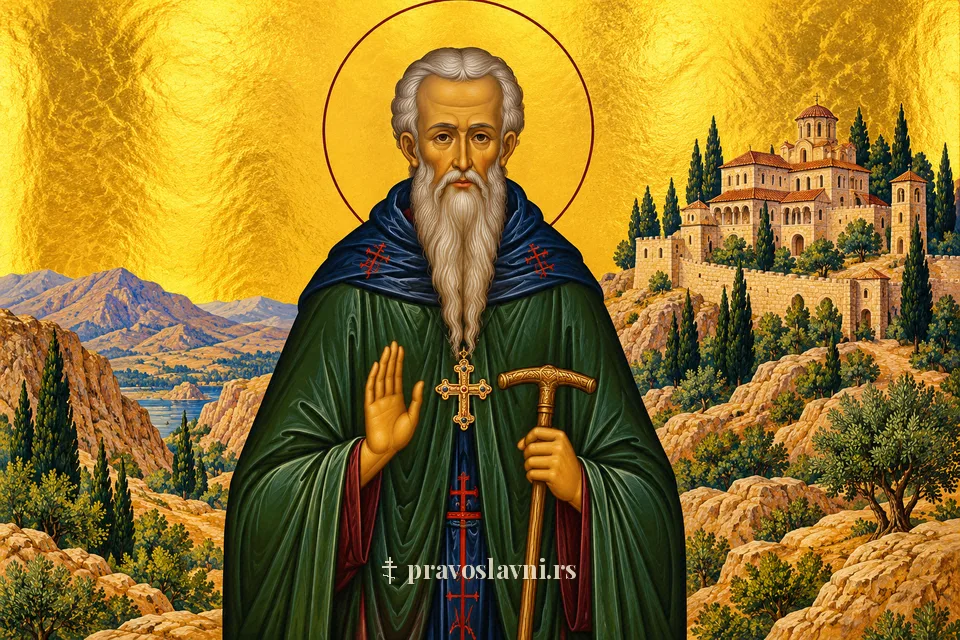
Saint of the day
Venerable Nicetas the Confessor
What happenedVenerable Nicetas, abbot of the Medikion Monastery, suffered for years in prisons and in exile for the sake of the holy icons and did not renounce the faith.
Read the LifeOrthodox Calendar · 3 April according to the Julian calendar
Thursday, 16 April 20263 April (according to the Julian calendar)What happenedVenerable Nicetas, abbot of the Medikion Monastery, suffered for years in prisons and in exile for the sake of the holy icons and did not renounce the faith.
Read the Life
You may eat meat, eggs, milk and dairy products, as well as any other food — but try to be moderate.
More about the fast →
Today the Church keeps the commemoration of a saint · Bright Week.
More about the feast →
“You are the light of the world. A city that is set on a hill cannot be hidden.”
— Mt 5:14The greatest victory of Venerable Nicetas lies not in his never having faltered, but in his having found the strength to rise after a fall. His Life says openly that, after a long imprisonment for the sake of the holy icons, at the request of the elders and with the promise of freedom, he agreed to receive Communion from the iconoclast patriarch. He soon repented, went to Constantinople and began to defend the true faith publicly, and to the Emperor, according to his Life, he said that he would not abandon his faith.
By then he already had years of suffering behind him. When Emperor Leo V the Armenian rose up once more against the icons and removed Patriarch Nicephorus, the abbots of the most important monasteries ended up in prison, and Nicetas among them. In various prisons he endured torments, want and mockery, and he did not yield. The Prologue and his Life remember Nicholas, who mocked him until his own late father rebuked him in a dream; after that Nicholas repented.
Nicetas was from Caesarea in Bithynia. He did not remember his mother, for she died on the eighth day after his birth, and so, according to his Life, he grew up with his grandmother. He was tonsured a monk by Nicephorus, abbot of the Medikion Monastery, who received him with love. His Life says that he stood out among the brethren for his humility and obedience, and after seven years Patriarch Tarasius ordained him a hieromonk. He did not wish to govern the monastery, but he accepted it when the brethren elected him.
Freedom came with the death of Leo V, when Emperor Michael Balbus released the confessors. Nicetas did not return to the monastery; he ended his days in prayer and thanksgiving, in peace, not far from Constantinople, in the year 824. His body was then translated to the monastery and laid beside Nicephorus, and the sick recovered their health by touching it.
The Prologue teaches that the closer a man is to God, the heavier his temptations are, but that love for the Lord makes the narrow way passable. The life of Nicetas adds a consolation: a fall need not be the end, if repentance comes after it.
“O Emperor, I will neither go to my monastery nor forsake my faith” — with these words, as his Life records, Abbot Nicetas answered the ruler who was persecuting those who venerated the holy icons. Behind those words stood years of prisons, hunger and exile, but also one fall from which he rose up stronger. That is why the Church calls him the Confessor: he defended the faith not only with words, but with his own suffering as well.
Nicetas was born in Caesarea in Bithynia, into a devout family; his father's name was Philaret. His mother died on the eighth day after his birth, his father then became a monk, and the boy was brought up by his father's mother. His Life says that after his schooling he served in church as a sacristan and read the divine books, and then went to a certain hermit, who prepared him for monastic life and sent him to the Medikion Monastery.
There Abbot Nicephorus, the founder and first superior of the community, received him with love and tonsured him a monk. According to his Life, Nicetas surpassed the other monks in labour, humility and obedience. After seven years of ascetic struggle Patriarch Tarasius ordained him a hieromonk.
He did not desire authority. When the aged Nicephorus, according to the Life, entrusted him with the governing of the monastery, he accepted it unwillingly, and by then the brotherhood had grown to about a hundred monks. At his side was Athanasius, a rich young man who had fled to the monastery. The Life tells that his father brought him home by force, dressed him in costly garments and beat him, but Athanasius tore the garments and would not give in, until his father, moved by his son's steadfastness, blessed him and returned him to the community. That young man became a monk and later the steward, and the Life says that he and Nicetas afterwards bore the care of the community together, in complete harmony.
When both Nicephorus and Athanasius had died, the brethren chose Nicetas as abbot. The Prologue remembers him as an abbot whom the brethren looked up to for years, and the Life adds that he healed by prayer: a mute boy began to speak when he made the sign of the cross over him, a brother who had lost his mind recovered when he was anointed with oil, and demons departed.
The peace was broken by Emperor Leo V the Armenian, who renewed iconoclasm. He removed Patriarch Nicephorus and sent him into exile, and handed the throne to Theodotus Kassiteras, whose very life was not pure. According to the Life, the bishops and Theodore the Studite refused to have the question of the icons opened again, for it had been settled by the Seventh Ecumenical Council. Then the Emperor, says the Life, summoned the abbots of the great monasteries, Nicetas among them, at first flattered them, and then separated them into different prisons.
Nicetas did not waver even under torments. For years he had no settled prison; not one of them, however hungry, frozen or mocked he was in it, forced him to give in. The Life says that in the bitter winter he was sent in rags into exile in the east, and then brought back to Constantinople, where the abbots were kept in cells on mouldy bread and stale water.
Then came a moment of weakness. According to the Life, the iconoclasts promised freedom if the abbots would receive Communion from Theodotus, and Nicetas, at the entreaties of the elders, unwillingly gave in. He soon repented, returned to Constantinople and began openly to teach the true faith. It was then that he spoke those words before the Emperor, after which, according to the Life, he was shut up on a certain island, in the keeping of a eunuch who kept him on little food and who had been promised a reward if he broke him.
The Prologue and the Life also remember a man named Nicholas, who mocked him especially. His late father appeared to him in a dream and rebuked him, as the Prologue records: “depart from the servant of God!” Nicholas repented and stopped his mockery. The Life adds that by his prayer Nicetas saved three brothers from drowning in a storm and foretold the release of a certain court official, who had been good to him and had fallen into captivity.
His Life says that he spent six years in captivity, until Leo was killed by his own soldiers. The Orthodox Emperor Michael the Stammerer set all the confessors free. He did not go to his own community again. He chose a quiet place in the neighbourhood of the capital, and there he devoted the rest of his days to prayer and thanksgiving to God, still healing people, according to the Life. The Life says that, weakened by the prisons, he fell ill, received Holy Communion and reposed early in the morning; this was in the year 824.
His body was carried to the monastery, and the sick who touched it on the way were healed. He was buried beside his spiritual father Nicephorus, and the Prologue adds, also beside his companion Athanasius. The miracles at his tomb did not cease.
The hymn in the Prologue compares the sufferings of Nicetas with the sufferings of the Apostle Paul. The deeper a man goes into the spiritual life, the heavier the temptations are, the Prologue teaches, but faith and patience conquer, and love for the Lord makes the narrow way passable. The life of Nicetas shows something more: whoever has once fallen can rise up and confess the faith again.


